Please cite as:
Poletti, Arlo. (2026). “EU-US-China Trade Relations.” In: Populism and the Future of Transatlantic Relations: Challenges and Policy Options. (eds). Marianne Riddervold, Guri Rosén and Jessica R. Greenberg. European Center for Populism Studies (ECPS). January 20, 2026. https://doi.org/10.55271/rp00127
DOWNLOAD CHAPTER 6
Abstract
The European Union (EU) has long been a central actor in global trade governance, leveraging its market size, regulatory capacity, and supranational institutions to jointly shape international trade rules with the United States (US). This chapter examines how two major disruptions – the China import shock and the protectionist turn of the second Trump administration – have fundamentally altered the political and strategic environment in which EU trade policy operates. It traces the evolution of the EU’s trade policy framework, the shifting constellation of domestic and transnational actors influencing policy choices, and the EU’s historical role as a joint shaper of multilateral trade rules. Against the backdrop of increasing politicization, rising economic nationalism and the breakdown of multilateralism, the chapter assesses the EU’s constrained bargaining position between the United States and China. It concludes by outlining strategic options for the EU, including options for credible retaliation, diversification of export markets and the full deployment of its emerging geoeconomic policy toolkit.
Keywords: China; EU trade policy; geoeconomics; US protectionism; multilateral trade governance; strategic autonomy
By Arlo Poletti*
Introduction
The European Union (EU) is the world’s largest trading bloc – ranking first both as trader of manufactured goods and services and as destination and source of foreign direct investment (FDI) – and has traditionally been able to play a pivotal role in international trade relations. However, two major developments significantly affected the political environment shaping EU trade policymaking: the Chinese and American trade shocks. The surge in imports from China had systemic consequences for the domestic politics of trade in the EU, strengthening antitrade sentiment and the political power of far-right populist parties advocating policies of global market closure. More recently, the marked protectionist turn of the second Trump administration brought to an end a long-standing tradition of transatlantic collaboration in managing international trade relations.
This chapter begins with a brief overview of the legal framework governing EU trade policymaking, the actors shaping the content of EU trade policy, and the historical evolution of the EU’s role as a global trade actor. Then, the chapter briefly analyses the China–US trade shocks and the transformations they brought about in EU trade policy. Finally, the chapter discusses possible ways forward for the EU to navigate an increasingly conflictual international trade environment. The final part of the chapter develops recommendations for the future of EU trade policy. The chapter suggests that the EU should be prepared to 1) credibly commit to retaliate in the face of a potential further escalation of the United States’ protectionist strategy, 2) strengthen its relations with other trade partners to diversify export markets, and 3) fully leverage its recently acquired ‘geoeconomic’ policy toolkit to defend its trade interests.
EU Trade Policy: Rules, Actors and Evolving Role in Trade Governance
With the entry in force of the Treaty of Rome, in 1957, West European governments pooled their sovereignty and fully delegated their state powers to the European Commission (EC) for the purposes of conducting external trade, creating a customs union, and developing a Common Commercial Policy (CCP), ultimately conferring European Economic Community (EEC)/EU powers equivalent to those of a federal state in international trade relations. (Gstöhl and De Bièvre 2018).
The fact that trade policy was placed under supranational competence meant that the EC had the sole right of initiative with respect to bilateral, regional, and multilateral trade negotiations and was entrusted with the responsibility to negotiate on behalf of, and in accordance with, the mandate granted by the member states. The agreements negotiated by the EC were then subject to approval by the Council of Ministers by qualified majority voting (QMV). Over time, however, the rules governing EU trade policymaking have evolved considerably. For one, the range of exclusive trade competences expanded to include many new regulatory trade issues. In addition, subsequent treaty reforms increased the European Parliament’s (EP) powers in the making of EU trade policy. Most notably, with the adoption of the Treaty of Lisbon in 2009, the EP was granted the power to veto EU trade agreements, making it a key player in EU trade policymaking.
Within this legal framework, the preferences of these institutional actors have been substantially shaped through interactions with various types of societal actors (Poletti and De Bièvre 2016). Traditionally, EU trade policy sought to strike a delicate balance between different economic interests, consistently striving to improve foreign market access for its exporters while also protecting domestic sectors threatened by foreign competition (De Bièvre and Poletti 2014). In recent years, two additional sets of societal actors have also come to play an important role in shaping the substance of EU trade policy. First, the growing integration of the EU’s economy into so-called global value chains (GVCs) strengthened the political role of European import-dependent firms such as retailers at the end of the supply chain and goods-producing firms that import intermediate inputs (Eckhardt and Poletti 2016). These import-dependent firms, which support trade liberalization because they have an interest in accessing cheap imported goods, have increased the political weight of the pro-trade domestic coalitions in the EU and systematically affected EU trade policy choices across the board (Poletti et al. 2020). Second, civil society organizations (CSOs) have played a key role in raising the public salience and politicization of some important trade issues, joining forces with import-competitors in trying to export labour and environmental standards through trade agreements, and, more generally, helping infuse EU trade policies with a values-based agenda (De Ville and Siles-Brügge 2015).
Trading access to its large market in exchange for valuable concessions from its trading partners (Damro 2012), the EU has traditionally been a powerful trade actor capable of both affecting the trade policies of other countries and shaping the rules that govern international trade relations (Poletti and Sicurelli 2018). For instance, the EEC played a key role in shaping multilateral trade rules very early on, as demonstrated by its ability to leverage its bargaining power to secure policy outcomes that aligned with its trade preferences during the Kennedy Round of the GATT (Dür 2010). Since then, the EC has effectively taken the driver’s seat, together with the United States, as joint shapers of the multilateral trading system (De Bièvre and Poletti 2013). The EC’s role as joint shaper of global trade rules reached its pinnacle in the Uruguay Round, which ultimately led to the creation of the World Trade Organization (WTO). In particular, the EU, again in line with the United States, decisively contributed to a change global trade governance by sponsoring both the expansions of the functional scope of multilateral trade rules to include a whole new set of regulatory provisions – the General Agreement on Trade in Services (GATS), the Agreement on Trade-Related Investment Measures (TRIMS), the Trade-Related Aspects of International Property Rights (TRIPS), the Technical Barriers to Trade (TBT) Agreement, and the Agreement on the Application of Sanitary and Phytosanitary Measures (SPS) – and the strengthening of mechanisms for enforcement of multilateral trade rules (Poletti et al. 2015).
The adoption of the Uruguay Round and the creation of the WTO marked the beginning of the decline of the EU’s ability to shape global trade governance in line with its preferences. Soon after the end of the Uruguay Round, the EU assumed leadership in promoting a new round of multilateral trade negotiations, which, following the setback of the Millennium Round in Seattle in 1999, led to the launch of the Doha Development Round in November 2001. However, after 12 years of negotiations, the only tangible result of the Doha Round was the adoption of the Trade Facilitation Agreement (TFA) in 2013, a modest agreement to reduce cross-border processing costs. In the end, the rising economic clout of a new set of emerging economies fundamentally reshaped power structures in multilateral trade governance and ended the bilateral EU–US joint hegemony in that domain (Mortensen 2009). Meanwhile, the EU trade policy strategy adapted to the new reality of multilateral trade politics by shifting towards seeking trade liberalization with Preferential Trade Agreements (PTAs). More specifically, in 2006, the EC released its Global Europe communication in which it announced a marked shift in the EU’s trade strategy from a ‘multilateralism first’ approach to a more strategic approach based on bilateralism (Eckhardt and Poletti 2016). Since then, the EU has moved towards a strategy of bilateral or regional, rather than multilateral, trade liberalization, signing trade agreements with a wide array of important trade partners across the globe.
The Chinese and American Trade Shocks
Despite these important changes, the basic features of EU trade policy and politics remained relatively stable until the mid-2010s: the EU used its bargaining power to maximize EU exporters’ access to foreign markets, while providing some protection to industries vulnerable to foreign competition and catering to the demands of CSOs. However, in recent years, two interrelated emerging trends have changed the domestic and international strategic contexts within which EU trade policy is shaped. I briefly illustrate these transformations before discussing their implications for future trajectories of EU trade policymaking.
The China import shock and the rise of populism and economic nationalism
As already briefly mentioned, some high-profile trade negotiations in recent years generated significant domestic political turmoil, leading many observers to speak of a growing politicization of EU trade policy (see De Bièvre and Poletti 2020). Prominent examples include the successful campaigns of various CSOs to raise public awareness of and opposition to trade negotiations such as the Transatlantic Trade and Investment Partnership (TTIP) and the Canada–EU Comprehensive Economic Trade Agreement (CETA).
But many works highlight that one of the most systematic changes in the EU’s domestic trade politics is associated with the so-called China import shock. China’s accession to the WTO in 2001 triggered a significant rise in exports in the United States and the EU, causing higher unemployment, lower labour force participation, and wage reductions in local labour markets with import-competing manufacturing industries (Foroni and Schroder 2025). Moreover, as China’s competitiveness in high-value-added industries increases, the impact of China’s competition on European labour markets may further intensify, potentially extending to nearly one-third of euro area employment (Berson et al. 2025). What is perhaps more important is that the adverse consequences of increased import competition from China had a systematic and clear political impact on domestic politics on both sides of the Atlantic. Indeed, the China shock contributed to an international increase in popular support for protectionism in both the United States and many EU member states and, consequently, contributed to the electoral success of far-right, populist political parties advocating policies of economic nationalism (Autor et al. 2013; Colantone and Stanig 2018). In addition, the growing exposure to Chinese trade competition has led to the gains from trade liberalization in the EU becoming increasingly concentrated in the hands of a few superstar exporting firms, mostly multinationals, often driving small- and medium-sized enterprises out of business (Baccini et al. 2021). These developments should be seen in combination with the increasing Chinese international political and economic activism exemplified by initiatives such as the Belt and Road Initiative (BRI), and institutions, such as the Shanghai Cooperation Organisation (SCO), the Asian Infrastructure Investment Bank and the Regional Comprehensive Partnership Agreement, which raised widespread concerns about China’s rising geopolitical influence.
To sum up, the sharp rise in imports of manufactured goods from China following its accession to the multilateral trading system had profound consequences for the EU economy, its labour markets, and, ultimately, its domestic politics. The China import shock, combined with other factors such as automation and offshoring, acted as an economic trigger for the rise of the so-called popular backlash against globalization in Europe (Milner 2021). Overall, these long-term processes have the potential to change EU trade policy in systematic ways. While the EU’s integration into GVCs produces a more free-trade orientation in EU trade policy, these processes push in the opposite direction. As the public grows more sceptical about the merits of trade liberalization and concerns about China’s geopolitical clout increase, political parties take more protectionist policy stances, we should expect these preferences to shape the EU trade policymaking process at various levels – member states, the EP and the EC – and to produce a more protectionist trade policy.
The American protectionist shock
A second, and perhaps more game-changing, shock for the EU came a few months ago in the form of US President Trump’s full-frontal protectionist turn. President Trump’s 2025 trade offensive is the most aggressive since the Smoot-Hawley Tariff Act of 1930, with global tariffs on tens of countries leading to an increase in the average applied US import tariff rate from around 2.5% to over 27%. Trade negotiations between the EU and the US administration that followed this strategic trade turn culminated in the adoption of the EU–US framework trade agreement on 27 July 2025. Under this framework agreement, the EU accepted a 15% import tariff on most EU goods exported to the US market, except for aircraft parts, national resources and critical minerals, which are exempt. While the agreed-upon 15% tariff accepted by the European Union is half of the 30% tariff threatened by President Trump in his second term, it is still much higher than the pre-Trump status quo, when the average tariff rate between the EU and the United States hovered around 3–4%. Moreover, there was no degree of reciprocity in the deal, since the EU agreed to eliminate tariffs on all US industrial goods, in addition to committing to purchase $750 billion worth of American oil, gas, and nuclear fuel and to investing a further $600 billion in the United States, in military equipment and other areas.
This deal is clearly a game-changer for the EU. Most evidently, this decision is likely to have a significant economic impact since EU producers will face the highest tariffs in the last seventy years in their top destination for exports of goods and services. Most estimates suggest larger losses and higher prices in the United States than in the EU, but they indicate a potential GDP fall for the EU ranging from 0.2% to 0.8%, depending on how much higher prices will be passed onto US consumers and exchange-rate movements, and a more significant negative impact for countries like Germany, Italy and Ireland – whose exports to the United States are the most substantial (CEPS 2025).
But the most important implication for the EU is political, not economic. The EU and the United States have acted together for decades as the engines of global trade liberalization, first within the multilateral trading system and later as sponsors of a global network of PTAs. Moreover, not more than ten years ago, during the administration of President Barack Obama, the European Union and the United States were negotiating the TTIP, an ambitious trade agreement that promised not only to further liberalize transatlantic trade but also to become a template for reformed multilateral trade rules (De Bièvre and Poletti 2016). The protectionist turn of the second Trump administration, which continued the track set by his first administration, which was only temporarily put on hold by President Biden, dramatically changed the international strategic context in which the EU defines its role as a global trade actor. In this reality, the United States can no longer be considered a natural partner in managing global trade relations, but rather a strategic rival willing to make full use of its immense bargaining power to coerce the EU into bending to its trade interests.
Navigating Trade Relations between China and the United States
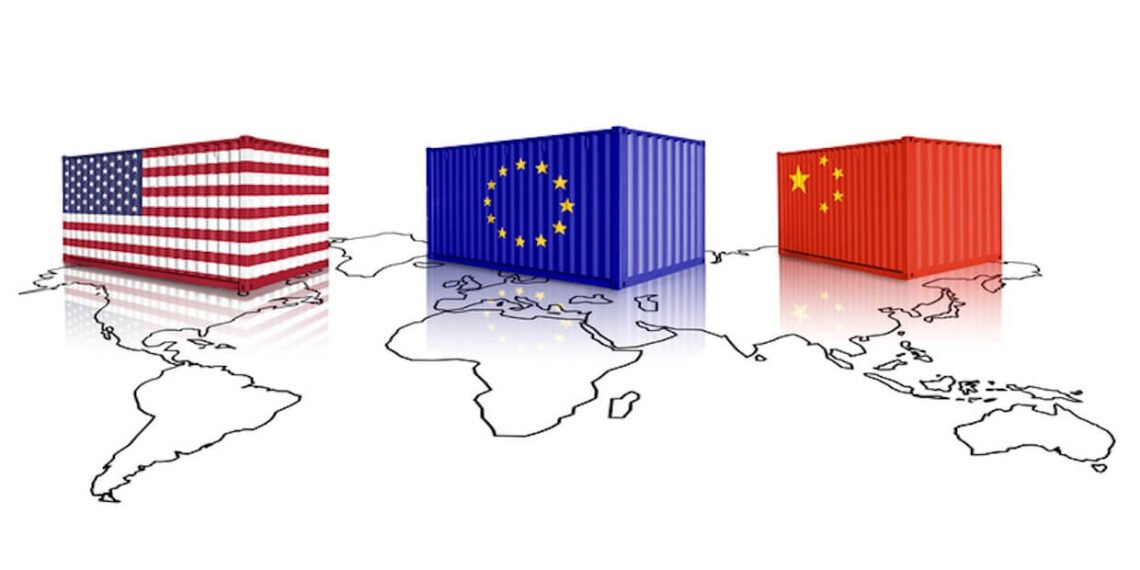
The EU finds itself in a difficult position, navigating the twin pressures of China’s import penetration and the United States’ aggressive international trade strategy, in the broader context of a breakdown of multilateral trade governance ‘as we knew it’. The radical shift towards aggressive unilateralism in US trade policy not only decrees the end of the already moribund WTO-based multilateral trading, but also to the idea that international trade relations could be organized around a stable set of mega-regional trade agreements gravitating around the two poles of the United States and China. The EU is now facing a breakdown of multilateral trade governance, in which unilateralism, rather than institutionalized cooperation, seems to have become the ‘new normal’ in international trade politics. But how should the EU approach this ‘new normal’ in the face of the twin pressures of the China and American trade shocks? Given the configuration of its trade relations with the United States and China, the EU is in a weak bargaining position. The EU’s trade surplus with the United States means it would bear the bulk of the costs of a transatlantic trade war. Such an asymmetrical distribution of the costs of a potential trade conflict clearly weakens the EU’s ability to make credible threats of retaliation in the face of the United States’ aggressive trade strategy. Moreover, EU member states’ dependence on the United States to underwrite European security in the face of growing geopolitical tensions (e.g., Russia’s invasion of Ukraine) further weakens their bargaining power.
At the same time, the EU’s bargaining power is constrained by the lack of ‘exit’ options. An obvious option in the face of the United States’ aggressiveness would be to deepen trade relations with other major trading partners to both diversify export markets and gain leverage in negotiations with the United States. Given its importance in international trade relations, the most obvious alternative would be China. However, deepening trade liberalization with China is not an attractive option because it would further intensify the pressure Chinese competition exerts on the European economy and yield little in terms of new market access opportunities. According to Eurostat data from 2022, while Chinese exports to the EU increased by over 30% year-on-year, EU exports to China grew by just 3%. Hence, while strengthening trade relations with China could be used to enhance the EU’s leverage vis-à-vis the United States, such a strategy would entail costs unlikely to be sustainable, neither economically nor politically. Given these structural constraints, I develop the following three recommendations for the future of EU trade policy.
Getting Ready for Tit-for-Tat
As already mentioned, the EU reacted to President Trump’s bargaining tactics without putting up a fight, clearly opting for an asymmetrical deal. The idea that the EU would not retaliate against Trump’s tariffs to gain leverage in negotiations, defend its own interests, and stand up for the international trade rules took many by surprise (Lichfield 2025). The reasons for this negotiating posture notwithstanding, it seems clear that any attempt to further escalate the trade conflict on the US side, which President Trump explicitly stated remains an open possibility, should be met with a different, and more confrontational, strategy from the EU. As basic theories of negotiation strategy suggest, the failure to credibly commit to retaliatory policies in the face of attempts to renegotiate the terms of what has already been widely considered a close-to-humiliating deal would signal that the United States can extract as many concessions as it wants from the EU. There are many reasons why the EU should fear, both economically and politically, a further escalation of this trade conflict. However, if the EU does not want to find itself in a spiral of never-ending negotiations aimed at extracting ever more trade concessions in its relations with the United States, it should be prepared to credibly commit to imposing retaliatory measures in the event of a potential US repudiation of the current framework agreement.
Diversifying Export Markets
While gaining leverage by turning towards China may not be economically or politically feasible, seeking to expand trade opportunities with the rest of the world is. With Trump’s return to the US presidency and the administration’s protectionist strategy, the EC has already moved in this direction. In December 2024 and January 2025, respectively, the EC completed negotiations for a comprehensive agreement with Mercosur and updated an already existing agreement with Mexico. Moreover, several trade negotiations are underway with key trading partners, including India, the Philippines, and Thailand, or have been revived, such as those with Australia and Indonesia. Finally, in response to Trump’s aggressive tariff initiatives, von der Leyen has expressed interest in greater cooperation between the EU and the members of the Comprehensive and Progressive Agreement for Trans-Pacific Partnership (CPTPP). This group includes seven Asia-Pacific countries, three Latin American countries, Canada and the United Kingdom. Strengthening trade ties with key trading partners across different continents could clearly enable the EU to enhance its standing in global trade politics, find an autonomous position in the bipolar dynamics of US–China rivalry, and position itself as a pivotal player in the multilateral trading system (Italia 2025).
Leveraging the EU’s Geoeconomic Power Toolkit
Finally, in recent years, the EU underwent a process of strategic reassessment of the broader objectives underpinning EU trade policy. While the EU has consistently been the staunchest advocate of an open trading system, in February 2021, the EC released a new trade strategy that made explicit the need to gear EU trade policy towards supporting the EU’s strategic autonomy and broader geopolitical goals while still positioning the EU as the guardian of openness and multilateralism (Meunier 2022). In 2020, the EU adopted a mechanism to screen inward FDI, which prompted member states to strengthen their national investment screening mechanisms. One year later, the EC also issued a legislative proposal for the so-called Foreign Subsidies Regulation, which introduced new instruments and procedures allowing the EU to monitor FDI transactions, investigate potentially distortive subsidies and adopt remedial measures. Also, in the same year, the EP and the Council finally agreed to establish a new international procurement instrument (IPI) to exert pressure on foreign countries to open their protected markets to EU operators. Finally, in 2003, the EU adopted a regulation establishing an anticoercion instrument to address pressing concerns about the increasingly porous border between the economy and security.
While these initiatives do not necessarily cast doubt on the EU’s continued commitment to upholding an open international trading system, they signal that the EU has recognized the need to equip itself with the necessary institutional tools to challenge a foreign partner’s actions that endanger the EU’s ability to pursue its trade policy goals. The shift towards a better appreciation of the security implications of trade policy is a welcome development. The EU should be ready to make full use of this comprehensive set of policy tools to defend its trade interests and navigate trade relations with other major trade powers.
(*) Arlo Poletti is a Professor of International Relations at the Department of Sociology and Social Research of the University of Trento. He obtained a PhD from the University of Bologna, was a post‐doctoral researcher at the University of Antwerp (2009-2013), and held positions as an Assistant professor at the LUISS Guido Carli (2013-2016) and the University of Bologna (2016). His research interests are in the area of International Political Economy, with particular emphasis on the politics of trade and investments, transnational advocacy at the global and EU-levels, and international regulatory cooperation. Recently, he expanded his research agenda to include analyses of how globalization-induced economic distress affects individual-level preferences and political behavior. He is the author of five monographs and his research has been published in journals such as International Organization, Regulation & Governance, JCMS: Journal of Common Market Studies, the Journal of European Public Policy, Review of International Studies, the European Political Science Review and Review of International Organizations. Email: arlo.poletti@unitn.it
References
Autor, David H., David Dorn, and Gordon H. Hanson. 2013. “The China Syndrome: Local Labor Market Effects of Import Competition in the United States.” American Economic Review 103: 2121–68.
Baccini, Leonardo, Mattia Guidi, Arlo Poletti, and Aydin B. Yildirim. 2021. “Trade Liberalization and Labor Market Institutions.” International Organization 76 (1): 70–104.
Berson, C., C. Foroni, V. Gunnella, and L. Lebastard. 2025. “What Does Increasing Competition from China Mean for Euro-Area Employment?” ECB Economic Bulletin 5/2025. https://www.ecb.europa.eu/press/economic-bulletin/focus/2025/
html/ecb.ebbox202505_02~6755747435.en.html
Colantone, Italo, and Piero Stanig. 2018. “The Trade Origins of Economic Nationalism: Import Competition and Voting Behavior in Western Europe.” American Journal of Political Science 62 (4): 936–53.
Damro, Chad. 2012. “Market Power Europe.” Journal of European Public Policy 19 (5): 682–99.
De Bièvre, Dirk, and Arlo Poletti. 2013. “The EU in EU Trade Policy: From Regime Shaper to Status Quo Power.” In EU Policies in a Global Perspective, edited by Gerda Falkner and Patrick Müller, 20–37. London: Routledge.
De Bièvre, Dirk, and Arlo Poletti. 2017. “Why the Transatlantic Trade and Investment Partnership Is Not (So) New, and Why It Is Also Not (So) Bad.” Journal of European Public Policy 24 (10): 1506–21.
De Bièvre, Dirk, and Arlo Poletti. 2020. “Towards Explaining Varying Degrees of Politicization of EU Trade Agreement Negotiations.” Politics and Governance 8 (1): 243–53. https://doi.org/10.17645/pag.v8i1.2686
De Ville, Ferdi, and Gabriel Siles-Brügge. 2015. TTIP: The Truth About the Transatlantic Trade and Investment Partnership. Cambridge: Polity Press.
Dür, Andreas. 2010. Protection for Exporters: Power and Discrimination in Transatlantic Trade Relations, 1930–2010. Ithaca: Cornell University Press.
Dür, Andreas, Jappe Eckhardt, and Arlo Poletti. 2020. “Global Value Chains, the Anti-Globalization Backlash, and EU Trade Policy: A Research Agenda.” Journal of European Public Policy 27 (6): 944–56.
Eckhardt, Jappe, and Arlo Poletti. 2016. “The Politics of Global Value Chains: Import-Dependent Firms and EU–Asia Trade Agreements.” Journal of European Public Policy 23 (10): 1543–62. https://doi.org/10.1080/13501763.2015.1085073
Foroni, C., and C. Schroeder. 2025. “Using Corporate Earnings Calls to Forecast Euro Area Labour Demand.” ECB Economic Bulletin, Issue 2. https://www.ecb.europa.eu/press/
economic-bulletin/focus/2025/html/ecb.ebbox202502_04~3283f1bc62.en.html
Gstöhl, Sieglinde, and Dirk De Bièvre. 2018. The Trade Policy of the European Union. London: Palgrave.
Italia, Roberto. 2025. “The EU’s Trade Network: What’s Next on the Agenda?” Italian Institute for International Political Studies (ISPI). https://www.ispionline.it/en/
publication/the-eus-trade-network-whats-next-on-the-agenda-211954
Meunier, Sophie. 2022. “The End of Naivety: Assertiveness and New Instruments in EU Trade and Investment Policy.” Policy Brief 2022/55, European University Institute.
https://cadmus.eui.eu/handle/1814/75041
Milner, Helen V. 2021. “Voting for Populism in Europe: Globalization, Technological Change, and the Extreme Right.” Comparative Political Studies 54 (13): 2286–320.
Mortensen, Jens Ladefoged. 2009. “The World Trade Organization and the European Union.” In The European Union and International Organization, edited by Knud Erik Jørgensen, 20–42. London: Routledge.
Poletti, Arlo, and Daniela Sicurelli. 2018. The Political Economy of Normative Trade Power Europe. London: Palgrave.
Poletti, Arlo, and Dirk De Bièvre. 2014. “The Political Science of European Trade Policy: A Literature Overview with a Research Outlook.” Comparative European Politics 12 (1): 101–19.
Poletti, Arlo, Dirk De Bièvre, and Tyson Chatagnier. 2015. “Cooperation in the Shadow of WTO Law: Why Litigate When You Can Negotiate.” World Trade Review 14 (S1): 33–58.
Poletti, Arlo, and Dirk De Bièvre. 2016. Judicial Politics and International Cooperation: From Disputes to Deal-Making at the World Trade Organization. Colchester: ECPR Press.
Poletti, Arlo, and Lorenzo Zambernardi. 2022. “Declining Hegemony and the Sources of Trump’s Disengagement from Multilateral Trade Governance: The Interaction Between Domestic Politics and the International Political Economy.” International Politics 59: 1101–1118.