Please cite as:
Syvak, Nikoletta. (2026). “Post-Truth Populism: A New Political Paradigm.” ECPS Book Reviews. European Center for Populism Studies. January 19, 2026. https://doi.org/10.55271/br0025
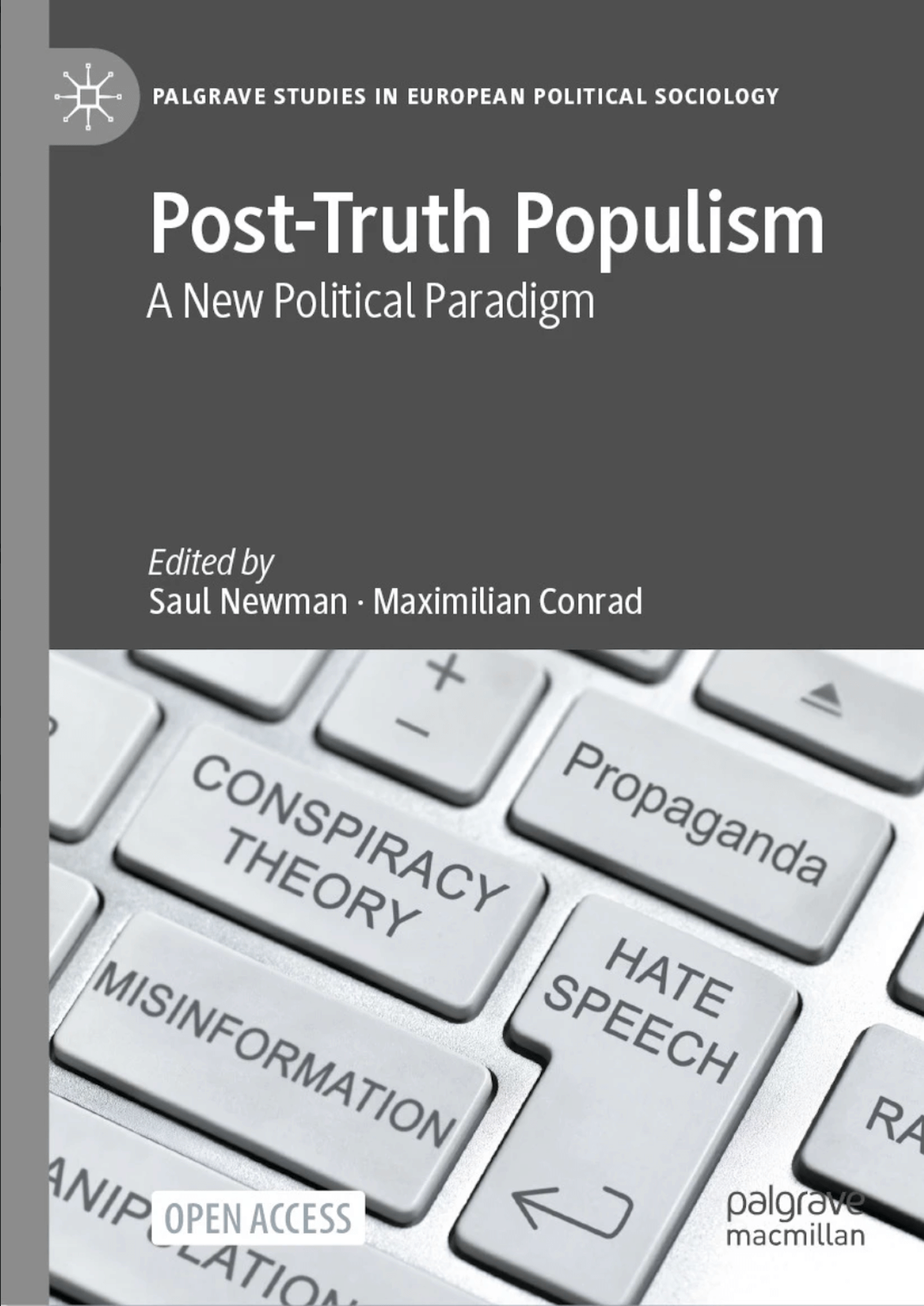
This review assesses Post-Truth Populism: A New Political Paradigm (2024), edited by Saul Newman and Maximilian Conrad, a timely and theoretically ambitious contribution to the study of contemporary populism. The volume advances the argument that post-truth populism is not merely about political lying, but about a deeper transformation in the status of facts, expertise, and epistemic authority in democratic life. Combining political theory, media studies, and comparative analysis, the book conceptualizes post-truth populism as an epistemic struggle in which claims to “truth” are grounded in identity and moral antagonism rather than verification. While the collection’s conceptual breadth sometimes comes at the expense of analytical coherence, it offers valuable insights into how populism reshapes knowledge, trust, and democratic governance in an era of information disorder.
Reviewed by Nikoletta Syvak*
This book review examines the edition 2024 – Post-Truth Populism: A New Political Paradigm, edited by Saul Newman and Maximilian Conrad, which explores the relationship between populism and post-truth in contemporary politics. The book offers an interpretation of post-truth populism (PTP) as a stable political complex in which anti-elitist mobilization logic is combined with a crisis of trust in expert knowledge and institutional sources of information. The review evaluates the central thesis of the collection, its place in political science literature, the quality of its arguments and empirical evidence, as well as its methodological strengths and limitations. It concludes that the book makes a significant contribution to the study of populism and political communication, although a unified conceptual framework is not always maintained at the level of individual chapters.
The main thesis of the collection is that post-truth is not limited to “lies in politics,” but reflects a change in the status of facts and expertise in the public sphere. The editors emphasize that populism has epistemic potential: the opposition between “the people” and “the elites” turns into a conflict between “the truth of the people” and “the manipulation of the elites,” where plausibility is subordinated to political identity (p. 4). In this sense, post-truth populism can be understood as a form of politics that not only ignores facts but actively redefines the conditions under which facts become legitimate in the first place. Particularly important is the idea that post-truth should be understood not as relativism, but as a kind of “truth fundamentalism”: actors can reject verifiable data while offering their own “only true” reality (p. 8).
The book is organized into four sections: theoretical debates about PTP, followed by chapters on political communication and media, counter knowledge and conspiracy narratives, and finally, the consequences for democracy (pp. 11-16). Thus, the collection combines political theory, media studies, and comparative politics, showing that post-truth politics concerns not only information bubbles but also the transformation of democratic institutions.
First, the book clearly positions itself within the political science literature on populism. The editors use an approach in which populism is understood as a “thin-centered ideology” based on a moral division of society into “pure people” and “corrupt elites” (p. 4). However, the collection also draws on the more recent “epistemic turn” in populism studies, which views populist politics as a struggle over knowledge, trust, and authority (p. 1). This allows the book to go beyond interpretations of populism exclusively as an electoral strategy or a reaction to economic crises.
Second, methodologically, the book is an edited volume, which means it includes different approaches. Qualitative methodology dominates conceptual analysis, a discursive approach, and case-oriented argumentation. However, the collection is not limited to theory. For example, the section on communication and media includes a study that uses experimental design to test how populist messages influence the perception of facts and the tendency toward “factual relativism.” This strengthens the book’s evidence base and shows that the PTP framework can be operationalized and tested, rather than just discussed at the level of metaphor.
Thirdly, the quality of writing and clarity of argumentation are generally high. The introduction provides a good introduction to the problem, quickly identifies its empirical relevance, and explains why post-truth populism cannot be reduced to moral condemnation of politicians. At the same time, it should be noted that some chapters in the collection may be theoretically dense and difficult for readers without prior knowledge: this is a typical feature of edited volumes, where a uniform style is not guaranteed.
Finally, the main question is how convincing the argument is and why it is important for us to pay attention to it. The strength of the book lies in its demonstration that PTP is not only about “fakes” and manipulation, but also about the erosion of trust as a resource of democratic governance. If citizens no longer share basic procedures for determining facts, rational public debate becomes impossible, and politics turns into a competition of moral narratives and identities. In this sense, the book raises a fundamentally important topic for contemporary political science
However, there are limitations. The term “post-truth populism” may be too broad and applicable to too many different phenomena, from anti-elite rhetoric to conspiracy theories and platform disinformation.
Furthermore, the claim of a “new paradigm” requires strict criteria: what exactly distinguishes PTP from mere populism plus media scandals? The collection presents a compelling formulation of the problem but does not always offer a single set of verifiable criteria that would allow PTP to be clearly distinguished from other forms of political communication.
Conclusion
Overall, the book makes a significant contribution to political science: it shows that populism should be analyzed not only as an ideology or mobilization strategy, but also as epistemic politics-the struggle for the legitimacy of knowledge and the right to “truth” in the public sphere (pp. 4-8). Despite its methodological heterogeneity and risk of conceptual vagueness, the collection is useful for researchers of populism, political communication, democratic theory, and the crisis of trust. The main merit of the book is its ability to explain why post-truth populism has become not a temporary anomaly but a symptom of structural changes in modern democracies.
(*) Nikoletta Syvak is a Graduate Student, Department of Political Science and International Relations, East China Normal University (ECNU). Email: syvaknikoletta@gmail.com
Newman, Saul & Conrad, Maximilian (eds.). Post-Truth Populism: A New Political Paradigm. Cham: Palgrave Macmillan, 2024. 349 pp. ISBN: ISSN 2946-6016