
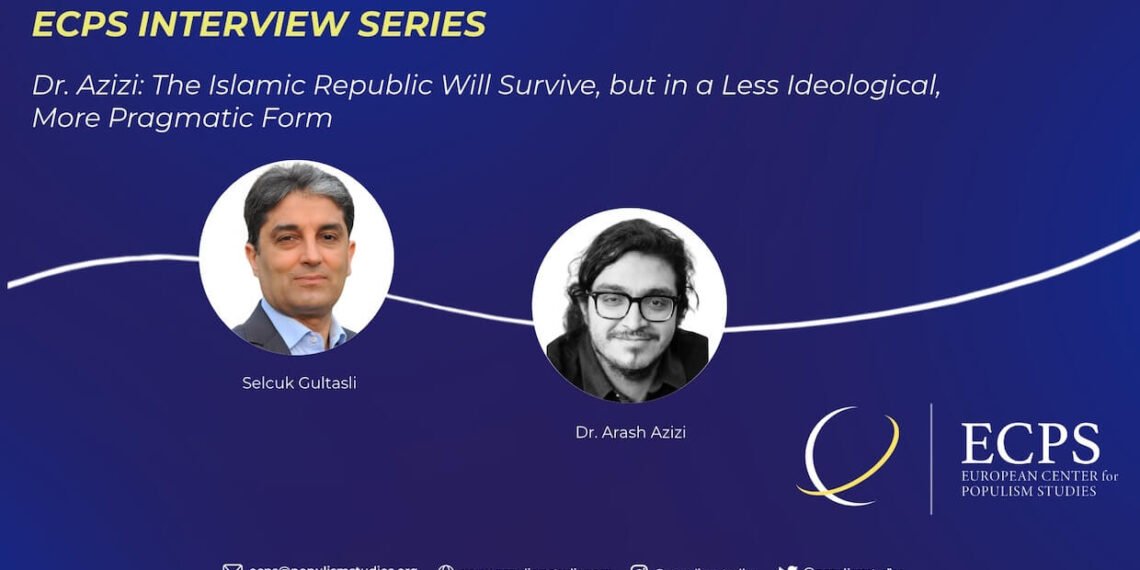
Dr. Arash Azizi of Yale University argues that the Iran Islamic Republic is likely to survive, but in a transformed form shaped less by ideology and more by pragmatism. In this ECPS interview, he suggests that Iran’s longstanding strategy of “sustained hostility toward the United States and enmity toward Israel… is not sustainable,” pushing the regime toward recalibration. Rather than collapse, Dr. Azizi foresees a shift: the decline of “Soleimaniism,” the rise of a securitized political order, and a growing emphasis on regional integration and diplomatic engagement. While power consolidates around military-security elites, Iran may simultaneously pursue normalization and reconstruction. The result, he argues, is not the end of the Islamic Republic, but its reconfiguration into a more technocratic, less ideological, and strategically adaptive state.
Interview by Selcuk Gultasli
Amid an intensifying cycle of confrontation between Iran, Israel, and the United States, the Middle East is entering what can only be described as a structurally transformative moment. Long characterized by proxy conflict and calibrated ambiguity, regional dynamics have now shifted toward direct interstate confrontation, leadership rupture, and accelerating geopolitical fragmentation. The killing of Iran’s Supreme Leader, the subsequent consolidation of power within a narrower elite, and sustained US–Israeli military pressure have together transformed a protracted shadow war into an overt systemic crisis. These developments raise urgent questions about the durability of the Islamic Republic, the reconfiguration of its strategic doctrine, and the broader implications for regional order.
In this context, this ECPS interview with Dr. Arash Azizi, who is a Postdoctoral Associate and Lecturer at Yale University, offers a timely and analytically rich intervention. As a scholar of Iranian politics and regional geopolitics, Dr. Azizi situates current developments within a longer trajectory of ideological evolution, institutional transformation, and strategic recalibration. His central argument—captured in the headline assertion that “the Islamic Republic will survive, but in a less ideological, more pragmatic form”—provides a unifying thread through the discussion.
At the heart of Dr. Azizi’s analysis lies the contention that the foundational logic of Iran’s revolutionary project is undergoing erosion. The model of regional power projection associated with Qassem Soleimani—what he describes as a “collection of militias that functioned very much as a unified multinational army”—has, in his view, reached the limits of its historical relevance. “That era is now largely over,” he notes, emphasizing that even prior to the latest war, “Soleimaniism was already under significant strain.” The cumulative effects of internal dissent in Iraq and Lebanon, combined with Israel’s military campaign and the collapse of allied structures in Syria, have rendered the “axis of resistance… even more out of vogue.”
Yet Azizi resists narratives of imminent regime collapse. Instead, he identifies a process of transformation rather than breakdown. The Islamic Republic, he argues, has come to recognize that its long-standing strategy of “sustained hostility toward the United States and enmity toward Israel… is not sustainable.” In its place, a more pragmatic orientation is emerging—one oriented toward “regional integration,” “a business-like relationship with the United States,” and eventual diplomatic normalization. This shift does not imply liberalization in a conventional sense, but rather a rebalancing of ideological ambition and strategic necessity.
Simultaneously, however, this transformation is unfolding alongside the consolidation of a more securitized political order. The post-Khamenei landscape, Dr. Azizi suggests, reflects “the rise of a security state, a militarized state… with important elements from the IRGC calling the shots.” This dual movement—toward external pragmatism and internal securitization—defines the paradox of Iran’s current trajectory.
Taken together, Dr. Azizi’s analysis points to a hybrid future: a state that sheds elements of its revolutionary identity while preserving—and in some respects intensifying—its coercive core. The result, as he suggests, is not the end of the Islamic Republic, but its reconstitution: less ideological, more technocratic, and increasingly embedded within a shifting regional order.
