
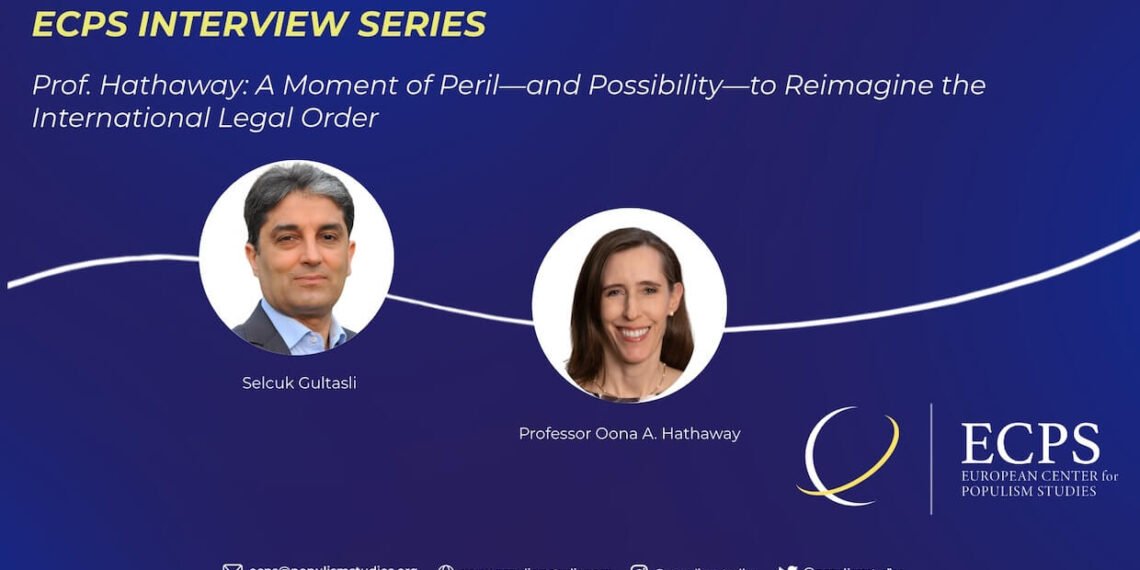
Giving an interview to the ECPS, Professor Oona A. Hathaway reflects on the resilience and fragility of the post-1945 international legal order at what she describes as a moment of both peril and possibility. She identifies the prohibition on the use of force as the “bedrock of the modern legal order,” yet warns that today’s geopolitical climate is marked by “extraordinary instability” and mounting challenges from major powers. International law, she argues, ultimately depends on shared belief: “what makes international law work is that states believe it works.” If repeated unilateral uses of force erode that belief, a “reverse norm cascade” could follow. Yet Professor Hathaway also stresses that crisis can generate renewal—an opportunity to reimagine and reconstruct a more equitable and effective international legal order rather than surrender to fatalism.
Interview by Selcuk Gultasli
Giving an interview to the European Center for Populism Studies (ECPS), Professor Oona A. Hathaway—Gerard C. and Bernice Latrobe Smith Professor of International Law at Yale Law School; Professor of Political Science in Yale’s Department of Political Science; Faculty at the Jackson School of Global Affairs; Director of the Yale Law School Center for Global Legal Challenges; and president-elect of the American Society of International Law—reflects on the resilience and fragility of the post-1945 international legal order at a moment she describes as both perilous and generative. The organizing theme of the interview is captured in the headline, “A Moment of Peril—and Possibility—to Reimagine the International Legal Order.” For Professor Hathaway, the contemporary crisis is not simply episodic noncompliance but a potentially systemic turning point—one that tests whether the prohibition on the use of force, which she calls the “bedrock of the modern legal order,” can endure under conditions of populism, geopolitical rivalry, and eroding rule-of-law commitments.
Professor Hathaway situates today’s tensions within a longer arc of normative transformation. The post-1945 order, she argues, was both a “genuine normative revolution that restrained power” and a system sustained by the strategic interests of dominant states. Yet the present moment raises acute questions about its durability. In her view, “what makes international law work is that states believe it works,” and the danger is that repeated unilateral uses of force could tip the system toward a “reverse norm cascade,” in which states “no longer believe that these rules matter and therefore no longer act as if they matter.” The concern is not only erosion, but the possibility of a broader unraveling in which the rules cease to structure expectations.
Several sections of the interview underscore why “today’s instability is unprecedented in the postwar international legal order.” Professor Hathaway emphasizes that in the post–World War II era “we’ve ever been at a moment of such instability and uncertainty” as when the most powerful state appears “clearly willing to use military force in violation of the UN Charter that it once championed.” This connects directly to another theme: “when rule-makers break the rules, the damage is far greater.” As Professor Hathaway notes, US violations are “particularly destructive,” not least because of the “failure of the international community to respond or push back forcefully,” shaped by entrenched assumptions about US stewardship and deep economic interdependence.
Yet Professor Hathaway also insists that breakdown need not foreclose renewal. “It is a moment of extreme challenge,”she concludes, “but it is also a moment of opportunity and creativity.” The task, she suggests, is to resist fatalism and instead “think together about what a more equitable and effective international legal order might look like”—because “it is up to us to decide which it will be.”
