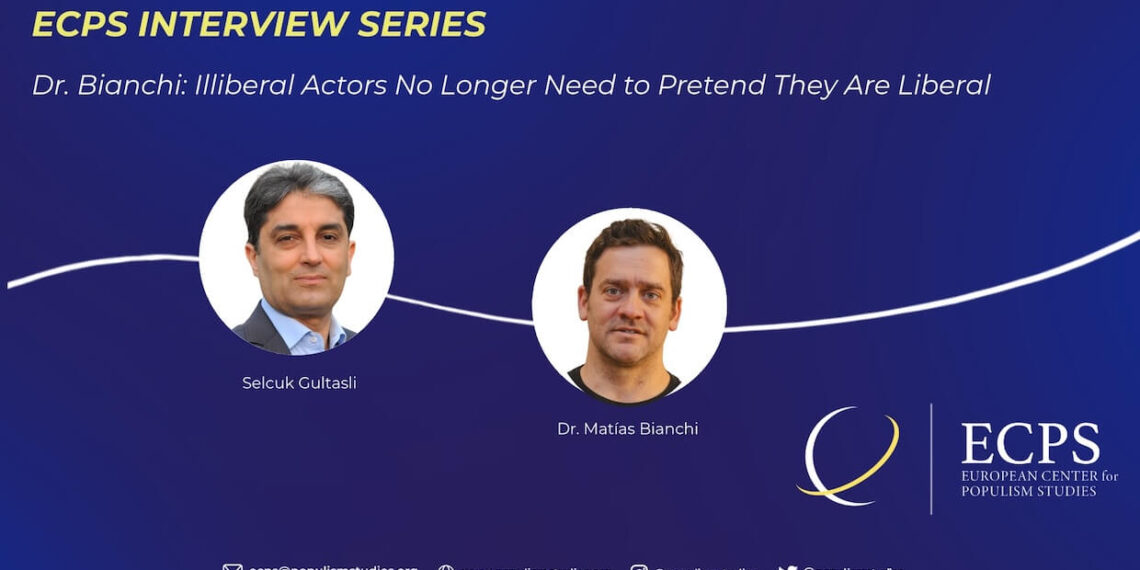
In this wide-ranging interview with the ECPS, Dr. Matías Bianchi offers a powerful diagnosis of contemporary illiberalism. Moving beyond regime-centric explanations, Dr. Bianchi argues that today’s defining shift is normative: “illiberal actors no longer need to pretend they are liberal.” He shows how illiberalism now operates through transnational networks embedded within liberal democracies, sustained by funding, coordination, and discourse originating largely in the Global North. Highlighting the erosion of liberal legitimacy, the normalization of illiberal language, and the structural weakening of the nation-state, Dr. Bianchi underscores why democratic institutions struggle to respond—and what is at stake if they fail to adapt.
Interview by Selcuk Gultasli
In an era marked by democratic backsliding, geopolitical fragmentation, and the global diffusion of illiberal norms, understanding the evolving nature of authoritarian and illiberal politics has become an urgent scholarly and policy task. In this in-depth interview with the European Center for Populism Studies (ECPS), Dr. Matías Bianchi, Director of Asuntos del Sur in Buenos Aires and co-author of “The Illiberal International,” offers a compelling diagnosis of contemporary illiberalism—one that departs decisively from regime-centric and state-centric explanations.
At the heart of Dr. Bianchi’s analysis lies a striking observation captured in the interview’s headline: “Illiberal actors no longer need to pretend they are liberal.” For Dr. Bianchi, the defining feature of the current moment is not the novelty of illiberal ideas themselves, but rather a profound normative and cultural shift that has lifted the constraints once requiring authoritarian or illiberal actors to cloak their agendas in liberal rhetoric. As he explains, “What we aim to show is that there is a set of actors working together and collaborating at different levels—geopolitical, institutional, and interpersonal—for whom liberal practices and ideas are no longer the goal.”
This “shedding of pretense,” as Dr. Bianchi describes it, represents a critical marker of the contemporary illiberal turn. Practices that were once “forbidden, punished, or had to be concealed are now openly articulated.” The symbolic need to maintain democratic façades—what Dr. Bianchi recalls through Fidel Castro’s claim that “we are a real democracy”—has eroded. “That veil is no longer necessary,” he argues, signaling a transformation not only in political behavior but also in the boundaries of legitimacy and civility within democratic publics.
Crucially, Dr. Bianchi situates illiberalism not as a discrete regime type but as a networked, relational political formation that increasingly operates within liberal democracies themselves. He emphasizes that many illiberal actors are embedded in ostensibly democratic systems—“in the European Union, the United States, or other contexts”—and that a major novelty of the past decade is that “much of the financing, support, and networking now originates from the US and Europe,” regions once seen as the pillars of the liberal international order.
Throughout the interview, Dr. Bianchi traces how cross-border coordination, transnational funding, and shared discursive strategies—exemplified by platforms such as The Conservative Political Action Conference (CPAC) or slogans like “Make Europe Great Again”—have accelerated the normalization of illiberalism. These networks thrive amid what he identifies as a deeper crisis of liberalism itself: declining legitimacy, shrinking human rights cooperation, and the inability of liberal institutions to deliver material security, social inclusion, and credible governance in an increasingly unequal and digitally mediated global order.