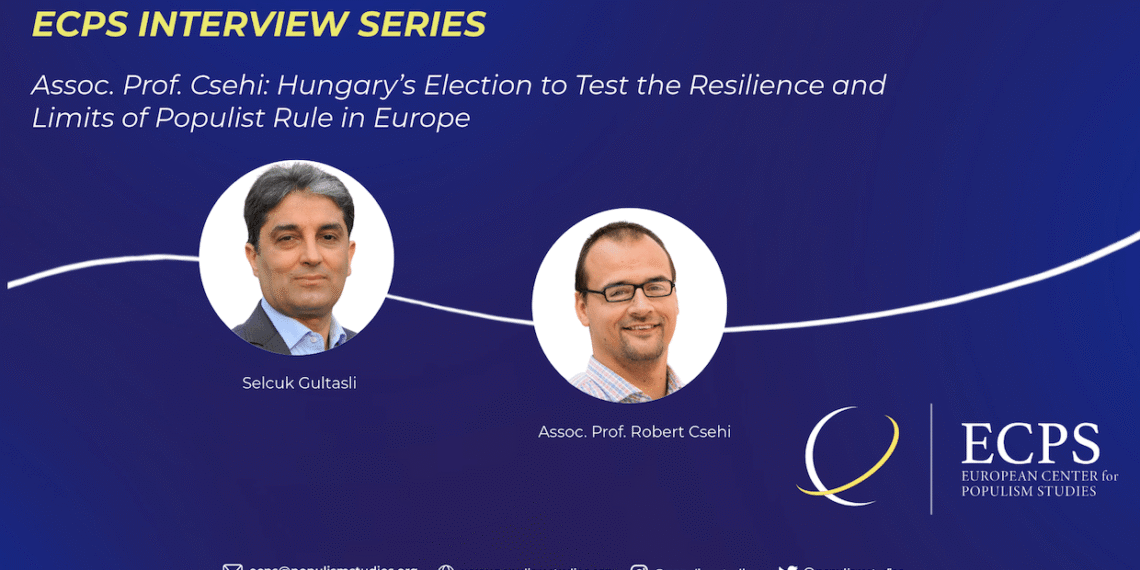
Assoc. Prof. Robert Csehi argues that Hungary’s April 12 election represents a critical test of whether entrenched populist rule can be electorally challenged. While he notes that “it will definitely be a test of incumbency survival,” he emphasizes that deeper dynamics—“ideological adaptation, state resource asymmetries, and narrative control”—remain decisive. Assoc. Prof. Csehi highlights growing limits in Orbán’s populist discourse, which “has lost its novelty,” alongside shifting political conditions marked by economic grievances and the rise of the Tisza Party as a credible challenger. Yet, even in the event of electoral turnover, he cautions that deeply embedded institutional structures may persist, potentially leading to “a prolonged struggle over state capacity.” Hungary thus offers a crucial case for assessing the resilience and limits of populist governance in Europe.
Interview by Selcuk Gultasli
Giving an interview to the European Center for Populism Studies (ECPS), Dr. Robert Csehi, Associate Professor and Program Director of the Political Science Doctoral Program at the Corvinus University of Budapest, offers a nuanced and theoretically grounded assessment of Hungary’s evolving political landscape on the eve of a pivotal electoral contest.
As Hungary approaches its parliamentary elections on April 12, 2026, the country stands at a critical juncture. After sixteen years of rule under Viktor Orbán, the election has come to signify more than routine democratic competition. It represents a broader test of whether entrenched populist governance—characterized by institutional consolidation, discursive dominance, and asymmetrical resource control—can be meaningfully challenged through electoral mechanisms. The campaign unfolds amid deep polarization, intensifying geopolitical tensions, and mounting concerns over democratic resilience, media pluralism, and institutional fairness. At the same time, the emergence of Péter Magyar and the Tisza Party has introduced a new dynamic into Hungary’s political competition.
Against this backdrop, Assoc. Prof. Csehi underscores that “it will definitely be a test of incumbency survival,” while emphasizing that the stakes extend beyond electoral turnover to questions of “ideological adaptation, state resource asymmetries, and narrative control.” In his view, the durability of Hungary’s populist system is no longer assured. He identifies emerging cracks within the governing discourse, noting that “the supply of the populist worldview… has become less creative” and “has lost its novelty,” with the government increasingly relying on repetitive narratives—particularly around the war in Ukraine—to sustain mobilization.
At the same time, structural shifts on both the supply and demand sides of politics are reshaping the electoral terrain. The rise of the Tisza Party, Assoc. Prof. Csehi observes, has created “a new channel for people to express their grievances,”while also reactivating political engagement at the grassroots level. Concurrently, worsening economic conditions have intensified public discontent, as “people’s everyday grievances are rising,” and the government finds it increasingly difficult to externalize responsibility for inflation, corruption, and declining public services.
Assoc. Prof. Csehi’s analysis situates Hungary within a broader comparative framework, highlighting the uncertain trajectory of mature populist regimes. While electoral defeat could mark “the end of the Orbán regime” in formal terms, he cautions that deeply embedded institutional structures may persist, generating “a prolonged struggle over state capacity and institutional de-capture.” Conversely, a renewed victory for Fidesz would signal that such regimes retain significant resilience, even under conditions of economic strain and ideological fatigue.
Ultimately, as Assoc. Prof. Csehi concludes, the Hungarian case offers a critical empirical test: whether “a mature, populist-authoritarian regime can still be changed… in an electoral process.” In this sense, Hungary’s 2026 election stands as a defining moment not only for the country itself, but for understanding the resilience—and limits—of populist rule across Europe.