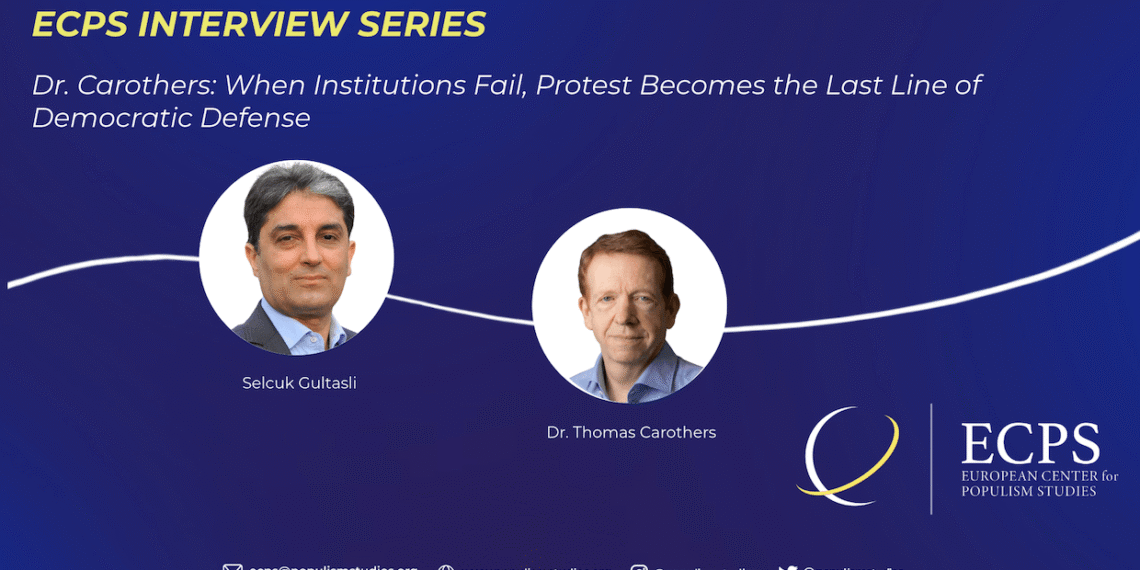
In this interview with ECPS, Dr. Thomas Carothers offers a nuanced reassessment of contemporary democratic backsliding, challenging dominant explanations that prioritize socioeconomic grievances over political agency. He argues that elite opportunism and institutional permissiveness are central drivers of democratic erosion, cautioning against overgeneralizing from Western experiences. Emphasizing that “when institutions fail, protest becomes the last line of democratic defense,” Dr. Carothers highlights the enduring role of civic mobilization in constraining authoritarian drift. At the same time, he resists declinist narratives, noting that democratic “guardrails” continue to hold in many contexts. The interview ultimately frames global democracy as entering a new phase of contested resilience, shaped by the dynamic interplay of elites, institutions, and citizen action.
Interview by Selcuk Gultasli
At a time when democracies across the globe face mounting pressures—from intensifying polarization in the United States and Europe to the growing assertiveness of authoritarian powers—the question of how democratic systems erode, endure, and renew themselves has taken on renewed urgency. In this context, Dr. Thomas Carothers, Director of the Democracy, Conflict, and Governance Program and Harvey V. Fineberg Chair for Democracy Studies at the Carnegie Endowment for International Peace, offers a timely and nuanced intervention. Speaking to the European Center for Populism Studies (ECPS), Dr. Carothers challenges prevailing explanatory frameworks and calls for a more differentiated understanding of democratic backsliding and resilience.
Central to his analysis is a critique of the widely invoked “democracy-not-delivering” thesis. As he observes,“democratic backsliding has been spreading around the world for over 20 years, but we’re still struggling to figure out why it’s occurring,” urging “a bit of humility” from both scholars and policymakers. Rather than attributing democratic erosion primarily to socioeconomic grievances, Dr. Carothers emphasizes the role of “power holders—elites and elite agency” in actively constraining democratic choice. He cautions against generalizing from the American and European experience, noting that in many contexts, citizens are not opting for extremist alternatives but are instead “not being allowed to make those choices” due to authoritarian interventions.
This analytical shift foregrounds the importance of political agency and institutional dynamics over structural determinism. Dr. Carothers expresses skepticism toward rigid dichotomies, arguing that the “structure-versus-agency framework… is not a particularly useful way” to understand contemporary democratic crises. Instead, he advocates for context-sensitive analysis that recognizes the interplay between institutional vulnerabilities and strategic elite behavior.
It is within this framework that Dr. Carothers advances one of his most compelling claims: “When institutions fail, protest becomes the last line of democratic defense.” In settings where courts, media, and civil society are systematically undermined, public protest emerges as a residual yet powerful mechanism of accountability. While acknowledging that even protest can be violently suppressed—as in cases like Tanzania or Nicaragua—he underscores that, in many democracies, mass mobilization continues to function as a critical constraint on executive overreach.
At the same time, Dr. Carothers resists overly pessimistic narratives. While democratic backsliding persists, he notes that “the rapid wave of backsliding has slowed somewhat,” and that in numerous cases institutional “guardrails have been holding up.” Drawing on comparative examples from Brazil, Senegal, and beyond, he highlights the capacity of civic mobilization and institutional resilience to counteract authoritarian drift.
Taken together, this interview situates contemporary democratic challenges within a broader landscape of contestation, adaptation, and uneven resilience. Rather than signaling an inevitable decline, Dr. Carothers suggests the emergence of a more complex equilibrium—one in which democratic erosion and renewal coexist, and where the future of democracy will depend on the dynamic interaction between elites, institutions, and citizens.