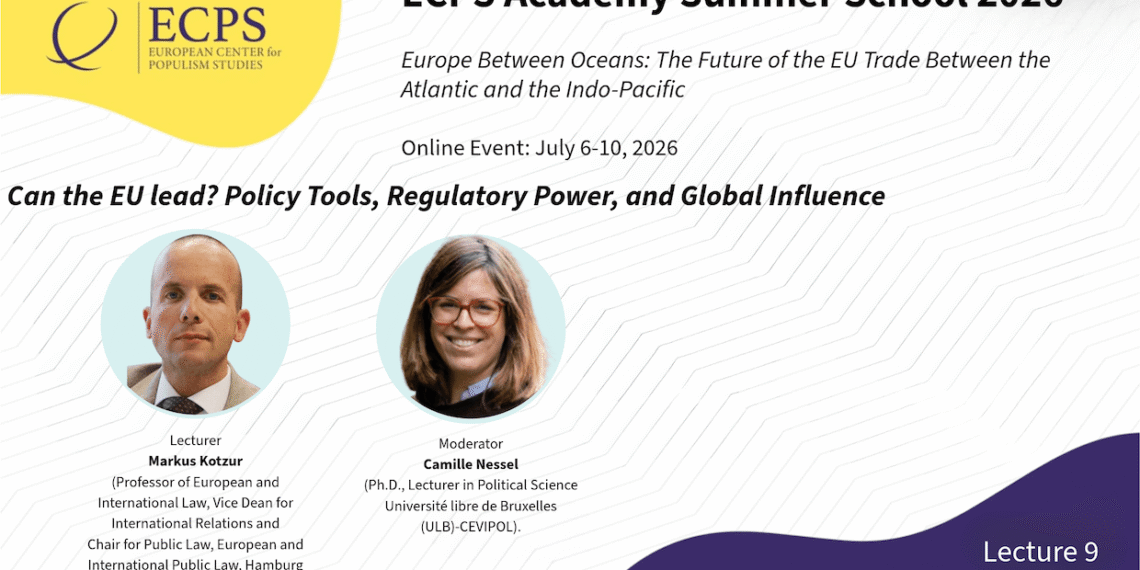
Professor Markus Kotzur’s lecture explored one of the defining questions of contemporary European integration: can the European Union translate its regulatory influence into genuine geopolitical leadership? Rejecting conventional measures of power centered solely on military capability, he argued that the EU’s comparative advantage lies in its constitutional foundations, legal authority, and capacity to shape global norms through regulatory governance. Examining concepts such as Normative Power Europe, the Brussels Effect, and strategic autonomy, the lecture demonstrated how Europe’s economic strength, legal order, and institutional resilience remain essential assets amid intensifying geopolitical competition. Combining European constitutional law with international relations and political economy, Professor Kotzur offered a compelling vision of an EU capable of reconciling values with strategic responsibility in a fragmented international order.
Reported by ECPS Staff
The concluding lecture of the ECPS Academy Summer School 2026, held under the overarching theme “Europe Between Oceans: The EU in the Age of Geoeconomics, Populism, and Strategic Competition,” addressed one of the most consequential questions confronting European integration today: Can the European Union exercise genuine geopolitical leadership in an increasingly fragmented international order? While much contemporary debate focuses on Europe’s economic competitiveness, military preparedness, or strategic autonomy, the lecture by Professor Markus Kotzur, Professor of European and International Law at the University of Hamburg and Vice Dean for International Relations, invited participants to examine a more fundamental issue. Before asking whether the European Union possesses sufficient power to lead, it is necessary to clarify what leadership itself means for a political entity that is neither a sovereign state nor a conventional international organization. Drawing upon constitutional law, international law, and European integration studies, Professor Kotzur argued that the future of European leadership depends not merely on accumulating material capabilities but on reconciling legal legitimacy, regulatory influence, political integration, and strategic purpose within a rapidly evolving geopolitical environment.
The session was introduced by Dr. Camille Nessel, who situated the discussion within the European Union’s broader geopolitical transformation initiated during Ursula von der Leyen’s first Commission. Recalling von der Leyen’s ambition to create a “geopolitical Commission” in 2019, Dr. Nessel explained how this initiative fundamentally altered scholarly and policy debates surrounding the European Union’s external role. Whereas previous decades had largely conceived European integration through the lenses of market integration and regulatory governance, recent developments increasingly emphasize economic security, strategic partnerships, critical raw materials, and geopolitical competition. Trade policy, environmental regulation, and technological governance have progressively become instruments of geopolitical influence rather than merely vehicles of economic integration. In this context, concepts such as open strategic autonomy, economic security, and regulatory sovereignty have emerged at the center of European policymaking, raising new questions about how the Union can exercise influence while remaining committed to multilateralism and the constitutional values upon which European integration has historically rested. Dr. Nessel’s introduction effectively framed the lecture by illustrating that Europe’s external policies can no longer be understood independently of broader geopolitical transformations, particularly the rise of China, renewed great-power competition, and increasing skepticism toward globalization.
Can the European Union Lead? Reconceptualizing Power, Political Community, and Global Actorship
Building upon this context, Professor Kotzur proposed that discussions of European leadership often begin from an inadequate premise. Much contemporary commentary measures geopolitical influence primarily through traditional indicators of state power—military capability, coercive capacity, or hegemonic dominance. Such perspectives, strongly associated with realist approaches to international relations, inevitably portray the European Union as structurally disadvantaged when compared with major powers such as the United States or China. Yet Professor Kotzur argued that this comparison overlooks the Union’s distinctive political character. Rather than attempting to evaluate the European Union as though it were an ordinary nation-state, he suggested conceptualizing it as a political community—a unique form of political organization that transcends the conventional distinction between sovereign state and international organization. This conceptual shift, he maintained, fundamentally alters how European leadership should be understood.
For Professor Kotzur, describing the European Union as a political community emphasizes that European integration extends far beyond economic cooperation or market regulation. The Union embodies an ongoing process of political integrationgrounded in shared constitutional values, institutional cooperation, and collective decision-making. Consequently, Europe’s capacity for leadership cannot be reduced solely to military capabilities or traditional notions of sovereignty. Instead, its influence derives from the interaction of legal authority, regulatory capacity, democratic legitimacy, and institutional resilience. The European Union therefore exercises a form of political leadership fundamentally different from that of conventional great powers—a leadership rooted less in coercion than in governance, coordination, and the production of international norms.