Nearly a decade after the mass displacement of the Rohingya, an entire generation has come of age in refugee camps where their lives are shaped by decisions they rarely help make. In this compelling ECPS Voice of Youth (VoY) article, PS Ayaas, a young Rohingya writer and community organizer, challenges the humanitarian paradigm that casts refugee youth primarily as beneficiaries of aid. Drawing on both lived experience and policy analysis, he argues that young Rohingya are already leading initiatives in education, human rights, environmental protection, and community development despite severe structural constraints. The article calls for a fundamental shift from tokenistic consultation to meaningful participation, insisting that sustainable humanitarian governance must recognize refugee youth as partners, decision-makers, and changemakers in shaping their collective future.
By PS Ayaas
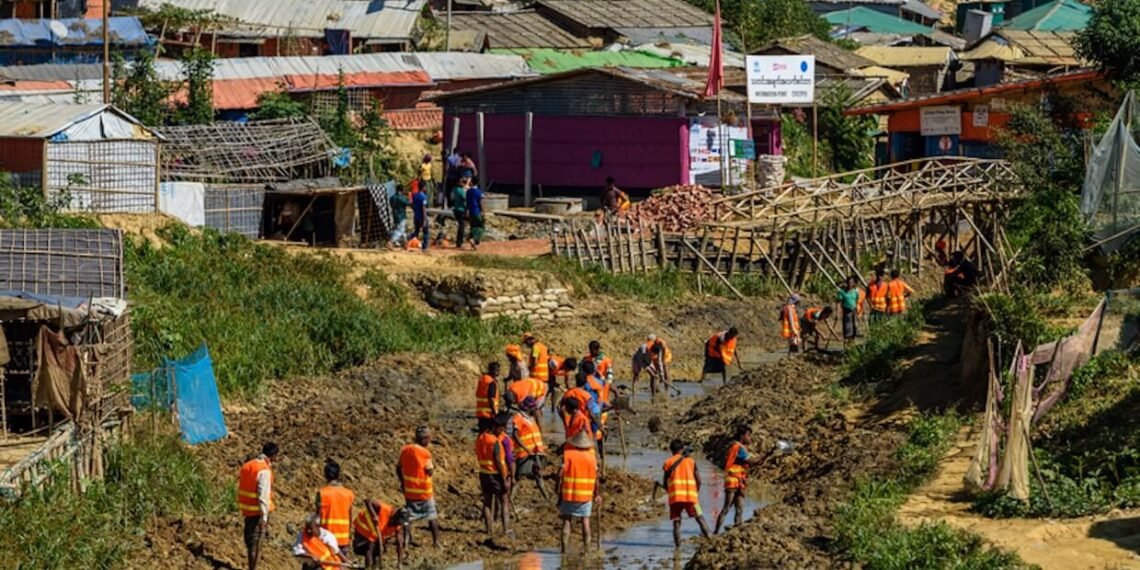
I have grown up watching decisions about my future being made in rooms I could not enter. I am a young Rohingya living in the refugee camps of Cox’s Bazar, Bangladesh, and I know the particular sound of a meeting happening somewhere close by, on the other side of a fence or a tarpaulin wall, deciding something about people like me without any of us inside it. Like thousands of other young people here, I have learned to build a future inside a place designed around uncertainty — where the rain decides some days whether a path is walkable, where a shelter roof gets patched more times than anyone bothers to count, where you learn early which queues take an hour and which take a whole morning. We are surrounded by humanitarian services, policies, assessments, and programs intended to protect us. Yet too often, the people designing these responses are speaking about young Rohingya rather than listening to us.
I know what it means to be grateful for assistance and, in the very same breath, to feel that your own voice is missing from the decisions that shape your life. Both things are true at once, and I have mostly stopped trying to resolve that contradiction, because living inside it is simply what it means to be young and Rohingya right now. I have watched young people keep studying despite severe limitations, volunteer in their communities with almost nothing to give, and organize around health, education, human rights, and environmental protection anyway — not because someone funded it, but because waiting for permission has never been something any of us could actually afford. These are not small things. They have convinced me of something I now hold as a plain fact rather than an opinion: Rohingya youth should not be treated only as beneficiaries of humanitarian assistance. We must be recognized as participants, problem-solvers, and changemakers.
Nearly a decade after the 2017 exodus, Cox’s Bazar remains home to close to a million Rohingya refugees, roughly half of whom are children and adolescents (UNICEF, 2025). Yet in nearly every major decision that shapes our daily lives — what we are permitted to study, where we may travel, whether our camp stays open or closed during a national election — young Rohingya are treated overwhelmingly as recipients of policy rather than participants in it. The international response to this crisis has structurally cast youth as beneficiaries of aid rather than as capable agents of change, even as a growing, under-recognized body of youth-led organizing inside these camps tells a very different story.
A Generation Defined by Ceilings
The most concrete example of this structural ceiling is education. Rohingya children in Bangladesh are, by government policy, not permitted to study in Bangladeshi schools and are barred from enrolling in formal schools outside the camps (Human Rights Watch, 2019). A 2022 pilot finally began offering instruction based on Myanmar’s national curriculum, reaching its first 10,000 students that year (UNICEF, 2022) — a genuine milestone, but one that arrived five years late and still reaches only a fraction of eligible youth. That fragile progress is now reversing. Foreign aid cuts have forced the closure of learning centers, and as of 2025, kindergarten and primary facilities across the camps remain shuttered while youth vocational centers have shut down entirely (UNICEF, 2025). Human Rights Watch (2025) reports that roughly 437,000 school-age children in the camps have been affected. Girls face a compounding barrier: while they make up roughly half of primary-level learners, safety concerns and restrictive gender norms reduce female participation at the secondary level to roughly twenty-five percent (Global Partnership for Education, n.d.).
For me, education has never been simply a classroom experience. I have studied by whatever light was available that evening, through a connection that drops mid-sentence, with materials passed hand to hand until the pages soften at the edges, and with a persistent uncertainty about where any of it actually leads once you reach the ceiling the policy has already built for you. Studying, some days, feels less like preparation for a future and more like an act of pure persistence, undertaken without any proof it will be rewarded. I continue anyway, because education has never meant a certificate to me. It means the possibility of becoming useful to my community, whatever shape that usefulness eventually takes — and some days, on the hardest ones, it is simply the one part of the day that still belongs to me and not to the camp around it.
Movement and livelihood are constrained in much the same way. Human Rights Watch (2022) documented curfews, checkpoint harassment, and arbitrary travel denials across the camps. Ahead of Bangladesh’s February 2026 national elections, camp authorities ordered the camps “sealed,” severely restricting movement (Fortify Rights, 2026). The International Crisis Group (2024) frames these restrictions on movement and the right to work as systemic pressures that leave refugees with no formal pathway to self-sufficiency. An entire generation is coming of age inside a system explicitly built to withhold the two pillars of adult independence: higher education and legal work.
The Agency the System Doesn’t Account For
What the policy framework misses is what is already happening despite it. I have felt this agency personally through community volunteering — in the small, unglamorous work of showing up for people who live three shelters down, in conversations that happen on a doorstep rather than in a workshop, in the particular satisfaction of solving something small and real for someone you actually know. Working directly alongside other young people has taught me that refugees do not need to be taught only how to receive services. Many of us already understand the particular, textured challenges of our environment, because we live inside them every day without a break, in a way no assessment visiting for an afternoon ever quite captures. What we lack is not motivation. It is the resources, the structural recognition, and the institutional space to turn what we already know into lasting action.
Across the camps, youth-led initiatives prove this daily, in ways that rarely make it into the reports written about us. In community leadership and rights work, the Rohingya Youth Union runs mentorship and problem-solving workshops designed specifically to bridge the learning gaps the formal system leaves open (UNHCR, n.d.-a), while the Rohingya Youth Advocacy Network, established in 2023, has grown to more than 700 volunteers coordinating human rights advocacy and community programming (Rohingya Khobor, 2025d).
In grassroots protection and media, the IOM’s Poribortok — “change makers” — program has trained 400 young Rohingya to lead neighborhood-level efforts against gender-based violence (International Organization for Migration, n.d.), and in late 2025 a four-day media workshop trained seventy young Rohingya storytellers and videographers to document their own community instead of continuing to rely on outside narrators (Rohingya Khobor, 2025a, 2025b). In ecological stewardship, the Rohingya Environmental Protection Network, founded entirely by young volunteers, coordinates practical projects and education addressing the deforestation and climate vulnerability our overcrowded camps now face (Rohingya Khobor, 2025c).
What unites all of it is that none of it waited for permission from the humanitarian structures meant to serve us. It exists as living evidence against the premise that Rohingya youth need to be spoken for.
Why the Gap Persists: A Policy Critique
If this agency is already visible, why does the policy conversation still so rarely include it? Part of the answer is structural. A camp environment built around restricted movement, capped education, and no legal right to work does not simply fail to cultivate youth leadership — it actively works against the conditions leadership normally requires. Omata’s (2022) fieldwork in Ghana’s Buduburam camp found much the same pattern: even when refugees acquired real skills through aid programs, the surrounding economic and legal environment made those skills nearly impossible to apply. Skill-building without any legal pathway to use those skills locally does not build capacity. It builds frustration.
It would be unfair to say Rohingya participation does not exist at all. Humanitarian agencies frequently engage refugee volunteers, community leaders, and informal committees, and I have been one of those volunteers. But the deeper problem is the distance between participation and decision-making. A young refugee is often asked to help implement a program, and far more rarely given any seat at the table where that program was actually designed. The problem, in other words, is not only that Rohingya youth are excluded from decision-making. It is that humanitarian systems are losing real, local knowledge every time they treat young refugees primarily as beneficiaries rather than as partners. “Nothing about us, without us” cannot remain an advocacy slogan. It has to become an operational standard — for program design, for monitoring, for evaluation, for all of it.
What Changes When Youth Become Partners
When young Rohingya are engaged as agents rather than recipients, the outcomes are not abstract. Community-based protection work led by trained young volunteers has proven significantly more effective at reducing stigma and shifting harmful social norms than top-down messaging campaigns designed elsewhere and delivered to us (UNHCR, 2025). Youth-led journalism is producing an authentic archive of camp reporting, quietly shifting narrative authority from international outlets back to the community those outlets have long written about. Youth-run environmental and advocacy networks are building local organizational capacity that outlasts funding cycles entirely, unlike the rigid, externally designed projects that tend to disappear the moment a grant runs out.
What Meaningful Participation Should Look Like
Moving from tokenistic consultation to genuine policy partnership requires structural change, not better intentions. I believe four reforms matter most.
First, institutionalized youth advisory structures. Humanitarian coordination platforms should establish formal, representative Rohingya youth advisory groups with direct consultative status during the drafting of Joint Response Plans and strategic policy reviews — not consulted after the fact, but present while the plan is still being written.
Second, direct, accessible micro-funding. Donors should create streamlined, small-scale grant mechanisms specifically for legitimate refugee-led youth organizations, bypassing the bureaucratic hurdles that keep resources concentrated among established international organizations instead of the young people already doing the work.
Third, accredited education and vocational pathways. Education policy has to look past basic literacy. Aid agencies and host authorities need to expand access to accredited secondary curricula, certified digital skills training, and tertiary scholarships, so that studying leads somewhere rather than stopping at a ceiling by design.
Fourth, transparent institutional accountability. Participation needs measurable consequences. When agencies consult young refugees, they should be expected to report back — clearly, and in public — on which youth recommendations were accepted, which were modified, which were rejected, and why.
Conclusion: Living Between Uncertainty and Action
I do not know exactly where my own future will lead. Like many young Rohingya, I live with daily uncertainty about where I will study, work, or build a permanent life — whether the place I am sitting in right now, writing this, is where I will still be sitting in five years, or ten. But that uncertainty has not removed my desire to contribute. If anything, it has sharpened it, and strengthened my belief that young people must be given real opportunities to shape the communities we are already serving, whether or not anyone ever officially asked us to.
I do not ask the world to listen to Rohingya youth simply because we are young, or because we are refugees. I ask it to listen because we know our communities from the inside, in ways no external assessment can fully reach. We know what works. We know what fails. We know what our families quietly fear at night, and what young people here still hope to build, even now, even without much reason to expect it.
Nearly a decade into one of the world’s largest and most protracted refugee crises, young Rohingya are already learning, volunteering, organizing, creating, and leading — often in the same week we are also queueing for rations, patching a roof before the next rain, or walking further than we should have to for water. We are not waiting to become changemakers. We are already trying, today, with what little the system gives us, to change what we can. The only real question left is whether the international systems surrounding us will keep speaking for us — or finally make room for us to speak, participate, and help shape the future we are the ones who will actually have to live inside.
PS Ayaas is a young Rohingya writer based in the refugee camps of Cox’s Bazar, Bangladesh, currently studying Bachelor of Health Science at the University of the People. His writing draws on lived experience of displacement, statelessness, and community organizing, and focuses on repositioning Rohingya youth as active participants and changemakers rather than passive recipients of humanitarian aid. He has previously been recognized in the Mixed Migration Review writing competition, and is currently developing an essay on Rohingya it was named as Living in Limbo: Voices and Resilience of The Rohingya Protracted and displacement. Email: rohingyapubgsquad@gmail.com
References
Fortify Rights. (2026, February 26). “Bangladesh: Incoming government must end restrictions on freedom of movement, protect Rohingya refugees.” https://www.fortifyrights.org/bgd-inv-2026-02-11/
Global Partnership for Education. (n.d.). “Changing mindsets: Education for Rohingya girls in Bangladesh.” https://www.globalpartnership.org/results/country-journeys/changing-mindsets-education-rohingya-girls-bangladesh
Human Rights Watch. (2019, December 3). “Are we not human?”: Denial of education for Rohingya refugee children in Bangladesh.” https://www.hrw.org/report/2019/12/03/are-we-not-human/denial-education-rohingya-refugee-children-bangladesh
Human Rights Watch. (2022, April 4). “Bangladesh: New restrictions on Rohingya camps. https://www.hrw.org/news/2022/04/04/bangladesh-new-restrictions-rohingya-camps
Human Rights Watch. (2025, June 25). “Bangladesh: Foreign aid cuts affect Rohingya children’s education.” https://www.hrw.org/news/2025/06/25/bangladesh-foreign-aid-cuts-affect-rohingya-childrens-education
International Crisis Group. (2024, March 12). “Crisis mounts for Rohingya refugees in Bangladesh.” https://www.crisisgroup.org/asia/south-asia/bangladesh/355-crisis-mounts-rohingya-refugees-bangladesh
International Organization for Migration. (n.d.). “Community advocates inspire positive change across Rohingya refugee camps.” IOM Storyteller. https://storyteller.iom.int/stories/community-advocates-inspire-positive-change-across-rohingya-refugee-camps
Omata, N. (2022). “Humanitarian assistance as performance? Expectations and mismatches between aid agencies and refugee beneficiaries.” Ethnos, 87(4), 789–806. https://www.tandfonline.com/doi/full/10.1080/00141844.2022.2154819
Rohingya Khobor. (2025a, September 3). “Rohingya youth trained to tell their own untold stories through journalism.” https://rohingyakhobor.com/rohingya-youth-trained-to-tell-their-own-untold-stories-through-journalism/
Rohingya Khobor. (2025b, November 29). “Youth led initiative completes four day journalism workshop empowering seventy Rohingya youth storytellers.” https://rohingyakhobor.com/youth-led-initiative-completes-four-day-journalism-workshop-empowering-seventy-rohingya-youth-storytellers/
Rohingya Khobor. (2025c, December). “Rohingya youth form environmental network to protect camps from growing ecological crisis.” https://rohingyakhobor.com/rohingya-youth-form-environmental-network-to-protect-camps-from-growing-ecological-crisis/
Rohingya Khobor. (2025d, April 20). “The journey of Rohingya Youth Advocacy Network (RYAN): Empowering a generation for justice.” https://rohingyakhobor.com/the-journey-of-rohingya-youth-advocacy-network-ryan-empowering-a-generation-for-justice/
UNHCR. (n.d.-a). “Empowering Rohingya youth through education and leadership. Global Compact on Refugees.” https://globalcompactrefugees.org/good-practices/empowering-rohingya-youth-through-education-and-leadership
UNHCR. (2025, October 23). “Young Rohingya volunteers confront gender-based violence in crowded Bangladesh camps.” https://www.unhcr.org/us/news/stories/young-rohingya-volunteers-confront-gender-based-violence-crowded-bangladesh-camps
UNICEF. (2022, May 1). “Education milestone for Rohingya refugee children as Myanmar curriculum pilot reaches first 10,000 children.” https://www.unicef.org/press-releases/unicef-education-milestone-rohingya-refugee-children-myanmar-curriculum-pilot
UNICEF. (2025, October 14). “Geneva Palais briefing on the situation of children in Cox’s Bazar, Bangladesh.” https://www.unicef.org/press-releases/geneva-palais-briefing-situation-children-coxs-bazar-bangladesh