
Session 15 of the ECPS Virtual Workshop Series offered a timely and theoretically rich interrogation of how populism, personalized leadership, and systemic crisis are reshaping the horizons of democratic politics. Bringing cybernetics, political sociology, and democratic theory into productive dialogue, the session illuminated the deep entanglement between emotional mobilization, institutional fragility, and global governance under conditions of accelerating complexity. Dr. Robert R. Traill’s systems-theoretical analysis of “populist panic” and Professor Lorenzo Viviani’s political-sociological account of “manipulated resonance” together revealed populism not as a peripheral disruption, but as a central mode through which legitimacy, leadership, and “the people” are being redefined today. Enriched by incisive discussant interventions and a conceptually fertile Q&A, the session underscored the need for new democratic vocabularies capable of confronting both exclusionary affect and global instability.
Reported by ECPS Staff
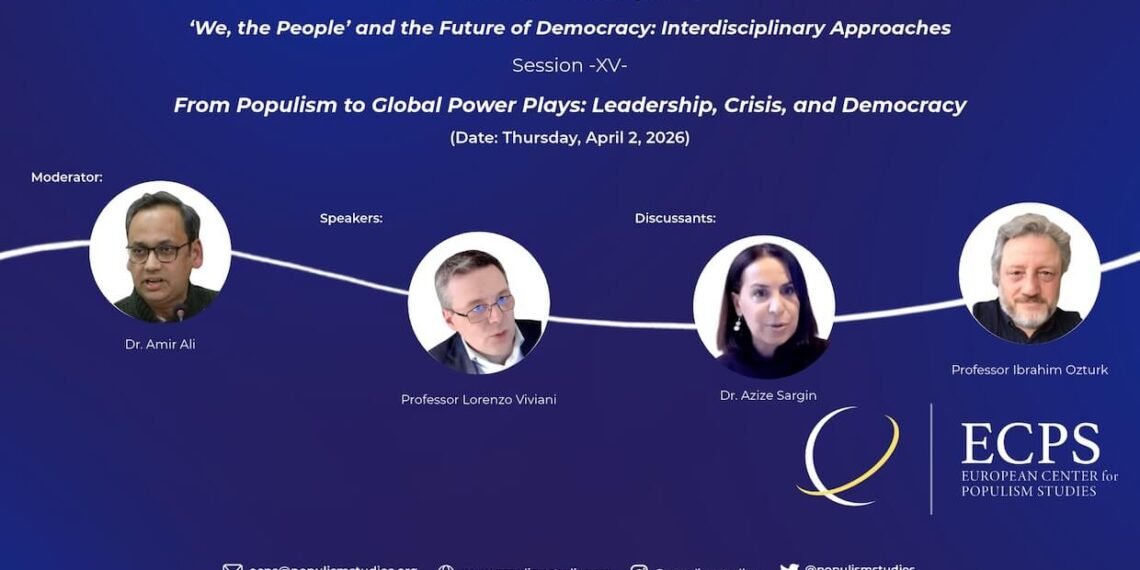
On Thursday, April 2, 2026, the European Center for Populism Studies (ECPS) convened the fifteenth session of its Virtual Workshop Series, “We, the People” and the Future of Democracy: Interdisciplinary Approaches,” under the title “From Populism to Global Power Plays: Leadership, War, and Democracy.” Bringing together perspectives from political sociology, economics, and cybernetics, the session explored the evolving relationship between populist leadership, systemic crisis, and the changing architecture of democratic governance in an increasingly complex and unstable global order.
The participants of the session were introduced by ECPS intern Reka Koleszar. Chaired by Dr. Amir Ali (Jawaharlal Nehru University), the session was framed around a central question of contemporary political life: how can democratic systems sustain legitimacy and effectiveness amid intensifying global pressures, including geopolitical conflict, economic uncertainty, climate crisis, and the rise of populist movements that challenge institutional mediation and pluralist norms? As Dr. Ali underscored in his opening remarks, the current conjuncture is marked not only by a crisis of representation but also by deeper transformations in how “the people” are constructed, mobilized, and governed across diverse political contexts.
The panel featured two analytically distinct yet conceptually complementary presentations. Dr. Robert R. Traill (Brunel University) offered a cybernetic and systems-theoretical intervention on the limits of democratic decision-making in the face of global-scale challenges. His presentation examined how complex adaptive systems—from individual cognition to national governance and global coordination—struggle to maintain stability when confronted with phenomena such as climate change and limits to economic growth. By introducing the notion of “populist panic” as a systemic response to perceived breakdown, Dr. Traill’s contribution invited participants to reconsider populism not merely as a political ideology, but as a symptom of deeper failures in collective decision-making.
In contrast, Professor Lorenzo Viviani (University of Pisa) advanced a political-sociological framework centered on the concept of “manipulated resonance” to analyze personalized leadership in populism. His presentation interrogated how populist leaders construct direct, emotionally charged relationships with “the people,” reconfiguring political representation through processes of identification, embodiment, and symbolic power. By foregrounding the role of emotions—particularly resentment—and the strategic bypassing of institutional intermediaries, Professor Viviani illuminated the cultural and affective foundations of contemporary populist mobilization.
The session was further enriched by the critical interventions of its discussants, Dr. Azize Sargin (ECPS) and Professor Ibrahim Ozturk (University of Duisburg-Essen), whose comments deepened the theoretical stakes of both presentations. Their reflections engaged key issues such as the distinction between democratic responsiveness and manipulated resonance, the tensions between technocratic solutions and populist distrust, and the broader challenges of governing complexity in a rapidly changing world.
Together, the contributions of chair, speakers, and discussants generated a rich interdisciplinary dialogue that bridged micro-level analyses of leadership and emotion with macro-level concerns about global governance and systemic stability. Session 15 thus provided a compelling exploration of how populism, far from being a peripheral phenomenon, is deeply embedded in the contemporary reconfiguration of democratic life and global political order.
