In this commentary, Dr. Kamil Jonski examines Poland’s protracted constitutional crisis through the prospect of what he calls “Schrödinger’s Tribunals”: parallel Constitutional Tribunals simultaneously regarded as legitimate and illegitimate by opposing political constituencies. Tracing the conflict from disputes surrounding the 1997 Constitution through the Law and Justice (PiS) government’s capture of the Constitutional Tribunal and the current center-left majority’s attempts at restoration, Dr. Jonski argues that the crisis reflects deeper, competing interpretations of Poland’s constitutional identity. As rival political camps contest judicial appointments, institutional legitimacy, and constitutional authority, efforts to restore the Tribunal may reproduce rather than resolve its politicization. Dr. Jonski ultimately raises a more fundamental question: whether effective constitutional review in Poland now requires institutional solutions beyond the existing Tribunal itself.
By Kamil Joński
The consequences of illiberal assault on Polish Constitutional Tribunal in 2015-2016 – and contemplated attempts to restore it – risks producing singular outcome: two parallel tribunals recognized as “legitimate” and “illegitimate” at any given time by respective sides of the political divide.
Single Text, Clashing Meanings
During the last year’s ECPS Virtual Workshop Series I argued that Polish constitutional crisis should be interpreted as the apogee of the decades-long struggle over constitutional values and identity. To back this claim, I presented survey data on (i) support for the new Constitution, as it was adopted in 1997, (ii) support for right-wing Law & Justice (PiS) “war”waged against the Constitutional Tribunal (CT), and (iii) assessment of the CT five years after the right-wing capture.
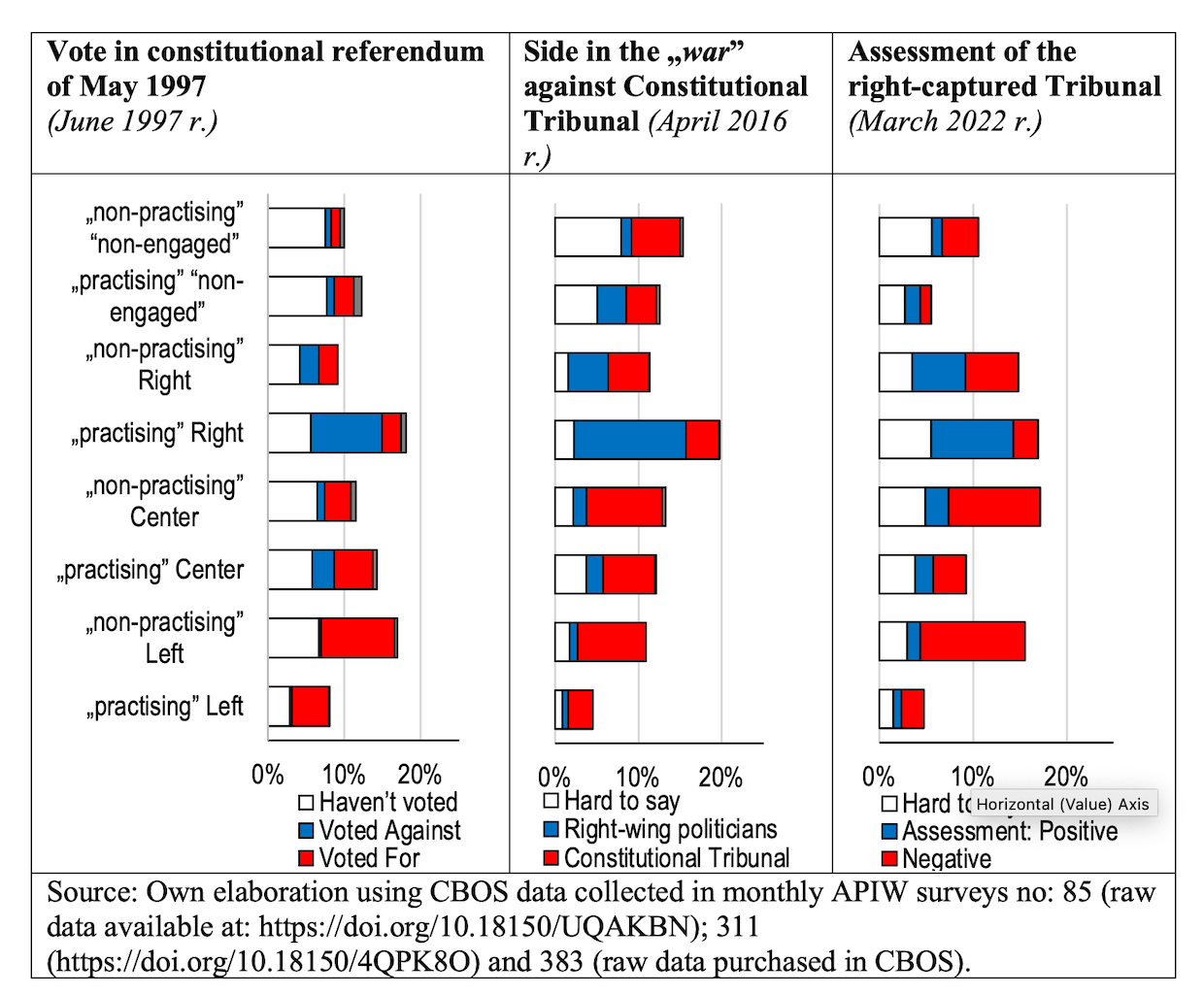
It turned out that initial opposition to the Constitution, support for Tribunal packing, and approval of the captured CT were all concentrated largely among self-identified rightists who regularly participate in religious services. Intriguingly, the results of the 2025 presidential runoff, analyzed at the level of 370 NUTS 4 regions, correlate with the results of the 1997 constitutional referendum, corroborating the claim that the current conflict over (dis)obeying the Constitution is linked to the past conflict over its adoption.
These empirical findings correspond with the narrative provided by the late professor L. Morawski – constitutional scholar and 2015 CT packing participant. As he explained during 2017 Oxford symposium, right-wingers and their opponents disagree on “how the Polish Constitution should be interpreted” with the government favoring “republican” and opposition – a “liberal way.” For him, “the republican tradition does not reject all liberal values. [Sharing] a deep respect for democracy, human rights and freedoms. But apart from this, Polish republicanism strongly emphasizes the attachment to values such as patriotism, solidarity, a strong state as a guardian of human rights, the role of the Catholic Church and religion in public life. In political reality, it means that Polish republicans defend the traditional family model and strongly oppose abortion and so on.”
I argue that lacking the majority required to amend the Constitution, right-wingers seek control of the CT – the only institution in the legal system, that is capable to saturate it with rightist values and identity (or increase the level of this saturation). That allows them to replace “liberal” meaning of the constitution with “republican” one – without altering its text at all.
Indeed, the signature achievement of the captured CT was its abortion ban verdict of 22 October 2020 (K1/20), and in a recent judgment of July 28, 2026 (U 2/26) it attempted to block implementation of the Supreme Administrative Court judgment of March 20, 2026 (II OSK 216/21) following CJEU judgment of November25, 2025 (C‑713/23) on recognition of same-sex marriages concluded in other EU countries.
Long Fight of the Right
The history of Polish Constitutional Tribunal dates back to communist era “normalization” after 1981 martial law. By coincidence, half of the bench had been ought to be replaced shortly after the groundbreaking semi-free elections of June 4, 1989, offering CT unique opportunity to successfully reinvent itself to the new, democratic reality.
However, the right-wing quickly became to contest the Tribunal. The first draft of the law that would enable CT purge had been submitted in 1992 (Doc. no. 458, I Term) but it was rejected by the major political forces pursuing negotiated transition to the democracy and market economy.
The issue returned to the agenda when so called “post-communist cleavage” gave way to the current divide between Civic Coalition (Platform) of Donald Tusk and Law & Justice (PiS) of Kaczyński twins.
The double elections of 2005 delivered Lech Kaczyński’s presidency and a fragile coalition government under leadership of Jaroslav Kaczyński. Although the cabinet lasted only to 2007 snap elections, it embarked “political mobbing” against CT and undertook two failed attempts to force PiS appointee as a CT Chief Justice (for first see Doc. no. 765, for second Doc. no. 2030, V Term).
Ten years later, another double election paved the way to Polish constitutional crisis of 2015. PiS’s candidate Andrzej Duda unexpectedly won presidency, and PiS itself secured first single-party majority since 1989. Perhaps mindful of the 2005-2007 excesses, outgoing parliamentary majority led by Civic Platform embarked an attempt to pack CT, passing legislation that allowed appointment “in advance” of five – instead of scheduled three – justices.
Although this initial crisis was properly resolved by CT judgment of December 3, 2015 (K 34/15), new PiS majority refused to implement it, instead appointing its own five justices (the three of them, including quoted professor Morawski, became referred to as “doubles”). What followed, was so called “war against the constitution,” resulting in right-wing victory, as its appointee Julia Przyłębska had been forced as CT Chief Justice. She presided over “a fundamental reversal of the traditional role of a constitutional court” and its transformation into “a governmental enabler.”
In a famous judgment, Polish Supreme Administrative Court described the right-captured CT as “infected with lawlessness” (judgment of November 16, 2022, III OSK 2528/21). Its legal deficiencies were also confirmed in ECHR judgment of May 7, 2021 (Xero Flor v. Poland) and CJEU judgment of December 18, 2025 (C-448/23).
Restoration Derailed
The parliamentary election of 2023, leading to the formation of center-left cabinet of Donald Tusk, inspired hope of rule of law “restoration”. On March 6, 2024 the Lower Chamber of the Parliament (Sejm) adopted resolution proclaiming that irregularities in CT amassed to the point where it is unable to carry out constitutional review and protect human rights (M.P.2024.198). That same day two draft laws had been submitted to reshape CT (Doc. no. 253 and 254, X Term). Passed on September 13, 2024, they were referred to the right-captured CT by President Duda and declared unconstitutional in its judgment of July 29, 2025 (Kp 3/24). Given that failure, on December 18, 2024, the Cabinet adopted resolution on captured CT’s inability to perform its tasks and denying promulgation of its judgments (M.P. 2024.1068).
As right-wing Karol Nawrocki replaced President Duda in 2025, it became apparent that legislative “restoration” of the CT is out of reach in the foreseeable future. The B-plan, involving judicial appointments, was launched in March 2026.
According to the Constitution, CT is composed of 15 justices. As of August 31, 2026, they can be divided into four groups, illustrating what Jakub Jaraczewski and Laurent Pech called “dualist constitutional court.”
- Justyn Piskorski and Jarosław Wyrembak, who replaced two late “doubles,” are recognized as legitimate justices by right-wingers (and Chief Justice Bogdan Święczkowski), but their status is contested by the current majority citing judgments of CT, ECHR and CJEU.
- Stanisław Piotrowicz, Bartłomiej Sochański (deputy Chief Justice), Jakub Stelina, Wojciech Sych, Święczkowski (Chief Justice) and Rafał Wojciechowski remain uncontested PiS-appointed justices.
- Magdalena Bentkowska, Sławomir Patyra and Dariusz Szostek are uncontested appointees of the current, center-left majority, properly sworn in by the President Karol Nawrocki.
- Marcin Dziurda, Anna Korwin-Piotrowska, Krystian Markiewicz and Maciej Taborowski are recognized by the current majority that appointed them, but contested by right-wingers (and Chief Justice Święczkowski), as President Nawrocki denied them opportunity to be sworn in.
In mid-August it was announced that Maciej Berek – cabinet member referred to as Donald Tusk “right hand” – will be dispatched to the CT (Doc. no. 3006, X Term), with expectations regarding his pivotal role in its restoration. The move was opposed by liberal NGO community and 60 % of surveyed Poles and inspired constitutional debate with Wojciech Sadurski calling for arms and Marcin Matczak warning against the “Tribunal in exile.”
Towards the Schrödinger’s Tribunals
Regardless the differences, both scholars agreed that some sort of CT restoration is both feasible and desirable. However, that is hardly the case if “dualist constitutional court” is indeed the consequence of parallel meanings, ascribed to the Constitution by polarized politicians, lawyers and large clusters of voters.
Leaving aside specific legal tactics, CT restoration is likely to involve the following sequence: the eight appointees of the current center-left majority (at least four of them contested by the right) would somehow assume the role of the CT’s General Assembly. Next, they will use the PiS-created institution of a justice chairing the CT to bypass Chief Justice Święczkowski (either on the grounds of “doubles” involvement in his appointment or by using disciplinary charges), paving the way for review (in five-justice panels) of the key PiS-enacted laws. Most likely, the so-called interpretative judgment technique will be used, in a way similar to the judgment of November 7, 2016 (K 44/16). These judgments will be promulgated in the Journal of Laws and enforced by the cabinet.
The reaction of the right-wingers seems equally predictable—they will deny the status of the CT’s General Assembly and frame the events as an illegal court capture. Święczkowski will carry the torch of “constitutional legitimacy” until February 2031, when his term in office expires. And once elections deliver a right-wing majority, it will unconstitutionally nullify the judicial appointments—just as in the case of the 2015 CT packing—to appoint another set of “doubles” contested by the liberals.
The two parallel interpretations of the Constitution will be crowned by two distinct benches of Tribunal justices, producing their respective jurisprudence. Just like Schrödinger’s cat—simultaneously dead and alive—the parallel Tribunals would be recognized as “legitimate” and “illegitimate” by their respective constituencies at any given time, with the current majority and cabinet determining whose case law should be followed and whose judgments ought to be promulgated and enforced.
It is widely acknowledged that, since 2016 (i.e., one-fourth of contemporary Polish democratic history), the CT has lacked the capacity to carry out effective constitutional review. In the longer run, Schrödinger’s Tribunals are unlikely to work any better. In an environment of clashing interpretations of the Polish Constitution, unorthodox solutions for improving rights protection—including abolishing the CT altogether and empowering ordinary and administrative courts—are badly needed. Unfortunately, it seems that old ideas have to be tested to destruction first.

From Parallel Constitutions to Schrödinger’s Tribunals: Poland’s Unresolved Constitutional Crisis
In this commentary, Dr. Kamil Jonski examines Poland’s protracted constitutional crisis through the prospect of what he calls “Schrödinger’s Tribunals”: parallel Constitutional Tribunals simultaneously regarded as legitimate and illegitimate by opposing political constituencies. Tracing the conflict from disputes surrounding the 1997 Constitution through the Law and Justice (PiS) government’s capture of the Constitutional Tribunal and the current center-left majority’s attempts at restoration, Dr. Jonski argues that the crisis reflects deeper, competing interpretations of Poland’s constitutional identity. As rival political camps contest judicial appointments, institutional legitimacy, and constitutional authority, efforts to restore the Tribunal may reproduce rather than resolve its politicization. Dr. Jonski ultimately raises a more fundamental question: whether effective constitutional review in Poland now requires institutional solutions beyond the existing Tribunal itself.
By Kamil Joński
The consequences of illiberal assault on Polish Constitutional Tribunal in 2015-2016 – and contemplated attempts to restore it – risks producing singular outcome: two parallel tribunals recognized as “legitimate” and “illegitimate” at any given time by respective sides of the political divide.
Single Text, Clashing Meanings
During the last year’s ECPS Virtual Workshop Series I argued that Polish constitutional crisis should be interpreted as the apogee of the decades-long struggle over constitutional values and identity. To back this claim, I presented survey data on (i) support for the new Constitution, as it was adopted in 1997, (ii) support for right-wing Law & Justice (PiS) “war”waged against the Constitutional Tribunal (CT), and (iii) assessment of the CT five years after the right-wing capture.
It turned out that initial opposition to the Constitution, support for Tribunal packing, and approval of the captured CT were all concentrated largely among self-identified rightists who regularly participate in religious services. Intriguingly, the results of the 2025 presidential runoff, analyzed at the level of 370 NUTS 4 regions, correlate with the results of the 1997 constitutional referendum, corroborating the claim that the current conflict over (dis)obeying the Constitution is linked to the past conflict over its adoption.
These empirical findings correspond with the narrative provided by the late professor L. Morawski – constitutional scholar and 2015 CT packing participant. As he explained during 2017 Oxford symposium, right-wingers and their opponents disagree on “how the Polish Constitution should be interpreted” with the government favoring “republican” and opposition – a “liberal way.” For him, “the republican tradition does not reject all liberal values. [Sharing] a deep respect for democracy, human rights and freedoms. But apart from this, Polish republicanism strongly emphasizes the attachment to values such as patriotism, solidarity, a strong state as a guardian of human rights, the role of the Catholic Church and religion in public life. In political reality, it means that Polish republicans defend the traditional family model and strongly oppose abortion and so on.”
I argue that lacking the majority required to amend the Constitution, right-wingers seek control of the CT – the only institution in the legal system, that is capable to saturate it with rightist values and identity (or increase the level of this saturation). That allows them to replace “liberal” meaning of the constitution with “republican” one – without altering its text at all.
Indeed, the signature achievement of the captured CT was its abortion ban verdict of 22 October 2020 (K1/20), and in a recent judgment of July 28, 2026 (U 2/26) it attempted to block implementation of the Supreme Administrative Court judgment of March 20, 2026 (II OSK 216/21) following CJEU judgment of November25, 2025 (C‑713/23) on recognition of same-sex marriages concluded in other EU countries.
Long Fight of the Right
The history of Polish Constitutional Tribunal dates back to communist era “normalization” after 1981 martial law. By coincidence, half of the bench had been ought to be replaced shortly after the groundbreaking semi-free elections of June 4, 1989, offering CT unique opportunity to successfully reinvent itself to the new, democratic reality.
However, the right-wing quickly became to contest the Tribunal. The first draft of the law that would enable CT purge had been submitted in 1992 (Doc. no. 458, I Term) but it was rejected by the major political forces pursuing negotiated transition to the democracy and market economy.
The issue returned to the agenda when so called “post-communist cleavage” gave way to the current divide between Civic Coalition (Platform) of Donald Tusk and Law & Justice (PiS) of Kaczyński twins.
The double elections of 2005 delivered Lech Kaczyński’s presidency and a fragile coalition government under leadership of Jaroslav Kaczyński. Although the cabinet lasted only to 2007 snap elections, it embarked “political mobbing” against CT and undertook two failed attempts to force PiS appointee as a CT Chief Justice (for first see Doc. no. 765, for second Doc. no. 2030, V Term).
Ten years later, another double election paved the way to Polish constitutional crisis of 2015. PiS’s candidate Andrzej Duda unexpectedly won presidency, and PiS itself secured first single-party majority since 1989. Perhaps mindful of the 2005-2007 excesses, outgoing parliamentary majority led by Civic Platform embarked an attempt to pack CT, passing legislation that allowed appointment “in advance” of five – instead of scheduled three – justices.
Although this initial crisis was properly resolved by CT judgment of December 3, 2015 (K 34/15), new PiS majority refused to implement it, instead appointing its own five justices (the three of them, including quoted professor Morawski, became referred to as “doubles”). What followed, was so called “war against the constitution,” resulting in right-wing victory, as its appointee Julia Przyłębska had been forced as CT Chief Justice. She presided over “a fundamental reversal of the traditional role of a constitutional court” and its transformation into “a governmental enabler.”
In a famous judgment, Polish Supreme Administrative Court described the right-captured CT as “infected with lawlessness” (judgment of November 16, 2022, III OSK 2528/21). Its legal deficiencies were also confirmed in ECHR judgment of May 7, 2021 (Xero Flor v. Poland) and CJEU judgment of December 18, 2025 (C-448/23).
Restoration Derailed
The parliamentary election of 2023, leading to the formation of center-left cabinet of Donald Tusk, inspired hope of rule of law “restoration”. On March 6, 2024 the Lower Chamber of the Parliament (Sejm) adopted resolution proclaiming that irregularities in CT amassed to the point where it is unable to carry out constitutional review and protect human rights (M.P.2024.198). That same day two draft laws had been submitted to reshape CT (Doc. no. 253 and 254, X Term). Passed on September 13, 2024, they were referred to the right-captured CT by President Duda and declared unconstitutional in its judgment of July 29, 2025 (Kp 3/24). Given that failure, on December 18, 2024, the Cabinet adopted resolution on captured CT’s inability to perform its tasks and denying promulgation of its judgments (M.P. 2024.1068).
As right-wing Karol Nawrocki replaced President Duda in 2025, it became apparent that legislative “restoration” of the CT is out of reach in the foreseeable future. The B-plan, involving judicial appointments, was launched in March 2026.
According to the Constitution, CT is composed of 15 justices. As of August 31, 2026, they can be divided into four groups, illustrating what Jakub Jaraczewski and Laurent Pech called “dualist constitutional court.”
In mid-August it was announced that Maciej Berek – cabinet member referred to as Donald Tusk “right hand” – will be dispatched to the CT (Doc. no. 3006, X Term), with expectations regarding his pivotal role in its restoration. The move was opposed by liberal NGO community and 60 % of surveyed Poles and inspired constitutional debate with Wojciech Sadurski calling for arms and Marcin Matczak warning against the “Tribunal in exile.”
Towards the Schrödinger’s Tribunals
Regardless the differences, both scholars agreed that some sort of CT restoration is both feasible and desirable. However, that is hardly the case if “dualist constitutional court” is indeed the consequence of parallel meanings, ascribed to the Constitution by polarized politicians, lawyers and large clusters of voters.
Leaving aside specific legal tactics, CT restoration is likely to involve the following sequence: the eight appointees of the current center-left majority (at least four of them contested by the right) would somehow assume the role of the CT’s General Assembly. Next, they will use the PiS-created institution of a justice chairing the CT to bypass Chief Justice Święczkowski (either on the grounds of “doubles” involvement in his appointment or by using disciplinary charges), paving the way for review (in five-justice panels) of the key PiS-enacted laws. Most likely, the so-called interpretative judgment technique will be used, in a way similar to the judgment of November 7, 2016 (K 44/16). These judgments will be promulgated in the Journal of Laws and enforced by the cabinet.
The reaction of the right-wingers seems equally predictable—they will deny the status of the CT’s General Assembly and frame the events as an illegal court capture. Święczkowski will carry the torch of “constitutional legitimacy” until February 2031, when his term in office expires. And once elections deliver a right-wing majority, it will unconstitutionally nullify the judicial appointments—just as in the case of the 2015 CT packing—to appoint another set of “doubles” contested by the liberals.
The two parallel interpretations of the Constitution will be crowned by two distinct benches of Tribunal justices, producing their respective jurisprudence. Just like Schrödinger’s cat—simultaneously dead and alive—the parallel Tribunals would be recognized as “legitimate” and “illegitimate” by their respective constituencies at any given time, with the current majority and cabinet determining whose case law should be followed and whose judgments ought to be promulgated and enforced.
It is widely acknowledged that, since 2016 (i.e., one-fourth of contemporary Polish democratic history), the CT has lacked the capacity to carry out effective constitutional review. In the longer run, Schrödinger’s Tribunals are unlikely to work any better. In an environment of clashing interpretations of the Polish Constitution, unorthodox solutions for improving rights protection—including abolishing the CT altogether and empowering ordinary and administrative courts—are badly needed. Unfortunately, it seems that old ideas have to be tested to destruction first.
Latest News
Lula’s Historic Comeback: Implications for Brazilian Democracy and the Emerging Global Order
Lega’s Changing Tactics, Enduring Populism: Salvini’s Political Reset Ahead of 2027
ECPS Panel on US Midterms: Trumpism, Democratic Resilience, and the Rise of Democratic Socialism
Long Read: Turkey’s Fund Crisis and the Political Economy of Authoritarian Rule
Prof. Mchangama: Liberal Institutions Are Becoming Increasingly Illiberal in Their Attempts to Fight Populism
Lula’s Historic Comeback: Implications for Brazilian Democracy and the Emerging Global Order
Lega’s Changing Tactics, Enduring Populism: Salvini’s Political Reset Ahead of 2027
ECPS Panel on US Midterms: Trumpism, Democratic Resilience, and the Rise of Democratic Socialism
Category
Lula’s Historic Comeback: Implications for Brazilian Democracy and the Emerging Global Order
Lega’s Changing Tactics, Enduring Populism: Salvini’s Political Reset Ahead of 2027
ECPS Panel on US Midterms: Trumpism, Democratic Resilience, and the Rise of Democratic Socialism
Long Read: Turkey’s Fund Crisis and the Political Economy of Authoritarian Rule
Prof. Mchangama: Liberal Institutions Are Becoming Increasingly Illiberal in Their Attempts to Fight Populism
Prof. Roznai: Israel Would Not Survive Another Coalition Like Netanyahu’s