In this commentary, Dr. Kamil Joński examines why Poland remains an exceptional case in contemporary Europe, where high levels of religiosity continue to overlap with strong right-wing political identification. Drawing on data from the 11th wave of the European Social Survey (ESS), he demonstrates that regular church attendance and conservative political identity increasingly reinforce one another, creating a distinctive “churchgoing right” that shapes both political discourse and the Catholic Church itself. Dr. Joński argues that this convergence helps explain Poland’s restrictive social policies, the enduring influence of the Church on public life, and emerging tensions between Polish conservatives and the post-Vatican II direction of the Holy See. The commentary offers fresh insights into religion, polarization, and democratic politics in Europe.
By Kamil Joński
The breakup of the Polish right-wing Law and Justice (PiS) party has inspired numerous analyses, commentaries, and anecdotes. One of them offers intriguing insight into the uniqueness of the Polish right on the European political landscape. The leader of the new initiative, Development Plus, M. Morawiecki ("Law and Justice" Prime Minister from 2017 to 2023), hosted its July 31, 2026, kick-off as a grill event. Among other preparations, he secured a Roman Catholic bishop’s permission to violate the canon law requirement of abstaining from eating meat on Fridays (the day of the Crucifixion), so that his fellow right-wingers could enjoy grilled sausage. Quite a bizarre touch at the gathering of a self-proclaimed modern and pro-development right, led by a former bank CEO? Only at first glance.
Many Poles Remain Religious…
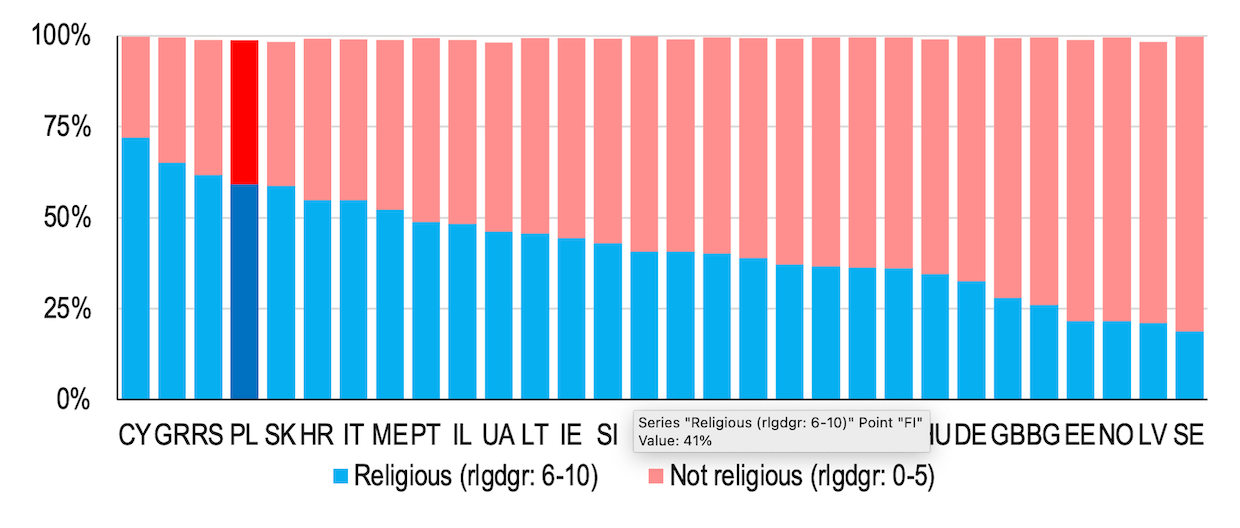
The data collected during the recent (11th) wave of the European Social Survey (ESS) documents the relatively high religiosity of Poles, with nearly 60 percent of respondents describing themselves as religious ("Regardless of whether you belong to a particular religion, how religious would you say you are?", variable rlgdgr).
…and Maintains Bond with Institutional Church
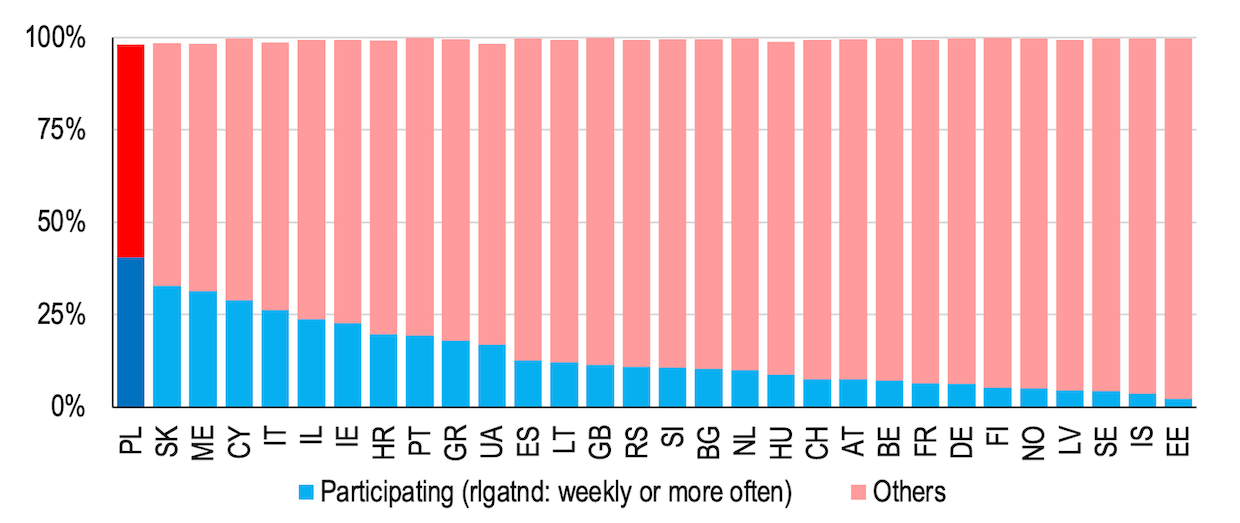
The theory predicts that "secular transition happens in three steps: first, public ritual participation declines; second, the importance of religion to individuals declines; and third, people shed religious affiliation." In this context, it is even more important that a substantial share of Poles maintains its bond with the institution of the Roman Catholic Church. Despite the post-COVID drop in religious participation, 40 percent of respondents declare regular, weekly participation in religious services ("Apart from special occasions such as weddings and funerals, about how often do you attend religious services nowadays?", variable rlgatnd).
The Right-Wing Is Strong…
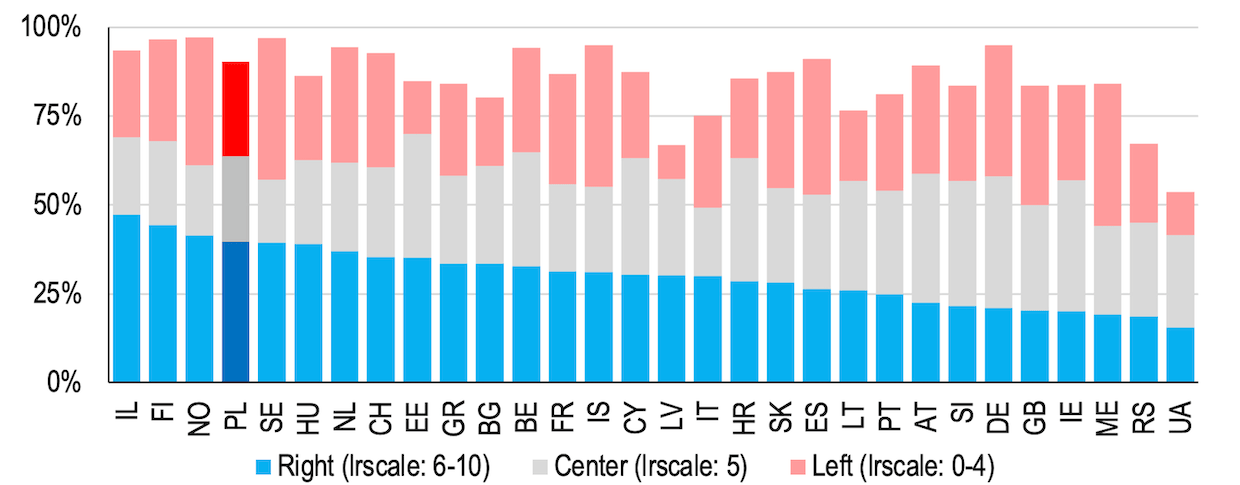
At the same time, the Polish political landscape is skewed toward the right, with two out of five respondents placing themselves on the right end of the political spectrum ("In politics, people sometimes talk of ‘left’ and ‘right’. Using this card, where would you place yourself on this scale, where 0 means the left and 10 means the right?", variable lrscale).
… and Overlap Matters
However, the most revealing insight emerges from combining these two dimensions: the bond with the institutional Church, as measured by religious participation, and self-placement on the political spectrum. It turns out that nearly one in four Poles declare both weekly attendance at religious services and right-wing identification.
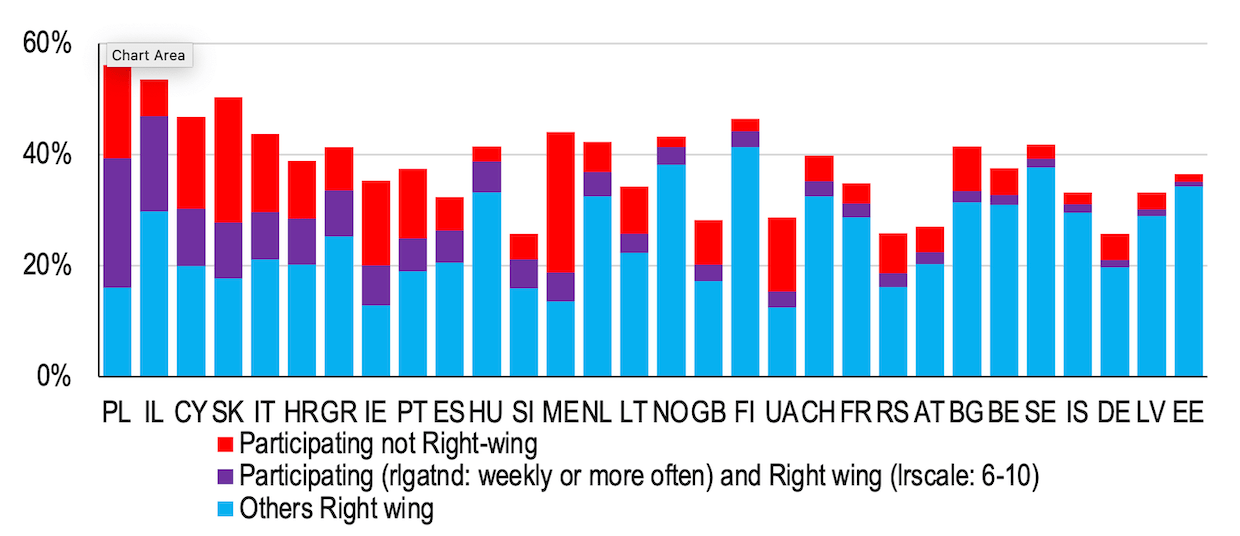
What makes this situation truly unique on the European political landscape is that this "churchgoing right" constitutes the majority among both churchgoers and right-wingers. In other words, their sensitivities are likely to set the tone for both political rallies and sermons. As a consequence, the Polish throne and the altar remain entangled in ways that are virtually unimaginable elsewhere in contemporary Europe.
The result is, among other things, an extraordinarily restrictive abortion law, a state-enforced de facto blasphemy law (the criminal provision on "offending religious feelings"), and the rejection of same-sex civil unions (not to mention marriages). For the mechanisms of Church influence, see A. Grzymała-Busse (2015), Nations under God: How Churches Use Moral Authority to Influence Policy.
“Post-Secularism” or Anti-Vatican II
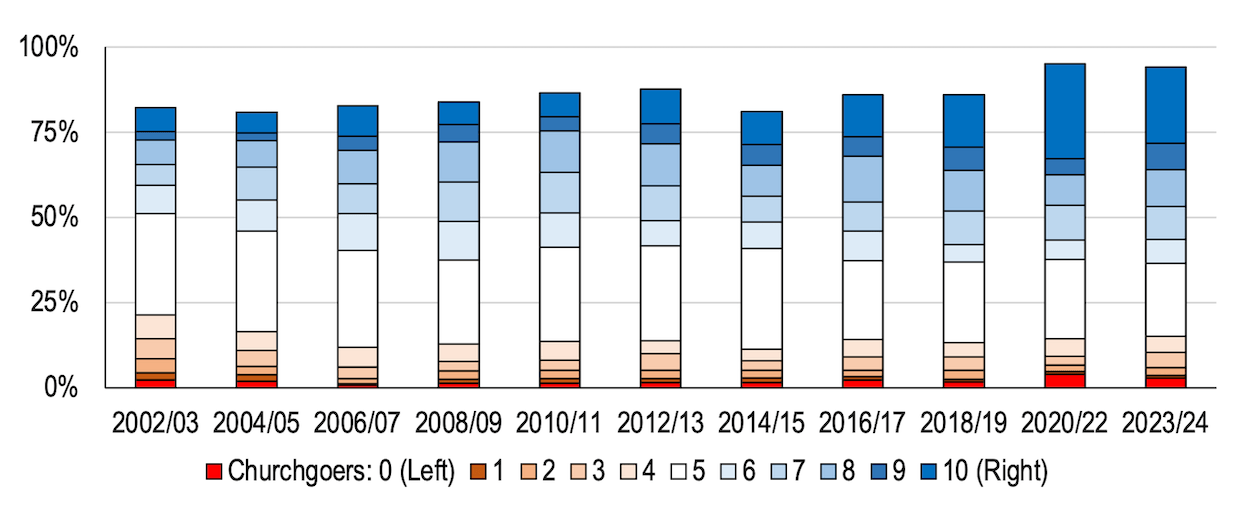
The situation seems to affect the Church as well. Back in the early 2000s, when the Polish conservative Pope John Paul II made statements that were interpreted as endorsing Poland’s accession to the EU, the population of churchgoers included self-declared moderate leftists and rightists, with a firm anchor in the center.
As time went by, the mutually reinforcing processes of polarization (not to say radicalization) and secularization (people voting with their feet) shifted the proportion of right-wingers among churchgoers from 30 to nearly 60 percent. According to the 11th wave of the ESS, right-wing hardliners (i.e., those who place themselves at 10 on the ten-point left-right scale) alone account for one-fifth of churchgoers. The median churchgoer in Poland now places herself at 7 on the ten-point left-right scale. There is evidence of similar processes shaping the clergy as well.
If a right-wing churchgoer demands a firm anti-left and anti-liberal group identity (spiced with a sense of divine truth and centuries-old tradition), she is unlikely to be satisfied by Pope Leo XIV’s visit to Lampedusa. Indeed, at Morawiecki’s grill event, the very first panel discussion—entitled "The Right 2027: How to Win Elections and Widen the Supporter Base"—drifted into a discussion of the Holy See’s teaching on migration, with one participant declaring what he called "Pope-skepticism."
That could be the indication of “post-secularism”, with politicians hand-picking suitable pieces of religious tradition, without particular regard to the religion itself. Alternatively, it could be just a nostalgia to pre-Vatican II Roman Catholic orthodoxy. All the disappointed rightists need to do, is to dust-off the writings of Pope Leo’s XIX-century namesake. In Leo XIII view, humanity is inherently “separated into two diverse and opposite parts, of which the one steadfastly contends for truth and virtue, the other of those things which are contrary to virtue and to truth. The one is the kingdom of God on earth … The other is the kingdom of Satan”.
That could be an indication of "post-secularism," with politicians hand-picking suitable pieces of religious tradition without particular regard for the religion itself. Alternatively, it could be just nostalgia for pre-Vatican II Roman Catholic orthodoxy. All disappointed rightists need to do is dust off the writings of Pope Leo’s nineteenth-century namesake. In Leo XIII’s view, humanity is inherently "separated into two diverse and opposite parts, of which the one steadfastly contends for truth and virtue, the other for those things which are contrary to virtue and to truth. The one is the kingdom of God on earth … The other is the kingdom of Satan."
In political life, the latter insists "that marriage belongs to the genus of commercial contracts, which can rightly be revoked by the will of those who made them … all men have the same right … each one is naturally free … power is held by the command or permission of the people, so that, when the popular will changes, rulers may lawfully be deposed … that the State should be without God; that in the various forms of religion there is no reason why one should have precedence over another … Their chief dogmas are so greatly and manifestly at variance with reason that nothing can be more perverse."

The Polish Exception: Religiosity and Political Right
In this commentary, Dr. Kamil Joński examines why Poland remains an exceptional case in contemporary Europe, where high levels of religiosity continue to overlap with strong right-wing political identification. Drawing on data from the 11th wave of the European Social Survey (ESS), he demonstrates that regular church attendance and conservative political identity increasingly reinforce one another, creating a distinctive “churchgoing right” that shapes both political discourse and the Catholic Church itself. Dr. Joński argues that this convergence helps explain Poland’s restrictive social policies, the enduring influence of the Church on public life, and emerging tensions between Polish conservatives and the post-Vatican II direction of the Holy See. The commentary offers fresh insights into religion, polarization, and democratic politics in Europe.
By Kamil Joński
The breakup of the Polish right-wing Law and Justice (PiS) party has inspired numerous analyses, commentaries, and anecdotes. One of them offers intriguing insight into the uniqueness of the Polish right on the European political landscape. The leader of the new initiative, Development Plus, M. Morawiecki ("Law and Justice" Prime Minister from 2017 to 2023), hosted its July 31, 2026, kick-off as a grill event. Among other preparations, he secured a Roman Catholic bishop’s permission to violate the canon law requirement of abstaining from eating meat on Fridays (the day of the Crucifixion), so that his fellow right-wingers could enjoy grilled sausage. Quite a bizarre touch at the gathering of a self-proclaimed modern and pro-development right, led by a former bank CEO? Only at first glance.
Many Poles Remain Religious…
The data collected during the recent (11th) wave of the European Social Survey (ESS) documents the relatively high religiosity of Poles, with nearly 60 percent of respondents describing themselves as religious ("Regardless of whether you belong to a particular religion, how religious would you say you are?", variable rlgdgr).
…and Maintains Bond with Institutional Church
The theory predicts that "secular transition happens in three steps: first, public ritual participation declines; second, the importance of religion to individuals declines; and third, people shed religious affiliation." In this context, it is even more important that a substantial share of Poles maintains its bond with the institution of the Roman Catholic Church. Despite the post-COVID drop in religious participation, 40 percent of respondents declare regular, weekly participation in religious services ("Apart from special occasions such as weddings and funerals, about how often do you attend religious services nowadays?", variable rlgatnd).
The Right-Wing Is Strong…
At the same time, the Polish political landscape is skewed toward the right, with two out of five respondents placing themselves on the right end of the political spectrum ("In politics, people sometimes talk of ‘left’ and ‘right’. Using this card, where would you place yourself on this scale, where 0 means the left and 10 means the right?", variable lrscale).
… and Overlap Matters
However, the most revealing insight emerges from combining these two dimensions: the bond with the institutional Church, as measured by religious participation, and self-placement on the political spectrum. It turns out that nearly one in four Poles declare both weekly attendance at religious services and right-wing identification.
What makes this situation truly unique on the European political landscape is that this "churchgoing right" constitutes the majority among both churchgoers and right-wingers. In other words, their sensitivities are likely to set the tone for both political rallies and sermons. As a consequence, the Polish throne and the altar remain entangled in ways that are virtually unimaginable elsewhere in contemporary Europe.
The result is, among other things, an extraordinarily restrictive abortion law, a state-enforced de facto blasphemy law (the criminal provision on "offending religious feelings"), and the rejection of same-sex civil unions (not to mention marriages). For the mechanisms of Church influence, see A. Grzymała-Busse (2015), Nations under God: How Churches Use Moral Authority to Influence Policy.
“Post-Secularism” or Anti-Vatican II
The situation seems to affect the Church as well. Back in the early 2000s, when the Polish conservative Pope John Paul II made statements that were interpreted as endorsing Poland’s accession to the EU, the population of churchgoers included self-declared moderate leftists and rightists, with a firm anchor in the center.
As time went by, the mutually reinforcing processes of polarization (not to say radicalization) and secularization (people voting with their feet) shifted the proportion of right-wingers among churchgoers from 30 to nearly 60 percent. According to the 11th wave of the ESS, right-wing hardliners (i.e., those who place themselves at 10 on the ten-point left-right scale) alone account for one-fifth of churchgoers. The median churchgoer in Poland now places herself at 7 on the ten-point left-right scale. There is evidence of similar processes shaping the clergy as well.
If a right-wing churchgoer demands a firm anti-left and anti-liberal group identity (spiced with a sense of divine truth and centuries-old tradition), she is unlikely to be satisfied by Pope Leo XIV’s visit to Lampedusa. Indeed, at Morawiecki’s grill event, the very first panel discussion—entitled "The Right 2027: How to Win Elections and Widen the Supporter Base"—drifted into a discussion of the Holy See’s teaching on migration, with one participant declaring what he called "Pope-skepticism."
That could be the indication of “post-secularism”, with politicians hand-picking suitable pieces of religious tradition, without particular regard to the religion itself. Alternatively, it could be just a nostalgia to pre-Vatican II Roman Catholic orthodoxy. All the disappointed rightists need to do, is to dust-off the writings of Pope Leo’s XIX-century namesake. In Leo XIII view, humanity is inherently “separated into two diverse and opposite parts, of which the one steadfastly contends for truth and virtue, the other of those things which are contrary to virtue and to truth. The one is the kingdom of God on earth … The other is the kingdom of Satan”.
That could be an indication of "post-secularism," with politicians hand-picking suitable pieces of religious tradition without particular regard for the religion itself. Alternatively, it could be just nostalgia for pre-Vatican II Roman Catholic orthodoxy. All disappointed rightists need to do is dust off the writings of Pope Leo’s nineteenth-century namesake. In Leo XIII’s view, humanity is inherently "separated into two diverse and opposite parts, of which the one steadfastly contends for truth and virtue, the other for those things which are contrary to virtue and to truth. The one is the kingdom of God on earth … The other is the kingdom of Satan."
In political life, the latter insists "that marriage belongs to the genus of commercial contracts, which can rightly be revoked by the will of those who made them … all men have the same right … each one is naturally free … power is held by the command or permission of the people, so that, when the popular will changes, rulers may lawfully be deposed … that the State should be without God; that in the various forms of religion there is no reason why one should have precedence over another … Their chief dogmas are so greatly and manifestly at variance with reason that nothing can be more perverse."
Latest News
ECPS Panel on US Midterms: Trumpism, Democratic Resilience, and the Rise of Democratic Socialism
Prof. Sátyro: Bolsonarismo Has Already Become Bigger Than Bolsonaro Himself
Prof. Schlozman: American Voters Are Tired of Trumpism
Who Pays to Adapt? Climate Debt and Populist Politics of Climate Justice in Africa
ECPS Joins TRACE, a New EU-Funded Project on Colonial Legacies and Climate Vulnerability
ECPS Panel on US Midterms: Trumpism, Democratic Resilience, and the Rise of Democratic Socialism
Prof. Sátyro: Bolsonarismo Has Already Become Bigger Than Bolsonaro Himself
Prof. Schlozman: American Voters Are Tired of Trumpism
Category
ECPS Panel on US Midterms: Trumpism, Democratic Resilience, and the Rise of Democratic Socialism
Prof. Sátyro: Bolsonarismo Has Already Become Bigger Than Bolsonaro Himself
Prof. Schlozman: American Voters Are Tired of Trumpism
Who Pays to Adapt? Climate Debt and Populist Politics of Climate Justice in Africa
ECPS Joins TRACE, a New EU-Funded Project on Colonial Legacies and Climate Vulnerability
Dr. Hasanović: Ethnically Defined Power Sharing in Bosnia Is the Algorithm That Continually Reproduces the Crisis