
Please cite as:
Riddervold, Marianne; Rosén, Guri & Greenberg, Jessica R. (2026). Populism and the Future of Transatlantic Relations: Challenges and Policy Options. European Center for Populism Studies (ECPS). January 20, 2026. https://doi.org/10.55271/rp00140
DOWNLOAD REPORT
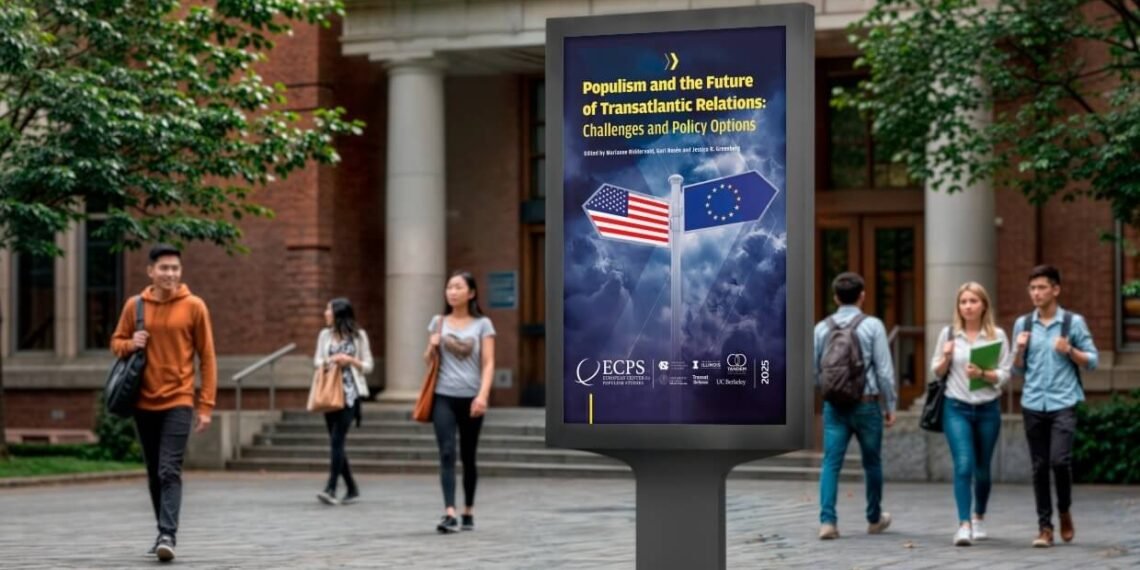
"Populism and the Future of Transatlantic Relations: Challenges and Policy Options" is a comprehensive ECPS report examining how the resurgence of right-wing populism—most notably under Donald Trump’s second presidency—reshapes the foundations of EU–US relations. Bringing together leading scholars, the report analyses the erosion of trust and shared norms across four pillars of the Atlantic order: security, trade, international institutions, and democratic values. It shows how domestic polarisation and illiberal trends now pose deeper, longer-term challenges than traditional diplomatic disputes. Combining theoretical insight with concrete policy recommendations, the volume outlines how the European Union can adapt strategically to a more volatile partner while defending multilateralism, democratic principles, and European strategic autonomy. An essential resource for scholars, policymakers, and practitioners navigating a changing transatlantic landscape.
The report offers a timely and comprehensive examination of how contemporary populism is reshaping one of the most consequential relationships in global politics. Published by the European Center for Populism Studies (ECPS), it brings together leading scholars from both sides of the Atlantic to assess the structural impact of right-wing populism—most visibly under Donald Trump’s second presidency—on EU–US relations.
In this project, ECPS collaborates with the ARENA at the University of Oslo, the European Union Center at the University of Illinois Urbana-Champaign, IES at the University of California, Berkeley, and CES at the University of North Carolina, Chapel Hill. The report is partially funded by the Jean Monnet-TANDEM and Transat-Defence Projects.
Moving beyond episodic diplomatic disputes, the report advances a central argument: the most serious long-term threat to transatlantic cooperation today stems from domestic political transformations. Rising polarisation, illiberal democratic practices, and populist challenges to multilateralism on both sides of the Atlantic increasingly undermine the shared norms and institutional foundations that have sustained the postwar Atlantic order. In this context, transatlantic relations are no longer strained merely by diverging interests, but by a growing clash over values, rules, and the meaning of democracy itself.
Analytically, the report is anchored in a four-pillar framework—security, trade, international institutions, and democratic values—derived from the liberal foundations of the Atlantic political order. Each section combines historical perspective with forward-looking analysis, examining how populist governance affects NATO and European security, rules-based trade and the WTO, multilateral institutions such as the UN and WHO, and the liberal-democratic norms that once underpinned mutual trust. Across these domains, contributors identify patterns of erosion, adaptation, and selective cooperation, highlighting a shift toward a more transactional, fragmented, and unstable relationship. Overall, the EU–US relationship is entering a phase best described as “muddling through”: selective cooperation where interests align, paired with growing divergence elsewhere.
While acknowledging areas of continued collaboration, the authors emphasise that any future stability will depend less on restoring past arrangements than on Europe’s capacity to adapt strategically without abandoning its commitment to multilateralism, democracy, and the rule of law.
The report concludes with detailed, policy-oriented recommendations aimed at EU institutions and member states. These include strengthening European strategic autonomy, reinforcing democratic resilience, investing in defence and industrial capacity, and building new coalitions to sustain global governance in an era of populist disruption. As such, the volume serves not only as an analytical diagnosis of a transatlantic relationship at a crossroads, but also as a practical guide for navigating an increasingly contested international order.
Please see the Introduction, 17 chapters, and Conclusion of the report presented separately below.
Introduction
By Marianne Riddervold, Guri Rosén & Jessica Greenberg
SECTION 1: SECURITY
Chapter 1: Overview and Background: Right-wing Nationalism, Trump and the Future of US-European Relations
By Riccardo Alcaro
Chapter 2: Functional Adaptation without much Love: NATO and the Strains of EU–US Relations
By Monika Sus
Chapter 3: EU-US-China Security Relations
By Reuben Wong
Chapter 4: The Russia-Ukraine War and Transatlantic Relations
By Jost-Henrik Morgenstern-Pomorski & Karolina Pomorska
SECTION 2: TRADE
Chapter 5: Overview and background: Transatlantic Trade from Embedded Liberalism to Competitive Strategic Autonomy
By Erik Jones
Chapter 6: EU-US-China Trade Relations
By Arlo Poletti
Chapter 7: From Trade Skirmishes to Trade War? Transatlantic Trade Relations during the Second Trump Administration
By Alasdair Young
Chapter 8: Transatlantic Trade, the Trump Disruption and the World Trade Organization
By Kent Jones
SECTION 3: INTERNATIONAL INSTITUTIONS
Chapter 9: Overview and Background: International Institutions, Populism and Transatlantic Relations
By Mike Smith
Chapter 10: The United Nations in the Age of American Transactionalism
By Edith Drieskens
Chapter 11: The Trump Administration and Climate Policy: The Effects of Right-wing Populism
By Daniel Fiorino
Chapter 12: Turbulence in the World Health Organization: Implications for EU-United States Cooperation during a Changing International Order
By Frode Veggeland
SECTION 4: DEMOCRATIC VALUES
Chapter 13: Overview and background: Democracy and Populism — The European Case
By Douglas Holmes
Chapter 14: Illiberalism and Democracy: The Populist Challenge to Transatlantic Relations
By Saul Newman
Chapter 15: The Illiberal Bargain on Migration
By Ruben Andersson
Chapter 16: Illiberal international: The Transatlantic Right’s Challenge to Democracy
By Robert Benson
Chapter 17: Vulnerable Groups, Protections and Precarity
By Albena Azmanova
Conclusion: How Should the EU Deal with Changing Transatlantic Relations?
By Marianne Riddervold, Guri Rosén & Jessica Greenberg