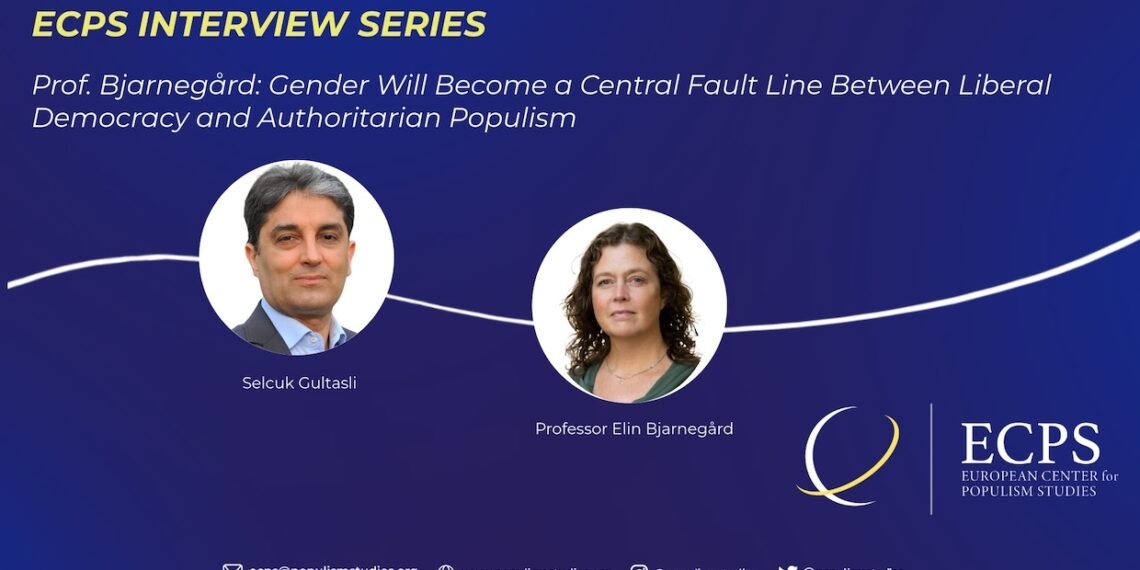
In this ECPS interview, Professor Elin Bjarnegård (Uppsala University) argues that gender is no longer a side issue but “a useful, malleable concept for authoritarian leaders”—and will become “an increasingly central fault line” separating liberal democracy from authoritarian populism. Moving beyond a simple backlash thesis, she shows how regimes alternate between ‘genderbashing’ and ‘genderwashing’, weaponizing equality talk for legitimacy at home and abroad. Professor Bjarnegård also links democratic backsliding to gendered intimidation, online harassment, and what she calls “sexual corruption.” Noting that the Epstein files revealed abuses “in the corridors of power” in democratic settings too, she warns that personalistic rule heightens risk—especially the “impunity surrounding them.” She urges resisting polarization, scrutinizing symbols, and asking where gender concretely matters in policy.
Interview by Selcuk Gultasli
In an era marked by democratic erosion and the global rise of authoritarian populism, gender politics has emerged not merely as a cultural battleground but as a strategic axis of regime competition. In this interview with the European Center for Populism Studies (ECPS), Professor Elin Bjarnegård of Uppsala University argues that gender will increasingly function as a defining fault line separating liberal democratic governance from authoritarian populist rule. Moving beyond conventional explanations that frame anti-gender politics primarily as ideological backlash, Professor Bjarnegård emphasizes the instrumentalization of gender as a tool of political survival, legitimacy, and international signaling. As she explains, “gender becomes a useful, malleable concept for authoritarian leaders—a powerful symbol that can be mobilized for regime purposes,” underscoring how strategic deployment rather than doctrinal conviction often drives contemporary gender politics.
This strategic perspective helps explain why gender rights are likely to intensify as a central arena of geopolitical and normative contestation. Professor Bjarnegård anticipates that “gender rights, or perhaps the strategic use of gender, will become an increasingly central fault line,” not only because of ideological polarization but also because gender provides an “easy, simplistic narrative to deploy strategically” in polarized societies. Such narratives enable regimes to oscillate between exclusionary rhetoric and symbolic inclusion, reinforcing domestic authority while communicating selectively with international audiences.
The interview also highlights the darker governance implications of weakened accountability in populist and authoritarian systems, particularly regarding gendered abuses of power. Drawing on her concept of “sexual corruption,” Professor Bjarnegård reframes such abuses as systemic governance failures rather than isolated misconduct. Referencing the recent release of the Epstein files, she cautions against simplistic regime-type explanations, noting that “these gendered abuses of authority have also proliferated in the corridors of power in predominantly democratic contexts in Europe and the United States.” Yet she stresses that personalistic rule and eroded oversight create heightened risks in authoritarian settings, where such systems are “more at risk both of experiencing these gendered abuses and, perhaps especially, of the impunity surrounding them—of people not reporting them, of them remaining unseen, and of not being addressed.” This dynamic speaks directly to the broader vulnerability of populist authoritarian governance to gendered exploitation and unaccountable power.
More broadly, Professor Bjarnegård situates these patterns within a continuum of gendered violence that includes psychological intimidation, reputational attacks, and digitally mediated harassment—forms of coercion that undermine democratic participation without overt repression. Taken together, her analysis suggests that gender politics is becoming a diagnostic lens through which scholars can assess democratic resilience, institutional integrity, and the trajectory of global political competition. The interview thus positions gender not as a peripheral social issue but as a central structural dimension of contemporary struggles between liberal democracy and authoritarian populism.