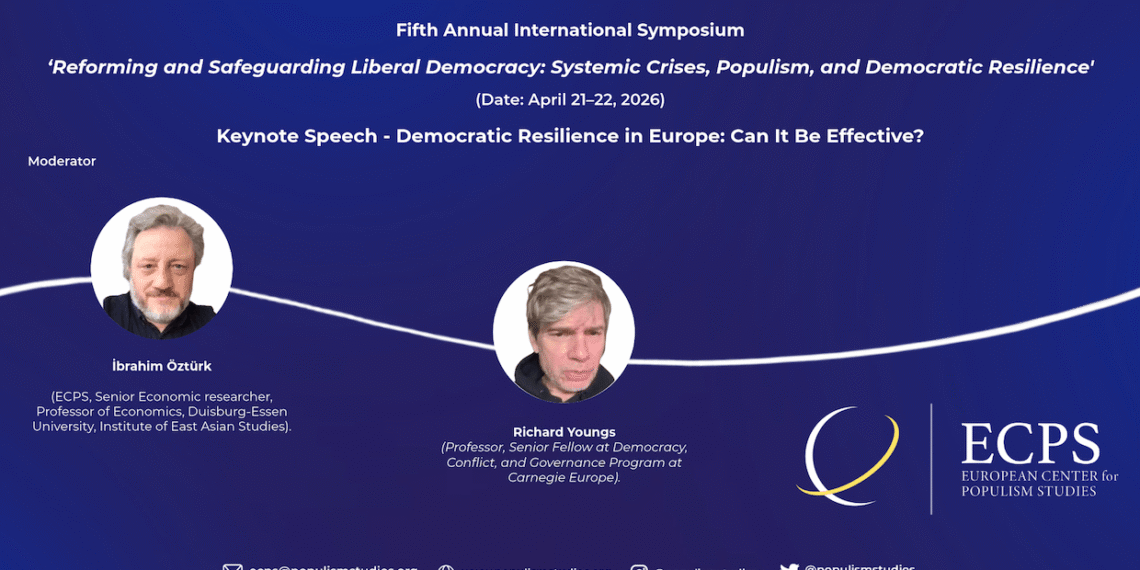
Professor Richard Youngs’ keynote examined the European Union’s evolving response to democratic backsliding, populism, and institutional fragility. Professor Youngs argued that the EU has developed important tools—including the Democracy Shield, digital regulation, rule-of-law conditionality, civil society funding, and participatory mechanisms—but that its approach remains uneven and incomplete. He emphasized that democratic resilience must address not only external threats such as disinformation and foreign interference, but also internal dysfunctions, including weakened civic space, far-right normalization, migration politics, and democratic recovery after state capture. The ensuing discussion underscored the need for a more coherent and holistic EU strategy that effectively connects institutional reform, grassroots mobilization, and long-term democratic renewal across member states.
Reported by ECPS Staff
The keynote session on the second day of the Fifth Annual International Symposium, “Reforming and Safeguarding Liberal Democracy: Systemic Crises, Populism, and Democratic Resilience,” featured Professor Richard Youngs, Senior Fellow in the Democracy, Conflict, and Governance Program at Carnegie Europe and leader of the European Democracy Hub. In his keynote, “Democratic Resilience in Europe: Can It Be Effective?” Professor Youngs offered a focused and policy-oriented assessment of the European Union’s evolving efforts to respond to democratic malaise, backsliding, and the broader challenge of democratic renewal.
Moderated by Professor İbrahim Öztürk, the session situated Professor Youngs’ analysis within the symposium’s wider debates on democratic vulnerability, populism, and institutional resilience. Professor Öztürk guided the discussion by opening the floor to critical questions and reflections, enabling participants to connect the keynote’s policy analysis to pressing concerns over civic freedoms, migration, far-right influence, transatlantic lesson-learning, and democratic recovery after autocratization.
Professor Youngs argued that EU democratic resilience policy has advanced considerably in recent years, especially through initiatives such as the Democracy Shield, the Centre for Democratic Resilience, digital regulation, rule-of-law conditionality, civil society funding, and participatory mechanisms. Yet his assessment remained deliberately balanced: while the EU has become more active, its approach remains partial, uneven, and marked by significant blind spots. It has been strongest in addressing online disinformation, foreign interference, and formal rule-of-law concerns, but weaker in supporting bottom-up democratic mobilization, developing systematic strategies for democratic recovery, confronting internal democratic dysfunctions, and reforming the EU’s own institutional architecture.
The discussion following the keynote extended these themes into politically sensitive terrain. Participants raised questions about Europe-wide restrictions on pro-Palestinian activism, the mainstreaming of far-right influence in migration and climate policy, the erosion of the cordon sanitaire, and the relevance of Polish and Hungarian experiences for democratic recovery. Professor Youngs emphasized that Europe’s democratic resilience challenge is not only external but deeply internal, involving unresolved tensions over civic rights, identity conflicts, policy accommodation, and institutional credibility. Taken together, the keynote and discussion provided a nuanced account of both the promise and the limits of the EU’s emerging democratic resilience agenda.