The third panel of the ECPS Fifth Annual International Symposium examined how authoritarian populism becomes normalized across institutions, media ecosystems, and political identities. Bringing together perspectives from political science, media studies, and political theory, the session highlighted the interplay between executive overreach, institutional erosion, and algorithmically amplified communication. Contributions by Professor Larry Diamond and Professor Bruce Cain underscored the dynamics of democratic backsliding and “autocratic drift” within the United States, while Assoc. Prof. Ibrahim Al-Marashi demonstrated how AI-driven media and “slopaganda” reshape populist mobilization in a hyperreal digital environment. Concluding the panel, Professor Tariq Modood proposed multicultural nationalism as a unifying alternative to exclusionary populism. Collectively, the panel offered a multidimensional framework for understanding and resisting contemporary authoritarian trajectories.
Reported by ECPS Staff
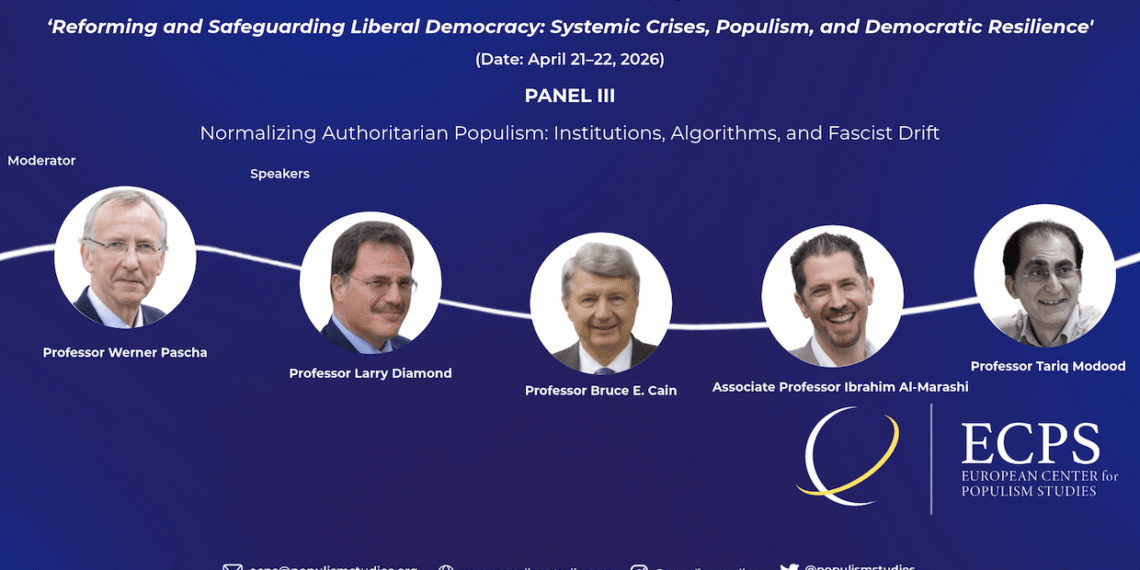
Third Panel of the ECPS Fifth Annual International Symposium, “Reforming and Safeguarding Liberal Democracy: Systemic Crises, Populism, and Democratic Resilience,” convened under the title “Normalizing Authoritarian Populism: Institutions, Algorithms, and Fascist Drift.” Moderated by Professor Werner Pascha, Emeritus Professor of Economics at Duisburg-Essen University and affiliated with the Institute of East Asian Studies (IN-EAST), the panel examined how authoritarian populism becomes normalized through institutional weakening, executive overreach, media transformation, algorithmic amplification, and exclusionary forms of nationalism.
Professor Pascha guided the session as a moderator attentive to both institutional and conceptual linkages. His role was especially important in bringing together the panel’s diverse disciplinary perspectives—from comparative democratization and American political institutions to media studies, war narratives, and multicultural political theory—into a coherent discussion on the contemporary vulnerabilities of liberal democracy.
The panel opened with Professor Larry Diamond, William L. Clayton Senior Fellow at the Hoover Institution, Mosbacher Senior Fellow in Global Democracy at Stanford’s Freeman Spogli Institute, and Bass University Fellow. In his presentation, “The Arc of Authoritarian Populism in the US under Donald Trump, How Far It Has Progressed, and the Prospects of Reversing It,” Professor Diamond assessed the trajectory of authoritarian populism in the United States, drawing on V-Dem indicators and comparative lessons from Hungary, Poland, and Turkey. He emphasized electoral manipulation, corruption, attacks on institutions, and the importance of broad democratic mobilization.
The second speaker, Professor Bruce Cain, Professor of Political Science at Stanford University and Director of the Bill Lane Center, presented “The Institutional Enablement of American Populism.” Professor Cain offered a measured analysis of autocratic drift in the United States, distinguishing between rule-of-law erosion and longer-term shifts in America’s federalized institutional structure. His remarks highlighted executive power, emergency authority, judicial interpretation, federalism, and the political economy of democratic resilience.
The third presentation, “Algorithmic Populism in the Age of the Deep-Fake,” was delivered by Assoc. Prof. Ibrahim Al-Marashi, Associate Professor at The American College of the Mediterranean and the Department of International Relations at Central European University. Assoc. Prof. Al-Marashi explored how AI-generated media, memes, “slopaganda,” and hyperreal digital narratives reshape war, propaganda, and populist communication.
The final speaker, Professor Tariq Modood, Professor of Sociology, Politics and Public Policy at the University of Bristol, presented “From Populist Capture to Democratic Belonging: Multicultural Nationalism as an Alternative to Exclusionary Nationalism.” Professor Modood proposed multicultural nationalism as a constructive response to exclusionary populism, seeking to integrate majority anxieties and minority vulnerabilities within a shared framework of equal citizenship and belonging.
Together, the panel offered a rich interdisciplinary account of how authoritarian populism is institutionalized, mediated, normalized, and potentially resisted.