Professor Quinn Slobodian, Professor of International History at Boston University and one of the leading scholars of neoliberalism and the contemporary far right, argues that “Muskism” represents a profound transformation in the relationship between capitalism, technology, and democracy. In an interview with the ECPS, Professor Slobodian contends that Elon Musk embodies a new political-economic order grounded not in liberal individualism but in “a cybernetic understanding of human society” shaped by digital networks, AI, and technocratic management. According to Professor Slobodian, Musk no longer treats democracy as a meaningful political ideal: “For Musk, democracy almost appears to be yesterday’s problem.” The interview explores neoliberalism, authoritarianism, Silicon Valley’s “state symbiosis,” digital sovereignty, and the growing convergence between platform capitalism and far-right populism.
Interview by Selcuk Gultasli
Giving an interview to the European Center for Populism Studies (ECPS), Professor Quinn Slobodian, Professor of International History at Boston University, argues that “Muskism” marks a profound shift in the relationship between capitalism, technology, and democracy. In his view, Elon Musk should not be understood merely as an eccentric billionaire, but as the embodiment of a new political-economic formation built on the infrastructures of platform capitalism, artificial intelligence, military technology, and state dependency.
For Professor Slobodian, Muskism cannot be separated from neoliberalism. “It’s impossible to understand how we arrive at Muskism without considering the effects of neoliberalism,” he explains. Decades of neoliberal policy helped create the conditions under which private actors could assume functions once performed by public institutions. Yet Muskism also departs from classical neoliberalism. Rather than beginning with “consumer sovereignty” or “individual freedom,” it rests on “a kind of cybernetic understanding of human society,” imagining society as “a networked totality that must be engineered and managed to produce optimized outcomes.”
This is where the headline of the interview becomes central. According to Professor Slobodian, Muskism radicalizes neoliberal efforts to constrain democracy, but goes further by treating democracy as increasingly obsolete. While earlier neoliberal thinkers such as Friedrich Hayek and Milton Friedman remained deeply concerned with democracy as a social force, Musk, he argues, does not even “offer lip service to traditional political ideas such as civil society, deliberation, or representation.” For Musk, these concepts belong to “an outdated era of social and political life” supposedly surpassed by “technological acceleration, digital connectivity, and new forms of mediated decision-making.” As Professor Slobodian puts it starkly: “For Musk, democracy almost appears to be yesterday’s problem.”
The interview also explores Professor Slobodian’s concept of “state symbiosis.” Contrary to the familiar image of Silicon Valley elites as anti-state libertarians, he argues that today’s tech oligarchs increasingly seek not to escape the state but to merge with it. Muskism, in this sense, is not about “withering away the state,” but about selling “sovereignty as a service”—from orbital launches and satellite connectivity to AI tools for state administration.
Professor Slobodian further warns that Muskism represents “a radical departure from the liberal tradition,” replacing ideas of human dignity, agency, and representation with optimization, efficiency, and programmable social systems. At the same time, he situates Muskism within broader far-right and populist transformations, arguing that many contemporary right-wing movements are not simply anti-neoliberal reactions, but “the bastard offspring of neoliberalism itself.”
Here is the edited version of our interview with Professor Quinn Slobodian, revised slightly for clarity and flow.
Muskism Begins with the Network, Not the Individual
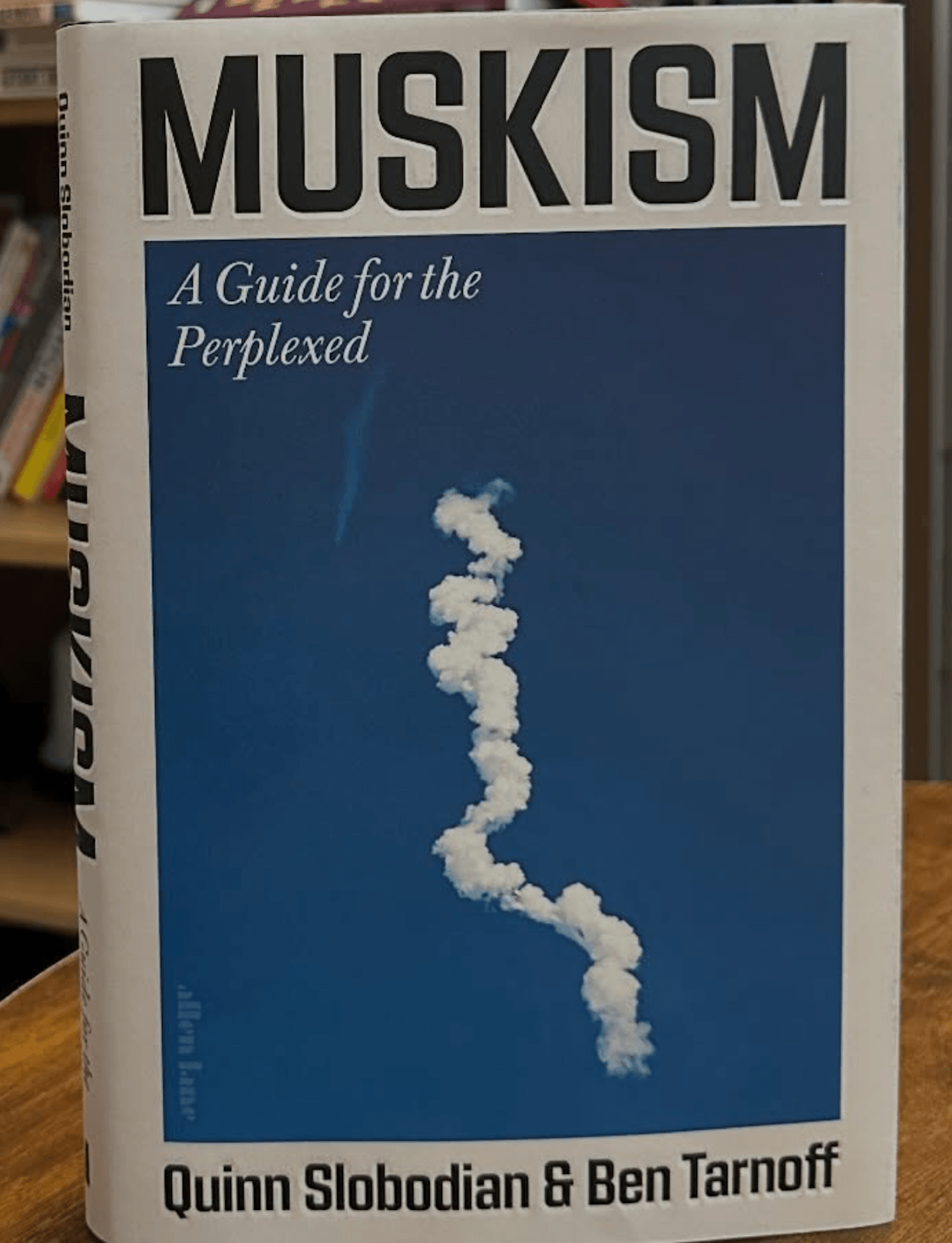
Professor Slobodian, welcome. In Muskism, you conceptualize Elon Musk less as an individual eccentricity than as the embodiment of an emerging political-economic order. To what extent do you see “Muskism” as a successor to neoliberalism, and to what extent is it better understood as neoliberalism mutating into a post-democratic or neo-feudal formation?
Professor Quinn Slobodian: It’s impossible to understand how we arrive at Muskism without considering the effects of neoliberalism. The basic idea that private actors can perform functions previously carried out by states better than public institutions can is really the premise on which Musk gains his initial foothold in both government and markets. A clear example is SpaceX, which got its start in 2002 through major contracts with the Pentagon and the Department of Defense.
The extent to which power has been transferred to business leaders like Musk is itself a symptom of neoliberalism. What we find distinctive about Muskism, however—and what differentiates it from neoliberalism—is partly the way it justifies itself. Rather than appealing to the language of consumer sovereignty or even individual freedom, Muskism—and this is shared more broadly among his cohort of tech leaders—rests on a kind of cybernetic understanding of human society and even of the relationship between the state and business.
Instead of viewing government as an institution that creates the conditions for individual free-market decision-making, which is the traditional neoliberal position, the Musk approach imagines society as a networked totality that must be engineered and managed to produce optimized outcomes.
So, rather than beginning with the individual, as neoliberalism ultimately does, Muskism begins at the level of the network—and that network is always already digital, a computerized world. In that sense, it feels quite different from the animating ideas of the neoliberal era, even if the extraordinarily concentrated wealth and power of someone like Musk could only emerge after decades of neoliberal policy.
Musk Treats Democracy as Something to Be Hacked
Your work repeatedly emphasizes the “encasement” of markets from democratic interference. Do contemporary tech oligarchs represent a new phase of this neoliberal project—one in which democracy is no longer merely constrained institutionally but rendered technologically obsolete through algorithmic governance and AI-driven administration?
Professor Quinn Slobodian: It does radicalize the trends that I and others have emphasized in the past when talking about neoliberalism, in the sense that it, like neoliberalism, is concerned with constraining the space for citizen input and citizen action to ensure that outcomes align with a preconceived idea of how law and policy should function.
In Globalists and other works, I and others have discussed how the creation of counter-majoritarian institutions and forms of international economic law that sit above the decision-making power of sovereign governments serve to guarantee market outcomes, even in the face of hesitation or resistance from populations. So, there was always this tension between protecting capitalism and respecting democracy. At times, democracy itself seemed to have to be partially suspended in order to secure the kind of capitalist outcomes policymakers wanted. The difference with Musk and Muskism is that there is far less serious consideration of the legitimacy of democracy altogether.
Even thinkers like Friedrich Hayek or Milton Friedman—or, at the more radical end, figures such as Murray Rothbard and the anarcho-capitalist tradition—however wary they were of democracy, majoritarianism, or populism, still understood democracy as something they had to contend with. There was, in a sense, a kind of respect for the social force democracy represented and for the symbolic value it held for ordinary people. What is extraordinary about someone like Elon Musk is that he does not even offer lip service to traditional political ideas such as civil society, deliberation, or representation. These concepts seem to him to belong to an outdated era of social and political life that has been transcended by technological acceleration, digital connectivity, and new forms of mediated decision-making.
So, democracy is no longer even something to be worried about in the way Hayek, for example, was endlessly preoccupied with it. For Musk, democracy almost appears to be yesterday’s problem. The technocratic engineering mentality he brings into politics treats democracy as just another technical issue to be hacked and aligned with one’s own interests.
This also applies to his relationship with the European far right—to perhaps anticipate a question you might ask—because the conventional journalistic interpretation of his ties to figures such as Alice Weidel, Tommy Robinson, or far-right actors in Poland and elsewhere is that they reflect ideological sympathy or a shared commitment to anti-immigrant politics or even white supremacist ideas. But I do not think that is the most accurate way to understand it. I think Musk sees far-right parties in highly functional terms. He views them as the parties of the future, destined to replace the legacy formations of social democracy, Christian democracy, and political centrism.
From that perspective, it makes sense for him to align himself with what he sees as the future engines of European politics—not out of any principled commitment to self-determination or popular sovereignty, but because such alliances are more functional for his business interests.
This very thin understanding of politics—one that treats politics memetically and as a series of engineering problems—is difficult for many people to grasp because we still instinctively assume that popular sovereignty remains an important political force. What is striking about Musk is that he no longer seems to believe it even requires attention.
Silicon Valley No Longer Wants to Escape the State
You argue that Silicon Valley elites are not anti-state libertarians but proponents of “state symbiosis.” How does this alter conventional understandings of authoritarianism? Are we witnessing the emergence of a privatized authoritarianism in which sovereignty is increasingly outsourced to platform monopolies?
Professor Quinn Slobodian: One of our main goals with the book was to reshape the conversation around Silicon Valley ideology. It has become quite common to describe Silicon Valley leaders as libertarians, and at one point that may indeed have been a reasonably accurate characterization. But that is far less true today.
One important thing to recognize is that digital capitalism has now existed for several decades, and Silicon Valley’s business model has changed dramatically since the mid-1990s, when internet infrastructure was first handed over to private interests. There have essentially been three distinct phases during this period, and the politics associated with Silicon Valley have largely reflected the dominant economic model of each phase.
At the dawn of the internet in the late 1990s, it was still possible to imagine the web as a genuinely de-territorialized space existing outside the boundaries of any single nation-state, enabling radical new forms of interaction, value creation, and community. That vision had a certain plausibility. It also aligned with clear business interests, since companies were attempting to build a parallel digital world of retail and payments. So, when Peter Thiel in the 1990s declared, “I’m a libertarian, and what I’m trying to do at PayPal is create stateless money,” that framing was not entirely implausible. It was a reasonable way to understand what was emerging at the time.
Roughly a decade later, after the dot-com boom and bust, the dominant model became Web 2.0: social media, platforms, apps, Uber, Facebook, Twitter, and so forth. These businesses were largely asset-light. They required relatively little capital expenditure and functioned primarily by creating open digital spaces in which users generated data that could then be monetized through advertising.
Even during that period, Silicon Valley ideology did not need to engage very seriously with the state. These companies portrayed themselves as building a parallel world of socialization and commerce that required little from government beyond permission to continue operating and generating profits.
What changes in the present moment is the rise of generative AI and the renewed focus on hard-tech industries. Just today, for example, there was a report about Anduril—the defense startup focused on drones, missiles, and military logistics—which doubled its valuation over the last year from $30 billion to $60 billion.
Musk now increasingly sees the state itself as his market: selling orbital launches to governments, selling satellites—or access to satellites—for battlefield operations and rural connectivity, and selling XAI chatbot software for government administration. This shift toward military technology and generative AI has fundamentally altered Silicon Valley’s relationship with government, and with it, its political philosophy. It no longer makes much sense to call yourself a libertarian when the government is your primary customer. Nor does libertarianism fit a situation in which companies rely on government to open federal lands for drilling, rewrite regulations, and guarantee preferred access to contracts. The fusion between state and private actors has become impossible to ignore.
At the same time, I do not think it is convincing to interpret all of this simply as the hollowing out or withering away of the state. You asked whether this represents the privatization of sovereignty away from government. We would describe it instead as “sovereignty as a service.” Certain state functions are privatized, but this process simultaneously expands state capacity. Access to low-Earth orbit, for example, or to integrated bureaucratic databases that can be queried across agencies in previously impossible ways—these developments do not diminish state power; they increase it.
Muskism Is About Becoming Part of the State
For that reason, it is important to understand Musk and Muskism as more than simple forms of rentierism or crony capitalism. Personally, I think terms such as “techno-feudalism” can be misleading because they suggest a backward or regressive form of capitalism in which private actors merely carve out digital fiefdoms and extract rents from dependent populations. That does not really capture what is happening. Countries such as China, Russia, and the United States are, in many respects, becoming more centrally powerful through access to the products and services developed by tech companies. At the same time, however, they are becoming increasingly dependent on those same companies.
This is why the balance of what we call “symbiosis” is so precarious and requires careful attention. It can easily tip into parasitism if the relationship becomes too unbalanced. Conversely, private firms may defect if they feel excessively pressured by their state clients.
We have seen examples of this dynamic even in recent months. The Department of Defense and Pete Hegseth’s staff suddenly declared Anthropic to be a supply-chain risk and sought to remove its software from government systems. Initially, this looked like an assertion of state authority over the private sector. But almost immediately, two things happened: courts ruled against the decision, and other tech firms rallied behind Anthropic, effectively saying, “We do not want to be subjected to arbitrary state decision-making, and we also want collective influence over how our products are used.”
So, what we are seeing is a partnership, an alliance, a fusion—however one chooses to describe it. But it is no longer the libertarian fantasy historically associated with Silicon Valley: escaping the state, building private cities, or founding sovereign communities on decommissioned oil rigs in Honduras. That may have been a plausible understanding of Silicon Valley in 2000, or perhaps even in 2009. But by 2026, the dynamic is much more about becoming part of the state than escaping it.
Tech CEOs Are Not Sovereigns
In your discussion of “sovereignty as a service,” firms such as SpaceX, Palantir, and Starlink appear not simply as contractors but as infrastructural sovereigns. Does this imply a transformation of the Weberian state itself—from a monopoly of legitimate violence to a dependency network mediated by corporate platforms?
Professor Quinn Slobodian: I think we are deliberately stopping short of that argument because we are not saying that Musk, Zuckerberg, and Bezos are sovereigns. They are not.
What is interesting about the DOGE moment we discuss in the final chapter of the book is that it serves as a revealing test case of how far a tech CEO can govern directly in practice. How far can that line actually be pushed? Can the tech lord effectively become the formal national government? What we saw was that Musk was actually quite bad at it. He not only failed to achieve the goals he had set for himself in terms of reducing state costs, but he also failed to secure legitimacy from the American public at a very basic level. His popularity plummeted during his time in Washington, and he did not emerge as a sovereign figure, as it were.
So, to us, the division of labor between traditional governments and tech firms remains essential. Governments still perform the old-fashioned functions of securing consent and legitimacy, and that remains a necessary condition for the expansion of tech leaders’ power. They do not need to govern directly, nor do they need to seize sovereignty for themselves. Contracting out sovereignty—what we describe as selling “subscription sovereignty,” as it were—is not the same thing as actually being sovereign. Those are distinct categories, and it is important to keep them separate.
Some of the more exaggerated alarm bells surrounding tech power too quickly jump to the conclusion that these figures have become new emperors or kings. But they have not. Nor do they necessarily want to be. What is interesting, of course, is that Musk has called himself “Technoking” at Tesla since 2021 rather than CEO. But in practical terms, these people are not especially good at governing. While governments increasingly outsource certain capacities to tech lords, the tech lords, in turn, outsource governing back to states. So far, that arrangement appears relatively stable and not easily disrupted in any fundamental way.
At the same time, what is fascinating about the present moment is that the disruptive effects of generative AI are creating such intense public attention around new technologies that figures like Dario Amodei and Sam Altman increasingly feel compelled to address populations in quasi-political or quasi-governmental terms. They now say things like, “We have a constitution for our AI,” or “Here is our vision for a public wealth fund,” or “Here is our proposal for fiscal policy.” In that sense, they are increasingly treated as though they are co-governing alongside agencies in Washington, D.C. But practically speaking, I still think there remains at least a horizontal relationship—and perhaps even a slight subordination—of these companies to the state itself.
Musk May Have Overplayed His Hand in Europe
Much contemporary scholarship frames democratic backsliding as a crisis driven by populist leaders and illiberal parties. Your analysis suggests that technological infrastructures and billionaire networks may be equally central. Should we rethink democratic erosion less as a purely political phenomenon and more as a reconfiguration of political economy?
Professor Quinn Slobodian: The relationship between Silicon Valley and the far right in Europe is a particularly fascinating one. It also provides another revealing example of the delicate balance between Silicon Valley and existing political parties over the question of who actually governs. In late 2024, when Musk was investing his money and political capital in Trump’s election campaign, he seemed to believe that he could replicate that success almost universally. For a moment, at least, he appeared to think he had acquired a kind of political superpower—the ability to make virtually anyone electorally viable in any political environment. For several months, he attempted to use this supposed superpower to transform even relatively fringe candidates across Europe into credible political figures.
What we have seen since then, however, is that it does not work like a superpower at all. In many cases, it is actually counterproductive. A number of these right-wing parties have built their legitimacy around the language of sovereignty, and they are often damaged when they become too closely associated with an American tech billionaire. Interestingly, some of the transnational support figures like Musk have extended to right-wing populist parties in Europe has actually undermined rather than strengthened their credibility.
The positive side of this development is that it shifts public debate away from purely symbolic issues—or highly distorted narratives about immigration and demographics—and toward questions of political economy, exactly as you suggest.
Europe’s dependence on American-produced technologies is becoming increasingly difficult to ignore. This creates a genuine opening for center-left and centrist parties in Europe. If they can demonstrate that they are capable of securing genuine digital sovereignty and data sovereignty vis-à-vis Silicon Valley, that could significantly strengthen their credibility among voters as forces capable of delivering national autonomy, strategic capacity, and political strength. In that sense, the past year has revealed that the Silicon Valley leadership class may, in some respects, have overplayed its hand and unintentionally produced a kind of boomerang effect. As people become more aware of the disruptive consequences of new technologies and of the dependencies created by a small number of tech firms, they are beginning to ask whether alternative arrangements might be possible. Increasingly, it appears that creating substitutes or alternatives to things like Starlink, SpaceX, or X.com is ultimately a matter of political will. None of these systems are inevitable.
We are already beginning to see this shift. France has started moving away from Microsoft products, Denmark is pursuing similar policies, and there is growing interest in Eutelsat as a European low-Earth-orbit alternative to Musk’s satellite infrastructure. These are genuinely praiseworthy developments. They may also provide a more material foundation for thinking about European identity and strategic autonomy in ways that could ultimately weaken some of the messaging power of right-wing populist parties.
Optimization Replaces Individual Freedom in Muskism
To what extent is Muskism compatible with liberalism at all? Is it best understood as an illiberal variant of neoliberalism, or does it represent a more radical break with liberal constitutional traditions altogether?
Professor Quinn Slobodian: Muskism has very little to do with the liberal tradition. In fact, it represents a much more radical break with the broader trajectory of Western political thought stretching from John Locke to the present. Because it is fundamentally a technologically determinist philosophy. It takes the functioning of network technologies—especially computers—as a kind of model for how society itself should be organized and managed. In doing so, central liberal categories such as the dignity of the individual, or the value of human agency and individuality, cease to function as foundational principles. They are displaced by concerns with optimization and efficiency.
In some respects, the closest intellectual tradition it resembles is utilitarianism, insofar as it evaluates social interventions primarily according to outcomes, regardless of their effects on individual freedoms or other normative principles. But because this worldview is fundamentally mediated through the logic of the computer, it also dehumanizes politics. Belief systems become reducible to systems of replicable memes—or, as Musk himself calls them, “mind viruses.” This framework assumes that people do not possess genuine convictions or socially rooted beliefs but instead function as programmable and reprogrammable units of information. Those informational units can either be modified arbitrarily by someone with sufficient coding power or removed from the system altogether, as we saw in Musk’s projects at Twitter and DOGE.
So, in that sense, I do think Muskism represents a radical departure from the liberal tradition. And that is precisely what makes it—while still very much a system that produces inequality and concentrates private power—operate according to fundamentally different premises from the neoliberalism of the last several decades to which we have otherwise become accustomed.
The Far Right Is the Bastard Offspring of Neoliberalism
In your recent writings, you argue that many contemporary far right-populist formations are not anti-neoliberal but “the bastard offspring of neoliberalism itself.” How does this insight complicate dominant narratives that treat populism simply as a backlash against globalization?
Professor Quinn Slobodian: This line of inquiry emerged for me during the period from roughly 2008 to 2018, when the rise of right-wing backlash parties—especially the Alternative for Germany (AfD), but also the Tea Party in the United States and eventually the MAGA movement—was frequently described as a rejection of neoliberalism. What fascinated me was that many of the people deeply involved in these movements actually came out of the libertarian tradition and, in some cases, directly from the think tanks most closely associated with neoliberal policy formation—the Heritage Foundation in the United States, the Institute of Economic Affairs in Britain, and similar institutions.
What I discovered was the rather surprising fact that, after the end of the Cold War, many neoliberals did not believe they had definitively won. Instead, they identified new enemies and new forms of opposition, particularly environmentalism, feminism, and anti-racism. As a result, they began forming alliances with people for whom those issues were primary concerns. Suddenly, individuals primarily committed to economic freedom found themselves working closely with people primarily motivated by racial purity or national chauvinism.
In the United States, this coalition became known as the Paleo Alliance. These were actors who rejected the post-Cold War consensus around democracy promotion and strongly opposed the compromises that had emerged between civil rights movements and the American legal order—affirmative action, workplace harassment laws, and similar reforms. Many neoliberals came to view these developments as a new “road to serfdom,” and therefore believed they needed to push back and seek allies wherever they could find them.
The AfD is, in many ways, a particularly clear example of this dynamic because it effectively united neoliberal economists with Islamophobic right-wing German nationalists. They were bound together by a shared hostility toward the European Union—both because they believed it undermined German monetary sovereignty and because they felt it weakened sovereign control over borders.
What emerged, then, were these unusual alliances between actors motivated primarily by economic concerns and others driven by cultural or even racial anxieties. If you examine many of the parties associated with Europe’s right-wing backlash, you find that a significant number emerged from precisely this fusion moment of the 1990s and early 2000s.
The same pattern was visible in the United States. If you look at Trump’s economic advisers during his first term, figures such as Arthur Laffer stand out. Laffer had literally advised Reagan on tax cuts in the early 1980s and then returned decades later to help design Trump’s tax cuts.
So, the mainstream narrative—which often portrayed a sharp rupture between an earlier era of market-friendly globalism and a new era of nationalist anti-neoliberalism—missed something important. The political actors themselves often remained the same. What changed was not their entire political worldview, but rather their preferred mode of organizing capitalism.