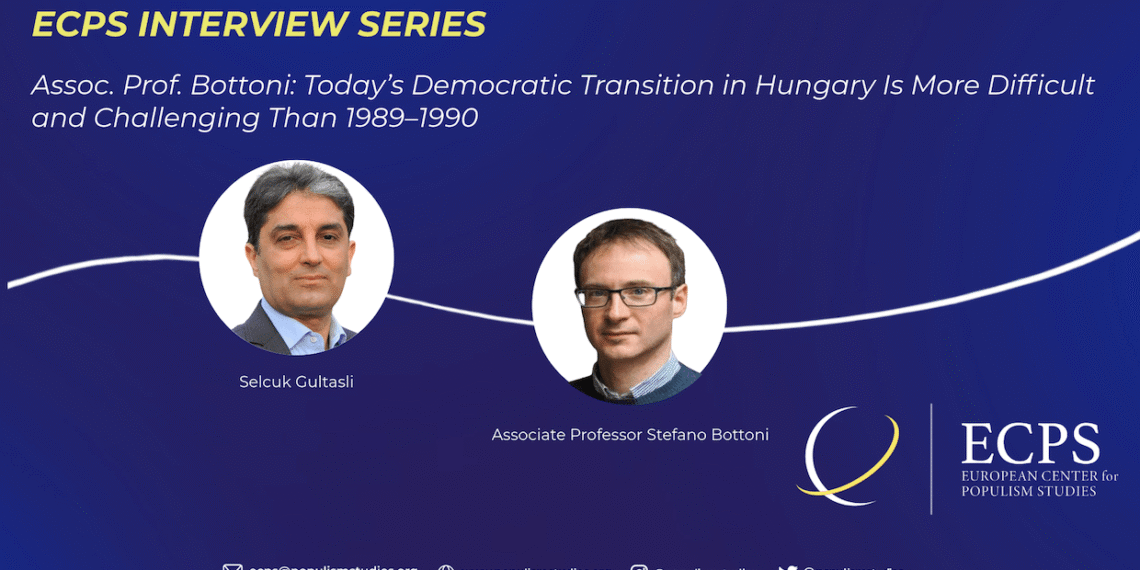
In this ECPS interview, Associate Professor Stefano Bottoni offers a compelling assessment of Hungary’s post-Orbán transition and the formidable challenges of democratic reconstruction after sixteen years of institutional capture and democratic backsliding. Rejecting simplistic notions of democratic restoration, Assoc. Prof. Bottoni argues that Hungary is not merely returning to a previous democratic order but attempting to “invent a new democracy for the twenty-first century.” Reflecting on European reintegration, anti-corruption efforts, institutional reform, civic education, and political culture, he contends that democracy cannot be rebuilt through legal changes alone. Instead, lasting democratic consolidation requires the cultivation of democratic citizens, the restoration of public accountability, and the creation of a new civic patriotism that reconciles national identity with European belonging.
Interview by Selcuk Gultasli
The electoral defeat of Viktor Orbán and Fidesz in Hungary’s April 12, 2026 election has triggered one of the most consequential political transitions in contemporary Europe. After sixteen years of increasingly centralized rule, democratic backsliding, institutional capture, and persistent conflict with the European Union, the rise of Prime Minister Péter Magyar has generated renewed debate about democratic restoration, post-populist governance, and the prospects for rebuilding liberal-democratic institutions. Yet, as scholars of democratization have long emphasized, the removal of an incumbent regime marks only the beginning of a transition rather than its successful completion.
In this wide-ranging interview with the European Center for Populism Studies (ECPS), Associate Professor Stefano Bottoni of the University of Florence—one of the foremost historians of contemporary Hungary and author of the forthcoming book The Orbán Enigma—offers a deeply historical assessment of Hungary’s uncertain democratic future. Drawing on his extensive scholarship on authoritarianism, nationalism, post-communist transformation, and democratic backsliding in Central and Eastern Europe, Assoc. Prof. Bottoni argues that the challenges confronting Hungary today may, in important respects, be even greater than those faced during the democratic transition of 1989–1990.
Rejecting simplistic narratives of democratic restoration, Assoc. Prof. Bottoni cautions that the current moment cannot be understood merely as a return to a pre-Orbán political order. “This is not simply about restoring something. Rather, it is about inventing a new democracy for the twenty-first century,” he argues. For Assoc. Prof. Bottoni, Hungary’s predicament is rooted not only in the institutional legacy of Orbánism but also in the country’s longer historical experience, which offers “only brief and largely unsuccessful democratic experiments, followed by a succession of autocratic, authoritarian, or fully totalitarian regimes.”
Throughout the interview, Assoc. Prof. Bottoni emphasizes that democratic reconstruction will require far more than personnel changes or legal reforms. While supporting the new government’s efforts to rejoin the European Public Prosecutor’s Office (EPPO), recover frozen EU funds, and confront systemic corruption, he stresses that institutional renewal must be accompanied by a profound transformation of political culture. The task is particularly difficult because, as he bluntly observes, “you cannot build democracy with a state apparatus forged by an autocratic system.”
One of the interview’s central themes is the distinction between formal institutional change and deeper democratic consolidation. Assoc. Prof. Bottoni warns against the illusion that democracy can be rebuilt quickly. “Building democratic consciousness takes 15, 20, or even 30 years,” he notes, arguing that genuine democratization requires sustained efforts across education, civil society, media, and local government. In his view, the most important test of democratic success will not be found in constitutional amendments or anti-corruption prosecutions alone, but in whether Hungary can cultivate future generations of democratic citizens rather than passive subjects.
At the same time, Assoc. Prof. Bottoni offers a nuanced interpretation of the emerging political landscape. He suggests that Hungary may be witnessing the formation of a new political cleavage across Europe, one that increasingly pits pro-European and pro-integration forces against sovereigntist and anti-European movements. Within this evolving framework, he sees the possibility of a “new civic patriotism” that reconciles national identity with European belonging.
Perhaps most strikingly, Assoc. Prof. Bottoni contends that Hungary’s current transition is “far more difficult and controversial” than that of 1989–1990 because it must confront not only political legacies but also the entrenched networks of wealth, patronage, and oligarchic power created during the Orbán era. For this reason, he concludes that “the transition taking place today is even more difficult and more challenging” than Hungary’s post-communist democratic breakthrough.
This interview offers a timely and thought-provoking exploration of democratic resilience, institutional reconstruction, political accountability, and the long-term challenges of overcoming authoritarian legacies in twenty-first-century Europe. It also raises a broader question with implications far beyond Hungary: how can democracies rebuild themselves after years of democratic erosion without reproducing the very illiberal practices they seek to overcome?