DOWNLOAD ARTICLE
Please cite as:
Ragheb, Ali. (2026). “Silenced Voices in a Democratic Dawn: How Iranian Constitutionalists Weaponized ‘the People’ Against Minorities.” Populism & Politics (P&P). European Center for Populism Studies (ECPS). May 20, 2026. https://doi.org/10.55271/pp0054
Abstract
The Iranian Constitutional Revolution (1905–1911) marks the genesis of modern Iranian political discourse, introducing concepts like nation, liberty, and the people as citizen rather than ra’iyat (in landlord-peasant system). Conventional explanations attribute its failure to foreign intervention, elite factionalism, or ideological extremism. A closer look shows another perspective: the revolution collapsed due to the leadership’s deliberate post-victory narrowing of "the people" as an empty signifier, excluding women, the urban poor, and religious/ethnic minorities who had fueled initial mobilization. Employing qualitative content analysis of primary sources – including underground leaflets, parliamentary debates, police and spy reports, photographs, historical books and memoirs – coded via Atlas.ti, the study traces discursive and institutional mechanisms of exclusion. Integrating Laclau’s theory of populism (empty signifier), Rancière’s "part of no part," and Chatterjee’s civil/political society distinction, it identifies four causal pathways: class interests, clerical hegemony, legal fixing, and performative contempt. These exclusions eroded the multiclass coalition, rendering the Parliament indefensible in 1908 and 1911. By reframing failure as coalition disintegration, the article contributes theoretically to populist rupture studies and empirically to Iranian historiography, offering a cautionary global lesson on revolutions that mobilize broadly but consolidate narrowly.
Keywords: Iranian Constitutional Revolution, populism, the people, political exclusion, social movements, democracy, Qajar Iran, Women, Urban Poor, Minorities.
By Ali Ragheb*
A Brief Historical Overview of the Constitutional Revolution in Iran
The Constitutional Revolution was a pivotal event in modern Iranian history, interpreted in sharply divergent ways. Traditional accounts focus on liberty and constitutionalism, while Marxist historiography (Jazani, 2009) sees it as a bourgeois revolution. Neither fully captures its social complexity. The movement was driven by intellectuals, artisans, traders, and urban workers, with clergy and merchants playing indispensable but ambivalent roles. Protests in 1905–1906 forced Moẓaffar al-Dīn Shah to grant a constitution and national assembly, with Tehran and Tabriz as strongholds. The telegraph spread the uprising, and a flourishing press expanded political speech. However, suppression of protesters and the royalist coup of June 1908 by the Cossack Brigade broke the fragile equilibrium. The court mobilized the urban poor through poverty and clerical influence. Tabriz became the radicalized resistance center; in Gilan, constitutionalist leaders restrained peasant uprisings. A rift widened between secular intellectuals and conservative clergy like Shaykh Fażl-Allāh Nūrī, who was executed in 1909. Conservative forces then gained influence, and factional strife between Moderates and Democrats (later Social Democrats) paralyzed reform. Russian military intervention, accepted by Britain, led to the dissolution of the Second parliament in December 1911 and the revolution’s defeat. The revolution thus shows a paradox: high mobilization and political innovation could not sustain the coalition that made them possible. Understanding this requires examining social diversity, political strategy, and institutional choices over time, beyond narratives privileging ideas or class alone.
Introduction and Research Problem
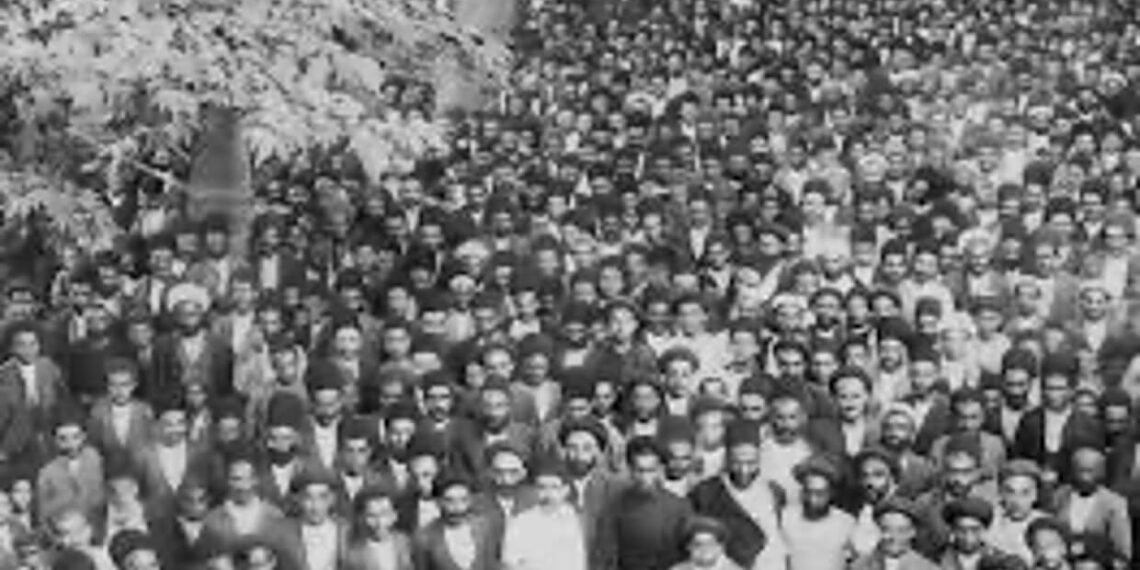
The most iconic photographs of the Constitutional Revolution (Rostami, 2006; Tabatabaei, 2011; Purhossein Khoniq, 2020) depict the sanctuary-taking (bast-nishīnī) or general strike at the British Embassy in the summer of 1906 as the movement’s turning point. According to accounts, "around 14,000 people" participated in this scene, a figure close to one-third of Tehran’s workforce (Afary, 1996: 55). Yet, these photographs only capture the urban protesters in Tehran, whereas historical narratives indicate that vast populations in other major Iranian cities, such as Tabriz and Rasht, also joined the revolutionaries.
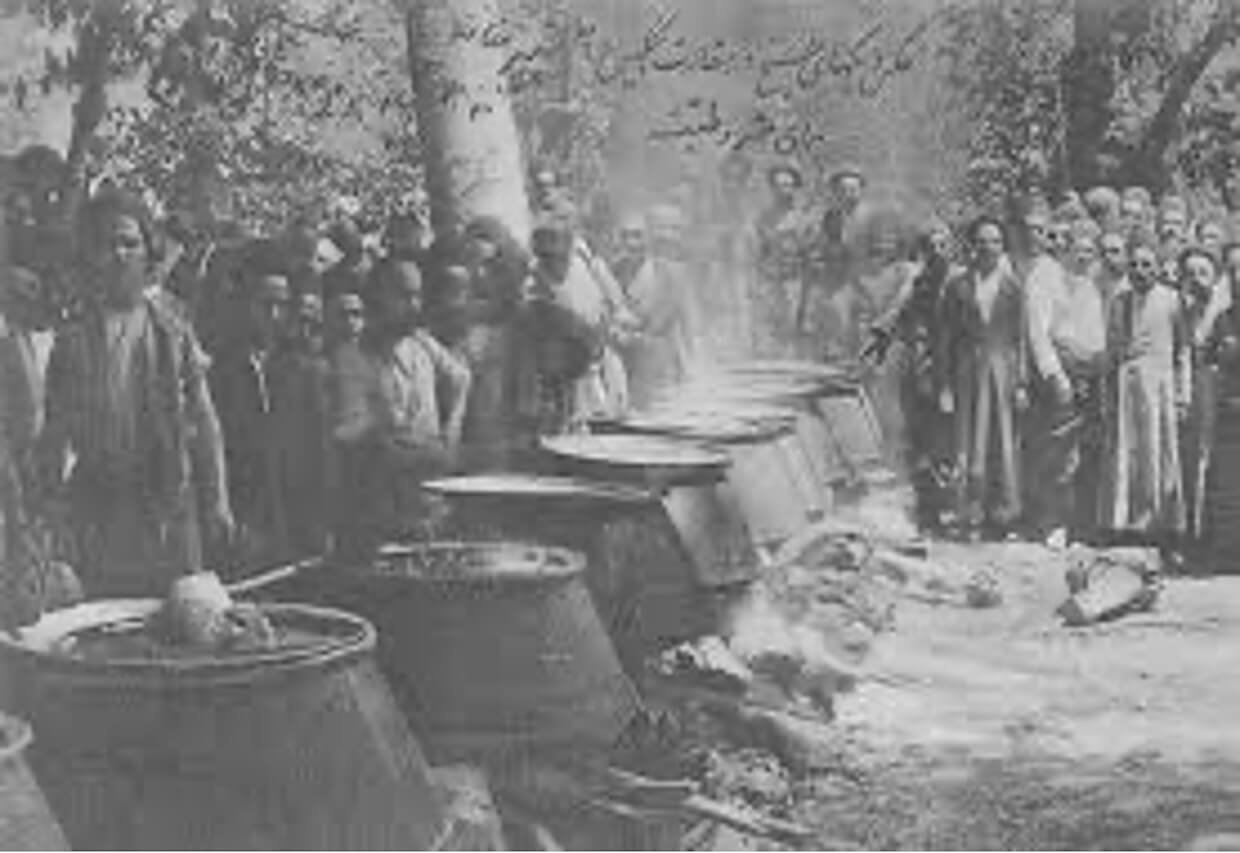
What is most striking about these scenes is not merely their scale, but their diversity. The social composition of this crowd was notably diverse, encompassing clergy and students, intellectuals, merchants, guild members, traders, artisans, and both skilled and unskilled laborers. As one eyewitness recounted, "I saw over 500 tents; every craft, even shoemakers, nut-sellers, and tinsmiths, had at least one tent," (Abrahamian, 1969: 133). Similar reports from the supplementary constitutional protests speak of "one hundred thousand people" in the streets (Abrahamian, 1979: 411). This sheer scale of participation lends significance to the concept of "the people," despite its inherent ambiguity, within the social context of the time.
This broad solidarity, however, proved short-lived. The constitutionalists secured their initial demands with remarkably little bloodshed, yet less than two years later, on 23 June 1908, when Colonel Liakhov shelled the Parliament on the Shah’s orders, the great crowds had vanished. Only a small core of committed revolutionaries remained to resist -a disappearance that cannot be explained solely by repression, because mass mobilization had previously withstood severe violence.
The central question of this study is therefore straightforward: why did "the people" disappear from the scene, and why was the Revolution unable to withstand the counter-revolutionary assault? Although the populace returned to the fray and recaptured Tehran after the Minor Tyranny 1908–1909, the Second Parliament suffered the same fate as the first.
I approach this question by examining the concept of “the people” not as a fixed social category, but as a politically constructed and contested one. It argues that the meaning of “the people” shifted over time, shaped by competing discourses and strategic considerations. These shifts were not merely semantic; they had concrete political consequences, influencing patterns of inclusion, exclusion, and mobilization. I examine the concept of "the people" in juxtaposition with "statesmen," "revolutionaries," and "revolutionaries in power," demonstrating that the term possesses a fluid meaning whose referents shift depending on the prevailing discourses. This fluidity was not accidental but politically weaponized. In pre-Constitutional Iran, society was defined by the binary of arbāb and ra’iyat (landlord and peasant), and reforms from above (such as the activities of Amīr Kabīr and Sipahsālār) were implemented without the engagement of the masses. Yet, the expansion of new relationships and the influx of modern concepts, including law and parliament, fractured the ancient structure and allowed for the emergence of "the people" as rightful holders of political rights.
To comprehend this transition, one must consider the landlord-peasant structure and patrimonialism, where the Shah was the "Shadow of God" and the source of justice and security. The Constitutional movement challenged this system by introducing concepts such as the nation, law, and representation. Even religious scholars such as Mīrzā Muhammad Hossein Nāʾīnī sought to reconcile sharīʿa with ʿurf in order to legitimize the new understanding of the people. However, this reconciliation remained partial and elite driven. This dialogue between traditional and modern forces was evident in the First and Second Parliaments, though the mechanism of dialogue gradually eroded with the ascendancy of landowners and the gentry, and the language of power was once again reproduced from above. The Constitutional experience thus revealed that the transition from ra’iyat to citizen was the outcome of intense intellectual and social struggle, but that transition was never institutionalized. Although law, suffrage, and parliament temporarily reshaped popular political consciousness, internal divisions and external pressures combined to arrest the process before it could mature.
The present study focuses on this rupture, by re-examining primary documents and tracing social dynamics after the initial victory. The analysis therefore proceeds along two axes: first, identifying which groups were incorporated into the revolutionary category of “the people” during the initial phase of mobilization; and second, tracing how and why certain groups were subsequently marginalized or excluded. By answering these interrelated questions, I offer a new internalist theory of revolutionary failure that complements – but does not dismiss – existing externalist and structural accounts.
Here, I argue that the failure of the Iranian Constitutional Revolution cannot be fully explained by external intervention, ideological radicalization, or institutional weakness alone. Instead, it resulted from the progressive narrowing of “the people” as a political category after the initial revolutionary victory. During mobilization (1905–1906), “the people” functioned as an expansive and flexible category that enabled the formation of a broad, multi-class urban coalition. However, once the constitutional order was established, this inclusive category was gradually restricted through legal design, institutional practices, and political discourse. This narrowing excluded key segments of the original coalition -particularly the urban poor, women, religious minorities, and peripheral populations- undermining the Revolution’s social base. As a result, when the counter-revolutionary assault occurred in 1908 and again in 1911, the constitutional regime was unable to remobilize the mass support that had initially secured its success. What becomes visible here is that this process was not merely incidental but partly deliberate, driven by elite concerns over order, property, and political control. The central claim is therefore that exclusion was not a by-product of failure- it was one of its primary causes.
Background and Mapping Gaps
Scholarship on the Constitutional Revolution has adopted social, discursive, and political perspectives, all of which confirm that reconstructing the role of social forces is inseparable from analyzing mechanisms of representation and exclusion. Najmabadi (2005), through close reading of speeches and clandestine leaflets, shows that even at the height of mobilization the dominant discourse constructed a male addressee and symbolically excluded women. This selective logic operated on a far wider scale. Afary (1996) has demonstrated that decisions about what enters the official record and what is omitted are never neutral; they silence groups that were effective participants but later deemed inconvenient.
Many dominant narratives – whether presented as the "true history" or as Iran’s "first national uprising"- have relegated local, regional, or transnational dimensions to the margins. Examples abound: the sale of girls in Quchan eclipsed by the killing of theology students (Najmabadi, 1998); the ideas of educated elites privileged over the actions of the popular classes; local movements judged solely by their alignment with "national" events. All such choices constitute acts of cultural power. De Groot (2010) illustrates how Constitutional historiography has redistributed agency among groups according to subsequent ideological needs, while Cronin (2010) interprets the Revolution as a state-building project in which tension between elites and popular forces shaped the emerging power structure. Abrahamian (1969), finally, emphasizes collective action and street mobilization as the movement’s driving force.
Despite this rich body of work, no study has yet systematically traced how the victorious revolutionary leadership actively narrowed the meaning of "the people" after 1905 in order to consolidate power, nor has the causal link between such exclusion and the Revolution’s inability to defend the parliament in 1908 and 1911 been rigorously established.
I address that gap by advancing a more focused argument: that one of the key factors in the revolution’s failure was the inability or unwillingness of the victorious leadership to sustain the broad coalition that had enabled its success. Once in power, revolutionary actors faced competing demands from a highly heterogeneous base. Rather than accommodating this diversity, they often responded by narrowing the scope of political inclusion, excluding certain groups for both political and material reasons.
This perspective engages directly with alternative explanations. A common argument in the literature is that exclusion emerged unintentionally, as a by-product of ideological radicalization or external pressures. While such factors were undoubtedly present, the evidence suggests that exclusion was frequently more deliberate and strategic than is often assumed. It was not merely something that happened to the revolution; it was, in part, produced from within. By foregrounding these internal dynamics, I propose a reinterpretation of the revolution’s trajectory. It suggests that the collapse of the popular coalition -and the contradictions among the groups that initially formed it- played a more central role than is typically acknowledged.
Theoretical Framework and Method
In studies of the Constitutional Revolution, the "crowd" or "street force" is an ever-present yet under-theorized actor. Despite the decisive role played by popular mobilization in modern Iranian history, neither historians nor sociologists have subjected it to systematic analysis. Contemporaries either celebrated the crowd as heroic defenders of liberty and justice or dismissed it as "riff-raff" and "vagrants" manipulated by rulers or foreign powers. European observers produced caricatures that ranged from exotic fascination to outright contempt, while literary representations cast the crowd as a fickle, uncontrollable force capable of toppling governments overnight. In short, the crowd has remained an abstract symbol -admired, feared, or ridiculed- rather than an object of empirical investigation (Abrahamian, 1969: 128–129).
Classical studies of popular collective action, notably George Rudé’s (1964) studies of European crowds, as well as more recent theories of "the people" as a performative and always contested political subject (Laclau, 2005; Rancière, 1999, 2016; Chatterjee, 2020), provide a useful starting point by demonstrating that crowds are not inherently irrational but operate within recognizable patterns shaped by social and economic conditions.
The descriptions related to the crowds active in the Revolution are mainly extracted from Persian and English historical sources: works by Browne (1910), Dawlatābādī (1983), the British Foreign Office correspondence on Iran, newspapers like Ḥabl al-Matīn and Ṣūr-i Isrāfīl, as well as Constitutional histories by Kasravi (1975), Malekzadeh (1984), Sharif Kashani (1983) and Nazem-al-Islam Kermani (1978) among others. Together these texts provide a rich, if heterogeneous, portrait of crowd behavior and social composition, making clear that understanding the role of "the people" demands moving beyond the stereotypes of "thugs" or "national heroes."
Equally ambiguous and closely related is the Persian term mardom ("people"). No conception of "the people" ever includes the entire population within a given territory; every version excludes and marginalizes some groups even as it claims universality (Rockhill, 2014; Chatterjee, 2020). Didi-Huberman (2016) reminds us that there are always multiple, coexisting "peoples" whose unity is far less coherent than imagined. Rancière (2016) goes further: the people have no existence independent of the conflicting representations produced of it, each with its own attributes, beliefs, and practices.
In Iranian culture, the closest conceptual equivalent to the word mardom in the Persian language is the term mellat("nation"). When the European concept of "nation" was first translated into Persian, mellat was chosen, yet before the Constitutional period mellat retained its pre-modern meaning of religious community or sect. Only during the Revolution did it begin to acquire its modern sense.
Therefore, this study rests on three interconnected theoretical pillars to theorize the populist dynamics of "the people":
(1) Ernesto Laclau’s concept of the empty signifier (Laclau, 2005): During the revolutionary upsurge, "the people" (mardom/mellat) functioned as an empty signifier, flexibly uniting heterogeneous demands against the patrimonial order. Post-victory, it was differentially filled with particular content (male, propertied, Shiʿi), producing necessary exclusions in the populist chain of equivalence.
(2) Jacques Rancière’s "the part of no part" (Rancière, 1999): Women, the urban poor, and religious minorities embodied those with no countable part in the pre-revolutionary police order, briefly disrupting it through egalitarian claims. Their post-victory "disqualification" was a reimposition of police logic, rendering them invisible in the new perceptual distribution of the sensible.
(3) Partha Chatterjee’s distinction between civil and political society (Chatterjee, 2004): The Revolution forged a narrow civil society of literate, propertied males while relegating the subaltern majority to a managed "political society," whose mobilizations were tactical and revocable.
Taken together, these perspectives provide a framework for analyzing the shifting meaning of “the people” during the Constitutional Revolution. They allow us to move beyond static definitions and instead examine how this category was constructed, contested, and redefined over time.
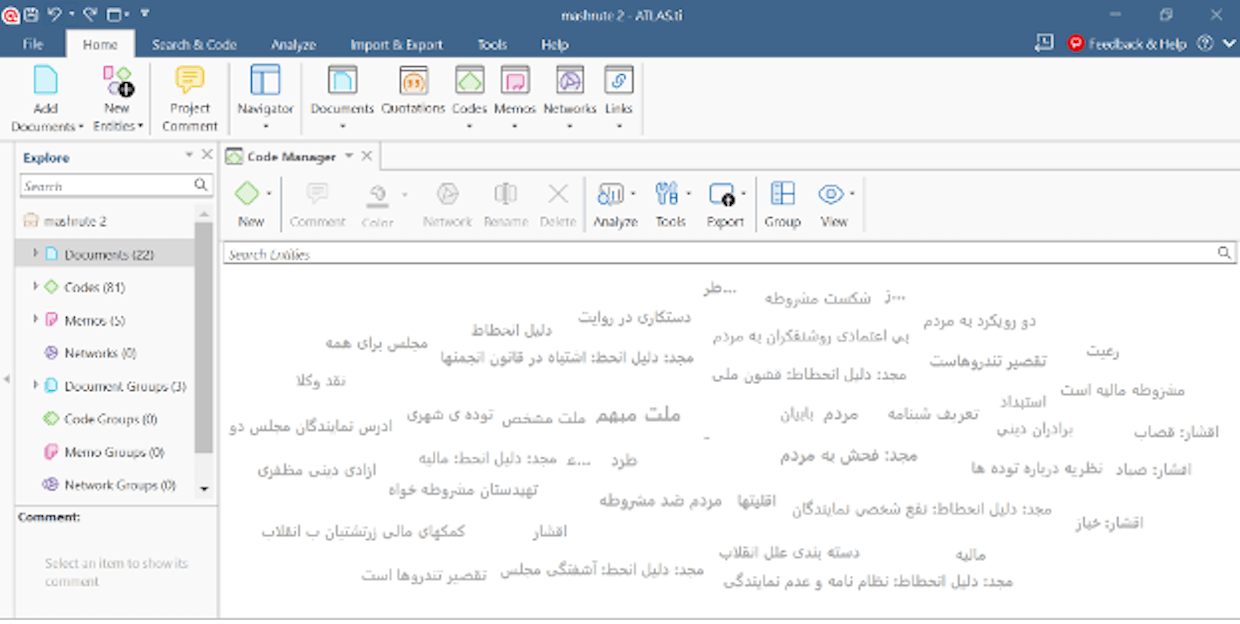
Methodologically, I employed qualitative content analysis, combining thematic and discourse-analytic coding performed with Atlas.ti 24. The analysis draws on a diverse corpus of primary sources, including newspapers, memoirs, parliamentary debates, police and intelligence reports, underground leaflets, communiqués, historical works and visual materials.
Table 1. Data sources
| Source Type | Examples | Time Coverage | Analytical Role |
| Newspapers | Ḥabl al-Matīn, Ṣūr-i Isrāfīl, Musāwāt, Rūḥ al-Qudus | 1905–1911 | Discursive construction of “the people”; public debate |
| Parliamentary Debates | Proceedings of the First National Assembly | 1906–1908 | Institutional decisions; legal exclusion |
| Memoirs & Chronicles | Dawlatābādī, Kermani, Kasravi | Retrospective | Elite perceptions; narrative framing |
| Leaflets & Proclamations | Underground publications, political declarations | 1905–1908 | Mobilization language |
| Archival Reports | British Foreign Office reports | 1905–1911 | External observation; social reactions |
| Local Anjumans | Tabriz Association records | 1906–1908 | Centre–periphery dynamics |
These sources offer multiple vantage points on the revolution, though they also reflect the biases and limitations of their respective contexts. The corpus selection inevitably reflects archival survival biases, and contemporary police/intelligence reports often exaggerate disorder to justify repression. To address these limitations, the study adopts a strategy of triangulation, comparing different types of sources in order to identify recurring patterns and discrepancies.
The coding scheme includes three primary clusters:
- Inclusion Codes: references to broad, collective mobilization (e.g., “nation,” “people,” “public,” “all classes”)
- Exclusion Codes: explicit or implicit boundary-making (e.g., references limited to Muslims, men, propertied groups, or “respectable” citizens)
- Delegitimation Codes: representations of segments of the population as ignorant, disorderly, or politically unfit
These codes are applied across source types to identify shifts in discourse and their alignment with institutional decisions. Analytical emphasis is placed on moments where discursive narrowing coincides with legal or political exclusion.
Findings
Social Configuration and the Revolutionary Construction of “the People”
Qajar Iran was characterized by an exceptional degree of social, ethnic, and religious diversity. This diversity was not merely demographic but structurally embedded in geography, economic organization, and patterns of political authority. Mountain ranges, deserts, and regional isolation had long preserved distinct local identities, resulting in a mosaic of linguistic, ethnic, and sectarian communities. Persians, Bakhtiyārī, Qashqāʾī, Lurs, and Arabs inhabited the central plateau; Baloch and Afshār communities were scattered across the southeast; Kurds, Lurs, and smaller Arab groups lived in the west; Azerbaijanis, Shahsevans, Armenians, and Assyrians dominated the northwest; Gilaks, Talesh, and Mazandaranis lined the Caspian shores; while the northeast contained Persians alongside Turkmen, Kurds, Afshārs, Taymūrīs, Baloch, Tajiks, and Jamshīdīs. Political unity thus coexisted with profound cultural and linguistic fragmentation. This extreme heterogeneity constitutes the essential backdrop for understanding why an apparently inclusive revolutionary discourse of "the people" could so rapidly become a weapon of exclusion.
Within such a context, Iran’s social structure was also complex and multi-layered. At the dawn of the nineteenth century, Iranian society could be categorized into four principal classes. The highest was the large-landowning class: the Shah and Qajar princes, courtiers, tīyūldārān [holders of land grants], mustawfīyān [financial administrators], ministers, governors, and a collection of government officials. This central elite, alongside local aristocrats, tribal khans, and chiefs, formed a network of political and economic power. A segment of the official clergy, such as judges, Friday Prayer leaders, and Shaykh al-Islāms, were also intertwined with this class. The second class consisted of the wealthy middle class: merchants, small landowners, artisans, and bazaar traders. The bazaar was not only the center of the urban economy but also the lifeblood of religious and educational institutions. Many mosques, religious schools and mourning centers were funded by the capital of merchants and artisans. This fostered a complex, reciprocal relationship between the bazaar and the clergy, from preachers to high-ranking mujtahids. Alongside them, some bazaar merchants were recognized as Sayyids and held significant religio-social roles.
The third class was made up of urban wage laborers: journeymen, apprentices, skilled workers, servants, construction workers, bathhouse attendants and porters. Finally, the fourth class, the majority of society, comprised villagers and īlāt (nomadic tribes): landless or smallholding peasants caught in the landlord-peasant structure, living far from the center of political power (Abrahamian, 1979; Ashraf & Banuazizi, 1992). The extraordinary occupational diversity of the period is vividly illustrated by the 1877 tax register of Isfahan, which recorded some two hundred independent guilds ranging from silversmiths and bookbinders to bath attendants and porters (Taḥvīldār, 2009).
Religious diversity further complicated the social landscape. Twelver Shi‘ism predominated, yet Sunni minorities -Kurds, Turkmen, Arabs, and Baloch- coexisted alongside non-Muslim communities of Armenians, Assyrians, Jews, and Zoroastrians. Even within Shi‘ism, sectarian divisions persisted between Ni‘matī and Ḥaydarī orders, orthodox believers, Shaykhīs, Ismā‘īlīs, and followers of the Karīmkhānī lineage. Urban space reflected these cleavages: Shiraz was divided into Ni‘matī, Ḥaydarī, and Jewish quarters; mid-nineteenth-century Tabriz comprised distinct aristocratic, orthodox believers, Armenian, guild, and laboring neighborhoods.
Qajar society, in sum, was a mosaic of ethnicities, languages, sects, neighborhoods, classes, and power networks -a structure that simultaneously enabled coexistence and harbored deep fissures, and no satisfactory interpretation of the movement is possible without grasping its underlying diversity.
An investigation of social forces during the Constitutional Revolution shows that the primary nucleus of change emerged from cities, with artisans, tradesmen, urban laborers, and intellectuals forming the revolutionary core against the Court, landowners, and Russian/British influence. The clergy and merchants, initially supportive, became fragmented, with some defecting to the counter-revolution. Tribes shifted allegiances based on local interests, while peasants and ‘ashāyir played no decisive national role beyond limited uprisings (e.g., in Gilan). Thus, the revolution was an urban, multiclass, popular movement sustained by a heterogeneous, brittle, and tactically inclusive coalition vulnerable to post-victory pruning.
The counter-revolutionary front coalesced around the court, landowners, conservative clergy, dependent tribes, and segments of the urban poor. The 1908 coup relied on the Cossack Brigade and court pensioners; in Tabriz, royalist crowds from impoverished neighborhoods were mobilized by high bread prices and clerical authority. Contrary to older narratives of peasant neutrality, rural unrest did occur in Gilan, villagers attacked landlords, believing constitutionalism meant absolute freedom, but constitutionalist deputies in Tehran ordered their suppression. Elsewhere, clerical or landlord pressure turned peasants against the revolution. Rural participation was real but localized and weak. In cities, the cleavage widened between secular intellectuals and conservative clerics. Intellectuals promoted legal equality, an end to despotism, and liberation from foreign domination via newspapers, but traditionalist clergy resisted. Large merchants and foreign-dependent capitalists also weakened initial unity.
In the Second Parliament, the share of artisans and intellectuals decreased, while landowners, tribal chiefs, and Qajar bureaucrats gained dominance. The suppression in Tabriz revealed this trend: most of the 35 executed were artisans and shopkeepers (Foran, 1991). Concurrently, royalists exploited religious and ethnic differences to prevent the spread of independent associations and the press in many regions.
The Urban Poor and the Economic Logic of Mobilization
The precarious economic situation of the Qajar era -poverty, unemployment, and injustice- brought the urban poor into the scene from the outset. These groups were motivated primarily by the hope for bread, work, and social security (Momeni, 1966: 15–19). Many of them did not understand the meaning and function of the "Constitution." Majd al-Islam Kermani (2017: 44) reported, "One in a thousand knew the meaning of Constitution; that is, in Tehran and other cities of Iran, one in a hundred thousand did not know the meaning … Some rioted for the dismissal of Ain al-Dawleh, a group for the dismissal of Monsignor Naus, some to collect treasury receipts they held from Mushir al-Saltaneh, and others with other motives."
Among the lower classes, the Constitutional Revolution was perceived in a profoundly economic sense, to the extent that Motahhari (1999: 382) wrote, "In the Constitutional era, some people were propagated with the idea that Constitution means that every morning fresh bread and kebab will be delivered to everyone’s house." A similar account is recorded in Tabriz, stating that "Constitution means cheap kebab" (Khalili, 2022: 46).
These satirical anecdotes are not merely amusing anecdotes; they reveal a profound mismatch between elite political objectives and popular material expectations -a mismatch the victorious leadership never attempted to bridge and instead exploited to demobilize the poor when convenient. This mindset is also evident in popular literature and the poetry of Nasīm-i Shomāl and Iraj Mirza. English translation of Persian poems: In the turmoil of Tehran, the clamor was at the Parliament, / Because the seekers of the Constitution were a chain of destitutes. / Behold the fervor and tumult of the poor, / Behold the commotion of the weak (Hosseini, 1991: 362). Or: The poor are entrapped by subsistence, / They are striving for their nightly bread. / The reason they sometimes speak the word ‘law’ (qānūn), / Is because the last letter of ‘law’ is Nūn [which suggests nūn (bread)]. / If they enter politics, / It is for the sake of job, work, and high office (Iraj Mirza, 1993: 94).
The Tehran poor -day laborers and the unemployed- initially joined the constitutional movement influenced by preachers and clerics, but their lack of organization and clear ideology made their political behavior volatile. Both sides deliberately engineered this volatility through selective distribution of food, cash, and religious rhetoric. Their presence in events like the destruction of the Russian Bank and sanctuary-taking at the British Embassy required such material incentives.
Victory and the First Parliament raised expectations, but economic deterioration -soaring bread prices, shortages, unemployment- spread disillusionment. Shaykh Fazlollāh Nūrī’s anti-constitution fatwa found support among those with traditional religious loyalties. Moḥammad-ʿAlī Shah worsened the crisis by withholding court salaries and subsidizing anti-parliamentary agitation. During the Artillery Square clashes, segments of the poor fought on both sides.
Lūṭīs and Jāhilān (neighborhood toughs) played a dual role: some supported the revolution, but many, bribed by the Court, joined the opposition with slogans like "We want the Prophet’s religion, not a constitution" -though these same groups had previously defended the Parliament. The bombardment of Parliament by the Russian Cossacks ended the revolution’s first phase; some lūṭīs received military rewards. Many poor had sincerely sought social justice, but lacking organization and political awareness, they became victims of elite competition and foreign maneuvering.
Intellectuals focused on law and liberty, not the subsistence needs of the lower classes. Thus, the urban poor were instrumentalized as revolutionary "muscle," then deliberately abandoned and re-mobilized against the revolution -because their inclusion threatened the property and status of the new parliamentary elite. Poverty, political inexperience, unawareness, and disorganization fundamentally altered the revolution’s course, rendering it fragile against the royalist coalition and Russian intervention.
Fractures, Exclusion, and the Collapse of the Popular Coalition
The initial unity of the constitutionalist coalition unraveled soon after the establishment of the new political order, most notably with the formulation of the Electoral Law. Rather than preserving broad inclusivity, the law restricted participation: women, lower classes, and the illiterate were disenfranchised. Only six classes (Qajar princes, clergy, aristocracy, landowners, merchants, and guild members) could enter Parliament, and only if they met property or business criteria (Abrahamian, 1979: 407-408).
This was the first deliberate act of legal exclusion, transforming "the people" from a broad revolutionary subject into a narrow propertied and Muslim male citizenry. The First Parliament’s composition confirmed this: affluent bazaar and wealthy middle-class strata secured 60 percent of seats, while lower classes had no role. Victors’ indifference to the poor -refusing tax reductions or addressing bread prices- deepened the fissure. As the British Minister reported, Parliament lost its "general credit." Constitutionalists lost poor support, alienated cautious religious leaders, and retained only the bourgeoisie and petty bourgeoisie. Middle-class neighborhoods remained revolutionary centers, while lower-class poor neighborhoods became counter-revolutionary strongholds.
The revolutionary leadership chose class consolidation over coalition maintenance, directly causing the disappearance of crowds in June 1908. This class division was acutely visible in Tabriz: constitutionalists drew strength from affluent neighborhoods like Amirkhīz (merchants, artisans, tradesmen), while royalists based themselves in poorer districts like Davahchī and Surkhāb (porters, muleteers, laborers, unemployed). Religious sectarianism compounded the cleavage: many middle-class constitutionalists followed the Shaykhī school, whereas the orthodox tendency predominated among lower classes, turning the conflict into a quasi-religious war (Abrahamian, 1969: 142–144).
The Center–Periphery Divide
A second structural fracture separated Tehran from the provinces. Tehran was allotted sixty-two deputies, Azerbaijan only twelve, and major provinces such as Fārs, Kermān, and Khorāsān a mere six each. Tribes, who constituted roughly one-third of the population, and rural areas were granted no representation whatsoever (Kermani, 2017: 56). Ethnic and linguistic minorities were thus structurally erased from the new political imaginary of "the nation."
This inequality was exacerbated when the First Parliament began its work solely with Tehran representatives -a revolutionary strategy to deny the counter-revolution an opportunity- with delegates from other cities joining late. Meanwhile, the Tehran assembly operated under the direct pressure of enormous crowds of spectators. Majd al-Eslām Kermani observed that "the entire population of Tehran intervened in the Iranian Parliament," compelling deputies to vote according to shouted demands from the galleries (Ibid: 62). Although public access was eventually restricted, the early chaos left a lasting imprint.
Distance and poor communications further marginalized the provinces. Remote regions struggled to form effective anjumans (association), and where such associations emerged, they frequently remained subordinate to local notables. Even royalists established rival anjumans—Anjuman-i Khidmat, Anjuman-i Akābir, Anjuman-i Aʿyān—that competed for allegiance with promises of patronage (Kharabi, 2020: ch. 13). The democratic potential of the anjuman movement was thus neutralized, and power remained concentrated along an unequal center–periphery axis.
Exclusion of Religious Minorities and the Curtailment of Liberties
A third fracture concerned religious minorities. Conservative clerics insisted only Muslims could sit in parliament. Secular revolutionaries, anxious to retain clerical support, initially acquiesced, making Sayyid ʿAbd-Allāh Behbahānī and Sayyid Muḥammad Ṭabāṭabāʾī proxies for non-Muslims. Armenians and Jews accepted, but Zoroastrians protested and secured a single dedicated seat (Shāhrukh, 2002: 72).
The draft Supplementary Constitutional Law originally declared "all Muslims equal before the law"; sustained protests forced amendment to "The inhabitants of the Iranian realm shall be equal in the possession of their rights before the state law" (Ibid: 73) -a reluctant concession revealing that equality was never a principled commitment but a tactical retreat.
During these phases, victorious clergy and revolutionaries began restricting liberties. Revolutionary tools before victory were criminalized afterward. Bihbahānī opposed underground leaflets -a principal revolutionary tool- declaring in Parliament: "If they have a word or a speech, they should write it and bring it to the Parliament… the Parliament must… prohibit these corrupt and malicious persons from these ugly movements" (Session 16, 18 December 1906).
After victory, leaflets took on an intimidating tone: "Whoever reads this proclamation and fails to circulate it… shall be deemed a traitor and a despot" (Mu‘izzī, 1999: 304). Many armed associations threatened the populace by using the label "despot." Kermani (2017: 73–74) wrote: "Any poor wretch who fell short in executing what was demanded of him was immediately called a despot… and was branded as invalid."
Some leaflets showed contempt for the people, e.g., regarding the June 1908 bombardment, the people of Tehran were addressed as: "Die, O less than animals… Let the women of Tabriz acquire freedom for you! Let the children of Azerbaijan sacrifice their lives for the preservation of your religion, honor, and liberty" (Mu‘izzī, 1999: 301). This illustrates how the revolutionary elite shifted from mobilizing "the people" to despising them once they ceased to be useful.
Prominent intellectuals also held this view: Yaḥyā Dawlatābādī (1983, V. 2: 84) wrote that except for a few, others do not know what law, parliament, or constitution are. Majd al-Islām Kermani (2017: 119, 144–145, 162, 223, 319) described the people as "self-serving," "wildly ignorant," "tyrannical and malicious," "lazy," and "parasitic." Thus, intellectuals who had invoked "the people" as sovereign now recoded them as an obstacle to enlightened governance, deepening the chasm between elite and social body.
Women as Active (but Silenced) Subjects
Women were also practically excluded in this discourse. Most leaflets and communiqués addressed only men: "O religious brothers and O zealous men of Iran" (Mu‘izzī, 1999: 281), or "O companions and O brothers…" (Ibid: 282). Women were only mentioned when listed alongside orphans or widows. Although revolutionary discourse was overwhelmingly male-addressed, women were far from passive recipients of exclusion. Women participated in some demonstrations and helped with strikes and sit-ins. Also, from earlier times, women were the vanguard of protests and bread riots (Cronin, 2018). They played a prominent role in the plan to establish a national bank and boycott foreign goods. Moreover, secret women’s anjumans, organized economic boycotts against foreign goods, and even armed themselves during the Tabriz siege of 1908 (Afary, 1996: Ch 7).
Figures like Bibi Maryam Amjadi and Sedigheh Dowlatabadi led petitions for suffrage, framing women’s inclusion as essential to the egalitarian "people." Yet, the Electoral Law and Supplementary Fundamental Laws explicitly barred them, justified by claims of unreadiness for civil society (Bayat-Phillip, 1978). This intersectional exclusion -gender compounded by class- highlights how the new police order silenced active disruptors, further eroding the populist coalition.
Similarly, religious minorities were effectively ignored in many texts through addresses like "The Nation of Islam." The revolutionary "people," therefore, was performatively constructed as male, Muslim, and Persian-speaking from the very first days of victory. For instance, in a leaflet entitled "The Request of the Hidden Well-wisher…" (Ibid: 277–278), or in a telegram from "The Constitutionalist Clergy of Tabriz Regarding the Fatwa of the Marja‘s of Najaf and the Opening of the National Consultative Assembly," signed by city elders, it is written: "It will not be within the honor of the possessor of the sharī‘at that the Nation of Islam be so degraded and the lives, property, and honor of Muslims become the prey of the oppressive group’s sword… and a revolution will occur that will inflict great damage upon the great monarchy, and all the Nation of Iran is prepared to obey the decrees of the Imām; moreover, all Shī‘a co-religionists will become agitated and tumultuous." (Jamshidiyān, 2016: 139).
As is evident from this statement, while the language refers to "all the Nation of Iran," the concrete referent is nothing but Muslims and Shī‘a. In other words, the letter writers, by emphasizing Islam and Shī‘a, firstly exclude and marginalize all Iranians adhering to other religions (Judaism, Zoroastrianism, and Armenians) and, secondly, all non-Shī‘a Muslims. Furthermore, terms such as "Nation" (Millat), "Public" (‘Umūm), and Ra‘iyat are highly ambiguous in these texts, and it is unclear exactly who they encompass. Even in the Parliament, representatives rarely spoke specifically of the people in their constituencies.
Parliamentarians Indifference and Structural Constraints
Another clear sign of the rupture between the Parliament and the people was the representatives’ indifference to daily, common issues. In the fourteenth session of the First Parliament, when Ḥājjī Sayyid Ibrāhīm warned about the high price of meat, he was answered: "The issue of meat is related to the government… it has nothing to do with the Parliament." The same pattern repeated with the Anzalī fishermen’s complaint about the Lianazov contract. This indifference was also structural: incorrect delineation of īyālat and vilāyat boundaries deprived Bāndar-i Langah, Muḥammarah, Anzalī, and Ṭālish of a Provincial Association, allowing only a Municipal Association. Protests of Rasht residents claiming "Rasht is a Province (īyālat), not a District (vilāyat)" yielded no result (Kermani, 2017: 56–58).
The Law of Associations prohibited all unofficial local associations, restricting local self-organization instead of strengthening popular participation. The contemporary press mirrored this rift. The newspaper Rūḥ al-Qudus initially criticized the government but soon turned on Parliament, writing, "For nearly two years, they have assumed a name without form, a body without a soul—meaning a constitution without reality," and regarding the Parliament Speaker, stated that "The Speaker of the Parliament must be knowledgeable of the necessities of the time… not deaf…" (No. 27, 4th June 1908: 4).
Ali-Akbar Dehkhoda, in Charand-o Parand, complained about representatives’ disarray and inexperience. Sayyid Jamāl al-Dīn Vā‘iẓ wrote: "The Sacred National Consultative Assembly… must all be united and of one accord…" (Al-Jamal, No. 15, 27th June 1907). But by late 1907, he attributed Parliament’s inefficiency to hasty election and delegate inexperience (Ibid, No. 26, 22th November 1907).
The newspaper Musāwāt, despite defending the constitution, criticized the "ignorance of the delegates" (No. 2, 27th October 1907: 4), wrote "We have been deceiving ourselves for two whole years…" (No. 13, 16th February 1908: 1), labeled Parliament as "incapable of defending the poor" and "a tool in the hands of the malicious," and asked representatives why they used to hide "like veiled women" until yesterday and now shout so brazenly? (No. 18, 22th March 1908: 2–3). Its conclusion: when Tehran is so chaotic, the condition of other cities is self-evident (Ibid: 5).
In Tabriz, the Tabriz Association repeatedly protested delays in sending the Constitutional Law and Tehran’s passivity. City clerics warned: "As long as they do not dispatch the Constitution towards Azerbaijan… we will not leave the telegraph office" (Tabriz Association, No. 81, 6th May 1907). The Association’s summary of parliamentary debates showed divergence between perception and reality: "The inhabitants have conceived that we are constitutionalized so that we may now commit aggression and injustice ourselves" (Ibid, No. 39, 24th January 1907). A Christian complained that even the purchase of "one kilo of grapes" was forbidden to him, contrary to liberty and equality (Ibid, No. 7, 14th October 1907). The Tabriz Association cited extravagance (No. 6), currency depreciation, population growth without income growth, hoarding, weak transport, and "ignorance" as the "first cause" of economic turmoil. In No. 25, quoting the people of Tabriz, it wrote that Christians had been placed in customs offices without competence instead of Muslims, and another stated: "The Constitutional nature of the government in Iran is a statement, not an action" (Ibid, No. 25).
The Erosion of the Revolution’s Social Base
The murder of the Zoroastrian Farīdūn and the impunity of his killers struck another blow to the Parliament’s credibility. Majd al-Islām Kermani (2017: 321–322) recounts that following this incident, "all devout and civilized souls" turned away from the Parliament, attributing this distrust to the actions of "irreligious clerics," "dishonorable orators," and judiciary components who took bribes and "took an axe to the root of Constitutionalism." He traced the problem to the electoral structure, which sent "bankrupt merchants" and "money-collecting clerics" to Parliament to pursue personal interests.
At the societal level, for many people, the Constitution meant nothing but chaos and anarchy. Every disturbance was interpreted with the phrase "Mashrūṭeh (Constitution) became reality": "Gradually, the businesses of hat-making [a derogatory reference to Westernized constitutionalists] and mujāhid [freedom fighter] games expanded, leading to a loss of trust in the Constitution and the constitutionalists; moreover, the word Mashrūṭeh was translated among the people as murder and plunder, so that whoever killed anyone or plundered anywhere, they would say: Mashrūṭeh became reality."(Mardūkh Kurdistānī, 2000: 549–550). Some constitutionalists regretted that a "plague should have come and they had died" before the Constitution was realized (Afshār, 1980: 52).
Fiscal mismanagement further undermined confidence: the Finance Commission failed to balance the budget or curb inflation, and soaring bread prices turned roughly a third of the urban population against the assembly. The resulting backlash culminated in the royalist riot at Artillery Square, where court muleteers, neighborhood poor, and followers of Shaykh Fażl-Allāh Nūrī converged to demand abolition of constitutional rule (Kermani, 2017: 276).
Despite these transformations, constitutionalist historians typically reduced anti-revolution gatherings to "hired thugs," "gamblers," and "paid hooligans," without questioning motivations. Only Malik al-Shuʿarāʾ Bahār briefly mentioned that a segment of the "upper class and lower classes" supported despotism, and only the middle class backed the revolution, but failed to explain factors shaping this alignment (Abrahamian, 1969: 136). Based on Abrahamian, three forces were present in royalist demonstrations: aristocrats and employees dependent on the palace economy; conservative clergy and their students; and segments of the lower classes. Crucially, the lower classes who joined the counter-revolution were often the same people who had earlier filled the streets for the revolution -demonstrating that their "volatility" was produced by deliberate elite abandonment rather than inherent backwardness. This pattern appeared elsewhere: court-dependent muleteers in Tabriz, the retinue of Qawām al-Mulk in Shiraz, and Kermanshah’s division into the "People’s Party" and the "Aristocrats’ Party."
Conservative clerics played a decisive role: Sheikh Fazlollah and Ḥājjī Mīrzā Ḥasan mobilized students, mullahs, and religious employees. A British Foreign Office report indicated that "a large portion" of the clergy sympathized with conservatives on minority issues. Lūṭīs and pahlavāns linked to guilds and religious institutions were active in Tabriz disturbances and the Artillery Square gathering. The urban poor -dyers, carpet weavers, bricklayers, peddlers, porters, laborers- were easily drawn to this counter-movement due to poverty, unrest, and distrust. Kasravi wrote that Fazlollah’s secession was a severe blow because he was "respected by the people." Malikzādih admitted his provocations affected the "common people." Amīrkhīzī confirmed bazaar commoners followed Fazlollah. Low-income guilds felt, as early as the sanctuary-taking at the British Embassy, that they would gain nothing from the Revolution. Field gatherings included a mix of the poor, clergy and students, lūṭīs, courtiers, and palace-dependent workers (Abrahamian, 1969: 138–144).
Even in the National Bank project, public distrust was evident: Sa’d al-Dawlah complained in Parliament that people who days before had "sacrificed life and property" for the bank, now not even ten had taken steps to buy shares, warning this inaction would "cause insult" to Parliament in the eyes of the world (Session 6, 1 December 1906). The evidence reveals that popular disaffection was neither abrupt nor reducible to a single event, but unfolded through cumulative political missteps, economic hardship, heightened insecurity, and religio-ideological competition. Contrary to the narrative blaming "mass ignorance," this distancing was a rational response rooted in lived experience. A revolution that was supposed to bring the "rule of law" became, in many eyes, a source of instability and a lived experience of betrayal, exclusion, and inefficiency, which ultimately eroded its social base.
Causal Mechanisms of Exclusion
The transformation of “the people” from an inclusive mobilizing category into a more restricted political constituency did not occur through a single process. Rather, it resulted from the interaction of several mechanisms, each of which contributed to the gradual erosion of the revolutionary coalition.
1. Class Interest and Fear of Anarchy (Chatterjee’s Political Society): The propertied leadership -merchants, landowners, and intellectuals- prioritized protecting guild privileges and private property over addressing the urban poor’s demands for bread subsidies or wage guarantees. As Chatterjee (2004, 2020) argues, subaltern groups in political society are mobilized for disruption but governed through exception; here, the fear of "anarchy" justified suppression. The Gilan peasant uprisings of 1906 exemplify this: villagers, interpreting constitutionalism as land redistribution, seized estates, only to be crushed by Tehran deputies who viewed them as threats to order (Afary, 1996: ch. 6). This mechanism demobilized rural and poor urban elements, fracturing the chain of equivalence Laclau (2005) describes as essential to populism.
2. Clerical–Secular Competition for Hegemony (Laclau’s Empty Signifier): Conservative clerics like Shaykh Fażl-Allāh Nūrī contested the signifier "mellat" by filling it with Islamic content, defining "the people" as true Muslims against secular "Western imitations." He actively accused Muslim revolutionaries of being Bābī Azalī, or Bahā’ī, and of holding anti-Islamic sentiments. Secular leaders, who needed clerical legitimacy in their struggle against the court, ultimately acquiesced to the clerics’ demand to deny parliamentary representation to religious minorities. This hegemonic struggle (Laclau, 2005) thus produced exclusion as a bargaining chip: Nūrī’s fatwas against non-Muslims gained traction among the poor, effectively splitting the revolutionary coalition along sectarian lines.
3. Legal-Institutional Fixing (Rancière’s Police Logic): The Electoral Law of 1906 and Supplementary Fundamental Laws of 1907 legally codified exclusion, restricting suffrage to propertied males and assigning minorities token seats. As Rancière (1999) posits, this was police work: re-partitioning the sensible to count only the "countable" (propertied Shiʿi men), disqualifying the "part of no part." Archival evidence from parliament debates shows delegates explicitly debating -and rejecting-women’s and illiterates’ inclusion to prevent chaos.
4. Performative Contempt and Demobilization (Integrated Framework): Post-victory discourses shifted from adulation to derision, with leaflets and speeches labelling the masses "ignorant parasites" or "less than animals." This performative disqualification justified demobilization, turning former allies into counter-revolutionary recruits via bribes and fatwas. Economic data corroborates bread price hikes from 1907–1908 correlated with poor neighborhood defections.
These mechanisms were intertwined, sometimes deliberate, sometimes reactive. The result is a populist revolution that imploded from within, unable to summon "the people" in 1908. These mechanisms and concepts operationalize the analysis as a populist rupture followed by exclusionary consolidation. In this sense, exclusion was not merely a by-product of the revolution; it became part of its trajectory (see Table 2).
Table 2 – Theorising the Changing Meaning of "the People"
| Phase | Dominant Signifier | Included Groups | Excluded Groups | Mechanism (Laclau/Rancière/Chatterjee) |
| Pre-1905 | raʿiyat (peasant) | None | Everyone | Traditional police order |
| Mobilisation 1905–06 | mardom (people) | All urban classes + some tribes | – | Populist rupture (empty signifier) |
| Consolidation 1907–08 | mellat (nation) | Propertied male Shiʿi citizens | Women, urban poor, non-Shiʿi, rural | Filling signifier + re-policing (part of no part) |
| Collapse 1908-09 | ʿavām /ʿubāsh (riff-raff/vagrants) | Only loyal subjects | Former revolutionaries | Managed political society |
A clear example of the exclusionary mechanism can be observed in the relationship between discourse, institutional design, and social response. First, revolutionary discourse initially mobilized a broad and undifferentiated notion of “the people,” encompassing diverse urban groups. Second, the Electoral Law and parliamentary practices restricted political participation to propertied male groups, formally excluding large segments of the population. Third, these exclusions coincided with increasing elite dissatisfaction with mass participation, reflected in discourses portraying the lower classes as disorderly or politically immature. Finally, this combination of institutional exclusion and discursive delegitimation contributed to the withdrawal -or reversal- of popular support, particularly among the urban poor, thereby weakening the Revolution’s capacity to resist the 1908 coup. This sequence illustrates how exclusion operated not as an isolated decision but as a cumulative process linking discourse, institutions, and political outcomes.
Comparative Perspective
The pattern observed in the Iranian case -broad mobilization followed by more selective forms of political inclusion- finds parallels in other historical contexts. In several major revolutions, expansive coalitions formed around shared opposition to existing regimes, only to fragment once the question of institutional consolidation arose.
In the French Revolution (1789–1791), the Third Estate’s empty signifier "the nation" united sans-culottes and bourgeoisie against absolutism, but post-Bastille, suffrage was restricted to propertied males, alienating the urban poor and leading to Thermidorian reaction (Soboul, 1974). Similarly, the Young Turk Revolution (1908) mobilized diverse Ottoman subjects under "liberty and equality," yet ethnic Turks quickly filled the signifier with Turkic-Muslim content, marginalizing Armenians and Arabs and fracturing the coalition against the Sultan (Zürcher, 2010). More recently, Egypt’s 2011 uprising invoked "the people" to topple Mubarak, but the Supreme Council of Armed Forces and Muslim Brotherhood’s power-sharing excluded labor unions and Copts, paving the way for Sisi’s counter-revolution (El-Mahdi, 2011).
Comparative examples suggest that this trajectory is not unique. In different settings, the category of “the people” has often functioned as a unifying but indeterminate concept during periods of mobilization. Its strength lies precisely in its flexibility, allowing diverse groups to align temporarily. However, this same flexibility can become a source of tension when more precise definitions are required.
What distinguishes the Iranian case is not the existence of such dynamics, but their particular configuration. The relatively rapid institutionalization of exclusion, combined with the interaction of religious, social, and regional factors, shaped a specific way of coalition breakdown. The role of clerical authority, the structure of urban society, and the balance between central and provincial actors all contributed to this outcome.
Rather than treating the Constitutional Revolution as an isolated case, this perspective situates it within a broader pattern of revolutionary politics. It highlights a recurring tension between the inclusive language of mobilization and the more limited realities of political consolidation. Understanding how this tension is managed -or fails to be managed- offers insight not only into the Iranian experience but into the dynamics of revolutionary change more generally.
Conclusion
The Constitutional Revolution did not collapse simply because of external intervention, ideological radicalization, or the limitations of social development -although all of these factors played a role. What ultimately proved decisive was a more gradual and internally driven process: the weakening of the broad social coalition that had made the revolution possible, and the inability to stabilize an inclusive and durable understanding of “the people” within the new political order.
The evidence suggests, through systematic analysis of primary sources, that the revolutionary leadership actively narrowed the meaning of "the people" after victory in order to protect class, gender, religious, and ethno-national privileges, thereby destroying the only force capable of defending the parliament in 1908 and 1911.
Early intellectuals had sought to elevate the raʿiyat from powerless subject to political agent, yet this conceptual leap never translated into durable practice. The parties that emerged in the Second parliament -whether moderate or democrat- proved incapable of forging lasting ties with a largely illiterate society. Their political vocabulary remained alien, their rhetoric opaque, and their programs offered no tangible place for the subaltern majority.
In reality on the ground, the active forces of the revolution, contrary to the exaggerated "thuggish" image some writers portrayed, were mainly composed of the urban middle class, merchants, tradesmen, artisans, and various social, religious, and ethnic groups. It was the middle class and the poor who ignited the engine of the revolution, but subsequently, the rift between intellectuals carrying Western ideas, clerics with religious concerns, and merchants with demands for economic security, eroded the initial cohesion.
The confrontation between the Democrats and the Moderates is a prime example of this cleavage, where traditional bazaar forces were able to marginalize the radical discourse of the intellectuals and reclaim the political trajectory. The result was that even historians like Kasravi and Nazem-al-Islam Kermani, who deemed the revolution a product of intellectual awakening, ultimately attributed its failure to the "ignorance" of the masses -an analysis that this study rejects as ideologically convenient elite self-absolution.
Moreover, no fundamental restructuring of class relations occurred. The old elites -monarchy, clergy, landowners, tribal khans- donned constitutional garb yet retained effective power. "Political brokers" whose sole concern was personal advantage neutralized attempts at genuine democratic institution-building (Kāveh, No. 1: 2). The Constitutional Revolution thus amounted to a limited rotation of elites rather than a social revolution.
This structural incapacity was accompanied by a kind of theoretical ambiguity regarding the "people" -a concept that carried heavy normative weight in the constitutionalists’ discourse but lacked precise definition and political clarity in practice. It was unclear which groups the "people" included: women? religious minorities? villagers? the lower classes? ethnic groups? The result of this ambiguity was the political misuse of the term. Before the revolution’s victory, all these groups were called upon for general mobilization; however, immediately after the establishment of the parliament, the first political act -the electoral law- was to exclude these very segments from the right to participate.
The exclusion of women, the lower classes, minorities, smaller cities, and the law restricting associations amounted, effectively, to throwing a large portion of society off the revolutionary train. The forces that were the mainstays of resistance, protest, and mobilization for the revolution, not only remained unrewarded after the victory but were cast out of the political structure and gradually joined the opposition. This process, coupled with the intensification of the economic crisis, caused a segment of the urban poor -who were the initial driving force of the revolution- to gravitate toward counter-revolutionary forces. This shift was not a sign of instability or ignorance; it was a sign of disillusionment with unfulfilled promises and a political structure that had no place for them.
The failure of the revolution was determined not from the outside but from within: the elimination of pluralism, the inability to hold together the multi-class coalition, and the absence of a clear, inclusive definition of political belonging. By showing that exclusion was deliberate, systematic, and causally linked to collapse, I offer a new internalist explanation that challenges both nationalist hagiography and external-determinist accounts.
Combining Laclau’s empty signifier, Rancière’s police logic, and Chatterjee’s political society, has demonstrated that exclusion was not an unfortunate by-product but the central mechanism that transformed a broad populist rupture into a narrow civil-society regime incapable of defending itself. This failure did, however, leave a legacy of new political consciousness -a legacy that reappeared in the movement for the nationalization of oil and subsequently in the 1979 Revolution.
Yet, the Constitutional Revolution experience still holds a clear historical warning, not only for Iran but internationally: no movement or revolution can survive without preserving social pluralism, without rigorously defining its constituency, and without genuinely sharing power among those who made victory possible. Triumph achieved through mass mobilization yet consolidated through exclusion is doomed to internal collapse. The lesson is universal: any revolution that mobilizes "the people" as an empty signifier yet consolidates power by filling that signifier with particular content is doomed to internal collapse.
The contribution of this article has been to highlight the central role of processes of inclusion and exclusion in shaping the revolution’s trajectory. By tracing how the meaning of “the people” shifted over time, and how these shifts were linked to institutional and political developments, it offers an internal perspective on revolutionary failure that complements existing explanations.
More broadly, the analysis suggests that the durability of revolutionary change depends not only on the capacity to mobilize, but also on the ability to sustain inclusive forms of political belonging. Where the gap between the language of mobilization and the structure of governance becomes too wide, the foundations of the revolutionary project may gradually erode. The experience of the Constitutional Revolution illustrates this dynamic with clarity, offering insights that extend beyond its immediate historical context.
(*) Dr. Ali Ragheb has a Ph.D. in Cultural Sociology, Department of Sociology, Faculty of Social Sciences, University of Tehran, Iran, ali.ragheb@ut.ac.ir, ORCID: https://orcid.org/0000-0003-4213-2960)
References
Abrahamian, E. (1969). The crowd in the Persian revolution. Iranian Studies, 2(4), 128–150. https://doi.org/10.1080/00210866908701385
Abrahamian, E. (1979). The causes of the Constitutional Revolution in Iran. International Journal of Middle East Studies, 10(3), 381–414. http://www.jstor.org/stable/162146
Afary, J. (1996). The Iranian Constitutional Revolution, 1906–1911. Columbia University Press.
Afshar, I. (1980). Oraq-e tazeyab-e mashrutiyat va naqsh-e Taqizadeh (Newly found documents on the Constitutional Revolution and the role of Taqizadeh). Tehran: Javidan.
Ashraf, A., & Banuazizi, A. (1992). Classes in the Qajar period. Encyclopaedia Iranica, 5, 667–672.
Bayat-Phillip, Mangol (1978). Women and Revolution in Iran, 1905-1911. in Women in the Muslim World, ed. Lois Beck and Nikkie Keddie. Harvard University Press.
Browne, E. G. (1910). The Persian Revolution of 1905–1909. Cambridge University Press.
Chatterjee, P. (2004). The politics of the governed: Reflections on popular politics in most of the world. Columbia University Press.
Chatterjee, P. (2020). I am the people: Reflections on popular sovereignty today. Columbia University Press. https://doi.org/10.7312/chat19548
Cronin, S. (2010). The Constitutional Revolution, popular politics, and state-building in Iran. In H. Chehabi & V. Martin (Eds.), Iran’s constitutional revolution (pp. 15–32). I. B. Tauris.
Cronin, S. (2018). Bread and justice in Qajar Iran: the moral economy, the free market and the hungry poor. Middle Eastern Studies, 54(6), 843–877. https://www.jstor.org/stable/48543815
De Groot, J. (2010). Whose revolution? In H. Chehabi & V. Martin (Eds.), Iran’s constitutional revolution (pp. 15–32). I. B. Tauris.
Didi-Huberman, G. (2016). To render sensible. In B. Bosteels & K. Olson (Eds.), What is people? Columbia University Press.
Dowlatabadi, Y. (1983). Hayat-e Yahya (The life of Yahya) (Vols. 1–4). Tehran: Ferdowsi.
El-Mahdi, R. (2011). Labour protests in Egypt: causes and meanings. Review of African Political Economy, 38(129), 387–402. http://www.jstor.org/stable/23055362
Foran, J. (1991). The strengths and weaknesses of Iran’s populist alliance. Theory and Society, 20(6), 795–823. http://www.jstor.org/stable/657604
Foran, J. (1993). Fragile resistance: Social transformation in Iran from 1500 to the revolution. Routledge. https://doi.org/10.4324/9780429041433
Hosseini, S. A. G. (1991). Divan-e Nasim-e Shomal (Collected poems of Nasim-e Shomal). Tehran: Hosseini Press.
Iraj Mirza (1993). Tahqiq dar ahval o afkar… (Research on the life and works of Iraj Mirza) (M. J. Mahjub, Ed.). Tehran: Roshdiyeh.
Jamshidian, S. (2016). Ruzshomar-e mohasere-ye Tabriz va e’ade-ye mashruteh (Chronology of the siege of Tabriz and the restoration of the Constitution). Tehran: Safir Ardehal.
Jazani, B. (2009). Enqelab-e mashrutiyat-e Iran; niruhā va hadafhā (The Constitutional Revolution of Iran: Forces and goals). Paris: Organization of Iranian Fadaiyan.
Kermani, A. M. (2017). Tarikh-e enhetat-e majles (History of the decline of the parliament). Tehran: Ashiyan.
Kasravi, A. (1975). Tarikh-e mashrute-ye Iran (History of the Persian Constitution). Tehran: Amir Kabir.
Keddie, N. (1980). Iran: Religion, politics and society. Frank Cass.
Khalili, M. (2022). Mashruteh yani chelokabab arzan! (Constitution means cheap chelow-kabab!). In A. Masoudi & M. Nouri (Eds.), Goftarhayi darbāre-ye mashruteh-ye Irani. Tehran: Hezareh-ye Sevom.
Kharabi, F. (2020). Anjomanha-ye asr-e mashruteh (Associations of the Constitutional Era). Tehran: Negarestan-e Andisheh.
Laclau, E. (2005). On populist reason. Verso.
Malekzadeh, M. (1984). Tarikh-e enqelab-e mashrutiyat-e Iran (History of the Constitutional Movement in Iran). Tehran: Elmi.
Mu‘izzī, F. (1999). Shabnameha va elamiyehha-ye mashruteh (leaflets and proclamations of the Constitutional Revolution). Iranian Contemporary History Quarterly, 10, 275–304.
Momeni, B. (1966). Iran dar astaneh-ye enqelab-e mashruteh (Iran on the eve of the Constitutional Revolution). Tehran: Amir Kabir.
Mardūkh Kurdistānī, M. (2000). Tarikh-e Mardūkh (History of Mardūkh). Tehran: Karang.
Motahhari, M. (1999). Yaddasht-hā-ye Ostād Motahhari (Notes of Motahhari). Tehran: Sadra.
Najmabadi, A. (1998). The story of the daughters of Quchan. Syracuse University Press.
Najmabadi, A. (2005). Women with mustaches and men without beards. University of California Press. http://www.jstor.org/stable/10.1525/j.ctt1ppqcv
Nazem-al-Islam Kermani, M. (1978). Tarikh-e bidari-ye Iranian (History of the awakening of Iranians). Tehran: Bonyad-e Farhang-e Iran & Agah.
Purhossein Khoniq, E. (2020). Mashruteh be bayān-e tasvir (Photographs of the constitutional revolution). Akhtar.
Rancière, J. (1999). Disagreement: Politics and philosophy. University of Minnesota Press.
Rancière, J. (2016). The populism that is not to be found. In B. Bosteels & K. Olson (Eds.), What is people? Columbia University Press.
Rockhill, G. (2014). Radical history and the politics of art. Columbia University Press.
Rostami, F., & Hadidi, M. (2006). Vaqāye‘negār-e tārikh-e mashruteh (Chronicle of the history of the Constitutional Revolution). Institute for Iranian Contemporary Historical Studies.
Rudé, G. (1964). The Crowd in History. A Study of Popular Disturbances in France and England, 1730–1848. Wiley & Sons.
Sharif Kashani, M. M. (1983). Vaqaye‘āt-e ettefaqieh dar ruzgar (Events that occurred in those days). Tehran: Nashr-e Tarikh-e Iran.
Shāhrukh, K. (2002). Khaterat-e Arbab Keykhosrow Shahrokh (Memoirs of Arbab Keykhosrow Shahrokh). Tehran: Maziar.
Soboul, Albert. (1974). The French Revolution, 1787-1799: from the storming of the Bastille to Napoleon. London: NLB.
Tabatabaei, M. H. (2011). Mashruteh dar tasvir (The Constitutional Revolution in images). Tehran: Nashr-e Abi.
Taḥvīldār, A. (2009). Joghrafiyā-ye Esfahān: Joghrafiyā-ye tabii va ensāni va āmār-e asnāf-e shahr (Geography of Isfahan: Physical and human geography and urban guild statistics). Tehran: Akhtaran.
Zürcher, E. J. (2010). The Young Turk legacy and nation building: From the Ottoman Empire to Atatürk’s Turkey. I. B. Tauris. https://doi.org/10.5040/9780755622082
Newspapers
Al-Jamal Newspaper (1905–1906). Tehran.
Kāveh Newspaper (1916–1922). Berlin.
Musāwāt Newspaper (1906–1908). Tehran.
Rūḥ al-Qudus Newspaper (1907–1908). Tehran.
Ṣūr-i Isrāfīl Newspaper (1907–1909). Tehran
Tabriz Association Newspaper (1905–1908). Tabriz.