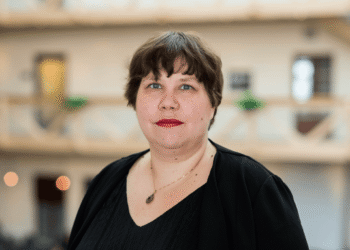
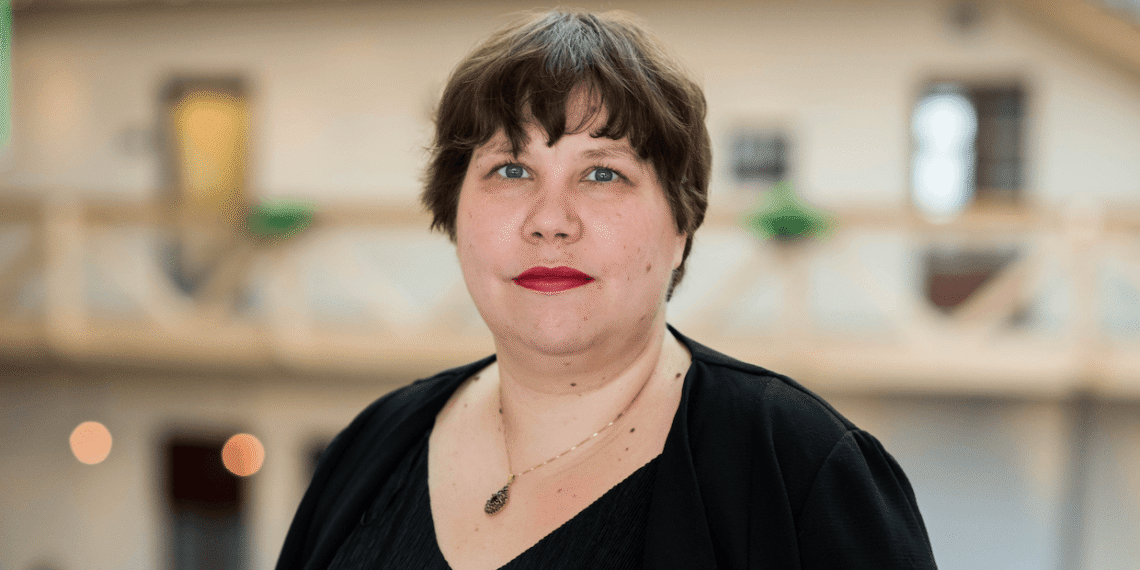
In this ECPS interview, Assistant Professor Sofie Blombäck examines the Sweden Democrats’ electoral setback alongside the continuing normalization of ideas long associated with the radical right. She argues that some voters may feel they have already “gotten what they wanted” on migration, even as SD itself remains partly stigmatized. Dr. Blombäck also highlights a darker post-election development: debate over whether Sweden’s newest citizens, particularly Muslim immigrants, are treated as legitimate political actors. “In my personal view, the debate has become quite ugly,” she says. More broadly, she situates the election within a changing party system shaped by normalization, bloc realignment, strategic voting, weakened parliamentary norms, and shifting boundaries of political legitimacy.
Interview by Selcuk Gultasli
Sweden’s 2026 general election has brought into sharp relief a paradox that has been developing for more than a decade: the Sweden Democrats (SD) may lose electoral ground while continuing to shape the ideological and policy environment in which other parties compete. In this interview, Assistant Professor Sofie Blombäck, Senior Lecturer in Political Science at Mid Sweden University, examines this paradox through the lenses of radical-right normalization, party-system realignment, political stigma, representative democracy, and the changing relationship between voters and political elites. Her analysis places particular emphasis on the extent to which ideas associated with SD have become embedded in mainstream political competition even as the party itself continues to carry a degree of stigma.
Dr. Blombäck argues that some voters who previously turned to SD because they wanted tougher migration policies may now feel that “they have now gotten what they wanted,” since the current policy direction has been “heavily influenced by the Sweden Democrats.” In her view, this helps explain how an electoral setback can coexist with deeper ideological influence: restrictive migration policies have become sufficiently entrenched that voters may no longer need to support SD itself in order to secure them. At the same time, she stresses that normalization remains incomplete. Although “the cordon sanitaire is gone,” and the stigma surrounding SD “is not as universal as it was four years ago,” the party is “not quite fully accepted into the mainstream.”
The interview’s most striking discussion concerns the post-election controversy over immigrant participation and the political legitimacy of Sweden’s newest citizens. Dr. Blombäck notes that rising turnout in socioeconomically vulnerable areas with significant migrant populations has been portrayed by some actors on the right as threatening. This, she argues, has shifted debate toward a more fundamental question: whether immigrants, “and especially Muslim immigrants,” are treated as “a potential problem or legitimate political actors.” Reflecting on the tone of the post-election debate, she states plainly: “In my personal view, the debate has become quite ugly over the past week or two.” She adds that Sweden is “a country of immigrants,” and warns that political mobilization which questions the legitimacy of such citizens as political actors carries particularly significant implications.
Beyond immigration, Dr. Blombäck situates the election within a broader restructuring of Swedish party competition. She argues that the party system has “tilted diagonally” along the GAL–TAN dimension, while the composition and ideological content of Sweden’s traditional blocs have changed. The result, she suggests, is not simply polarization, but a transformation in how parties compete, cooperate, stigmatize one another, and define the boundaries of political legitimacy in contemporary Sweden.
Here is our interview with Assistant Professor Sofie Blombäck, edited lightly to enhance clarity, readability, and overall flow for publication.
Sweden Is Unlikely to Return to the Migration Policies It Had Ten Years Ago
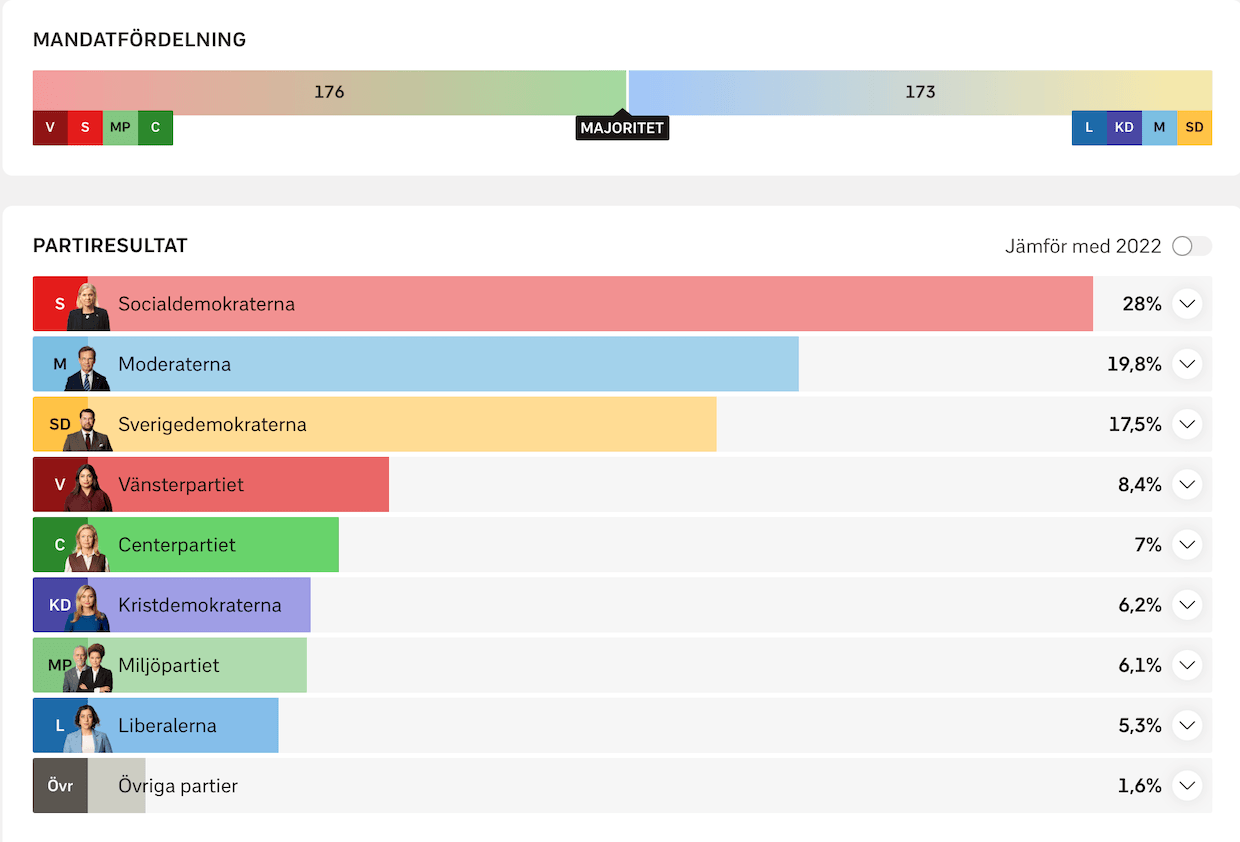
Professor Blombäck, welcome! Let me begin with the most striking paradox of the September 13 election. The Sweden Democrats fell from 20.5 percent in 2022 to 17.48 percent and lost ground for the first time since entering Parliament, yet many policies and frames associated with SD—particularly on immigration, integration, crime, citizenship, and deportation—have become considerably more mainstream. How should we distinguish between an electoral setback for a populist radical-right party and the longer-term success of its political agenda? Can a party lose votes while simultaneously winning the ideological argument?
Dr. Sofie Blombäck: It’s still a little early to determine exactly what caused this setback in the Sweden Democrats’ electoral fortunes. The party itself tends to blame strategic voting, arguing that some of its supporters voted for the Liberals. I’ve also seen suggestions that it lost some votes to parties even further to the right that failed to enter Parliament.
But I believe another factor is that some voters supported the Sweden Democrats because they wanted tougher migration policies and a tougher approach to crime. In a sense, they have now gotten what they wanted. On migration, parties across the political spectrum, including the Social Democrats, are essentially campaigning to maintain the current policy direction, which has been heavily influenced by the Sweden Democrats.
So, for voters who supported the Sweden Democrats in the last election because they wanted tougher migration policies, those policies are now largely in place. They may not want to go as far as the Sweden Democrats do, but they are perhaps fairly confident that another government, whether led by the Moderates or the Social Democrats, would not return to the migration policies Sweden had 10 years ago, or even four years ago.
The Cordon Sanitaire Is Gone, but the Stigma Around the SD Has Not Disappeared
Your research with Niklas Bolin and Stefan Dahlberg found a persistent “stigmatization effect”: voters evaluated identical proposals less favorably when they were told that the proposal came from SD, even after the party had grown substantially and its political isolation had weakened. After four years in which SD exercised extensive influence through the Tidö agreement, what would you expect that stigma to look like today? Has SD finally acquired something closer to a “reputational shield,” or might voters still distinguish sharply between accepting SD-inspired policies and accepting SD itself?
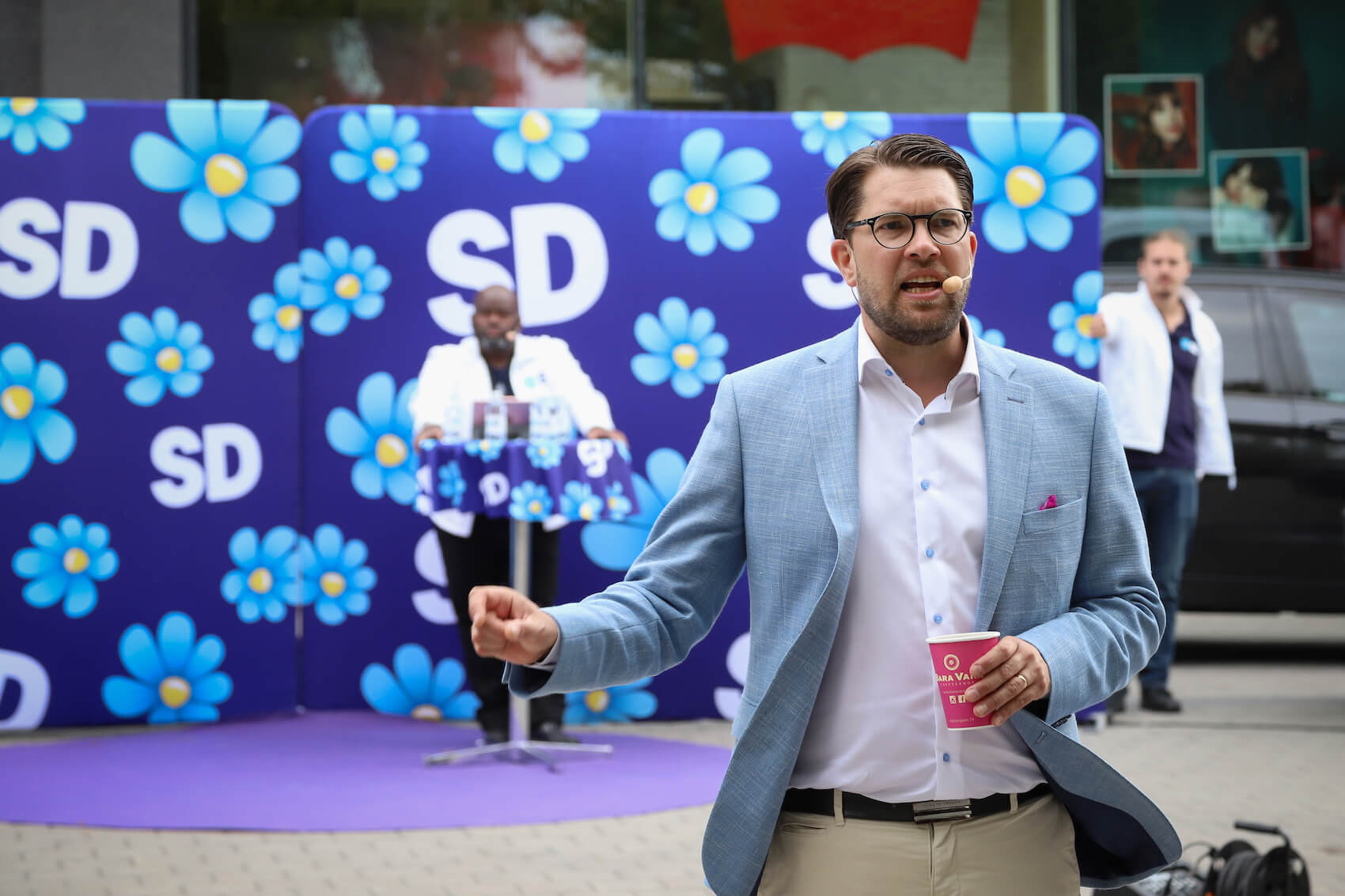
Dr. Sofie Blombäck: One of the most memorable moments from the election-night coverage was when the Sweden Democrats’ party leader, Jimmie Åkesson, went on stage before the cameras and said that their voters no longer needed to feel ashamed. From the party’s perspective, this seems to have cemented its status as a party like any other.
It would be really interesting to run the same experiments now, after four years with a government influenced by the Sweden Democrats. Unfortunately, we haven’t been able to do that. There is probably still some stigma attached to the Sweden Democrats, but it is not as universal as it was four years ago. All the parties on the right are now on the record saying that they would be willing to include the Sweden Democrats in a government. So, the cordon sanitaire is gone; it is no longer in effect. But among voters on the left, the Sweden Democrats remain highly stigmatized.
We do not yet know what the government will look like, but for the Sweden Democrats, being allowed to join a government after this election was supposed to be the final step into the political mainstream. At the moment, a left-wing government appears more likely, and the Sweden Democrats are not the largest opposition party. One outcome of this election, therefore, is that they are neither able to enter government nor become the default opposition leader by virtue of being the largest opposition party. So, they are not quite fully accepted into the mainstream, but the stigma has clearly decreased.
Countering the Party Does Not Necessarily Mean Countering the Ideas It Represents
That distinction seems particularly important for understanding normalization. Should we analytically separate the normalization of a party from the normalization of its ideas? If mainstream parties adopt restrictive migration policies, assimilationist rhetoric, or tougher approaches toward citizenship while SD itself remains socially or morally stigmatized for some voters, are we dealing with partial normalization rather than full political mainstreaming?
Dr. Sofie Blombäck: That’s a strategy that parties across Western Europe have tried in response to SD and other parties in the same political family. There has been considerable debate among mainstream parties over what the most effective strategy should be. If the goal is to counteract the party as an organization, one option is to adopt some of its positions and policies. If voters can obtain the policy ideas associated with a right-wing party from another party that does not carry the same stigma, that may, of course, be more palatable to some of them.
Other voters, however, may actually be attracted to the anti-establishment rhetoric itself. But, as your question suggests, countering the party does not necessarily mean countering the ideas that the right-wing populist party represents. Those ideas can still become normalized. We know from research that voters take cues from party leaders. If the leader of the party you support says that a proposal or policy is good and acceptable, you are more likely to agree with it. By adopting the right-wing party’s policies and messages, other parties are therefore, in effect, contributing to the mainstreaming of those ideas.
That being said, one explanation political scientists in Sweden have offered for the rise of the Sweden Democrats is that the party was able to tap into ideas and preferences that were already present in the electorate. Immigration used to be one of the issues on which the electorate and elected representatives differed most. Members of the Riksdag (Swedish Parliament) were much more pro-immigration and more accepting of refugees than the average Swedish voter. In that sense, the Sweden Democrats helped align these two groups by becoming the party-political expression of an idea or preference that was already present in the electorate.
Sweden Is a Country of Immigrants
The 2026 campaign also exposed the continued importance of anti-immigration and, at times, explicitly anti-Islam politics. SD’s campaign included proposals concerning Islamic dress, while opposition mobilization was particularly strong in some immigrant-dense urban districts. How should we distinguish legitimate democratic debate over immigration, integration, and secularism from forms of political mobilization that turn Muslims or immigrants into collective objects of suspicion? At what point does cultural conflict become exclusionary or nativist politics?
Dr. Sofie Blombäck: This is one of the issues that has carried over into the post-election public debate. I mentioned earlier that one of the memorable moments from the election-night coverage was when the Sweden Democrats’ leader said that their voters no longer needed to feel ashamed. Another memorable moment came during the final party leaders’ debate before the election, when Jimmie Åkesson said that this could be the first election decided by the immigration that the other parties had allowed.
This has become a recurring trope over the past couple of weeks. There have been articles and media coverage from various outlets debating whether this election was won by Sweden’s newest citizens. Electoral participation increased in some of the most vulnerable, socioeconomically deprived areas, where many relatively recent migrants live and where some residents may not have been Swedish citizens four years ago. Of course, this has sparked a debate over whether this is a positive development. We generally want citizens to vote; that is regarded as democratic. Yet the Sweden Democrats and some other opinion leaders on the right have portrayed this participation as threatening.
The argument is that the parties on the left—the Left Party and the Social Democrats—have mobilized voters who do not really know what they are doing and are essentially voting the way they are told. This has been compounded by accusations of electoral impropriety concerning one particular candidate of Somali heritage in a small Swedish town.
So, this is still very much up in the air and further complicates the discussion. I realize I have not yet directly answered your question, but it connects to the same debate over immigrants, and especially Muslim immigrants, as either a potential problem or legitimate political actors.
The parties on the left would say that we should not be surprised that voters in these communities overwhelmingly support parties on the left, because parties on the right want to deport them and their neighbors. So why would you vote for a party that has said it does not want you to be here?
This is something Sweden is going to have to grapple with over the coming weeks and months. In my personal view, the debate has become quite ugly over the past week or two.
Sweden is a country of immigrants. A substantial share of the adult population has roots outside Sweden, including outside Europe, and this brings the issue to the forefront. When you have one party mobilizing against this group, even questioning their legitimacy as political actors, the implications become particularly significant.
So, it is not new. This has always been part of the Sweden Democrats’ electoral appeal, but it has been brought more clearly to the forefront, not least because I have seen others joining this discussion and accepting its premise. At the same time, you also see pushback from the left, arguing that you might just as well say that churchgoers decided the election, or point to various other groups that also account for roughly the 50,000-vote difference between the two blocs. You can identify such groups across many demographic categories, not just among new citizens.
Voters Judge the Same Policy Differently Depending on Who Proposes It
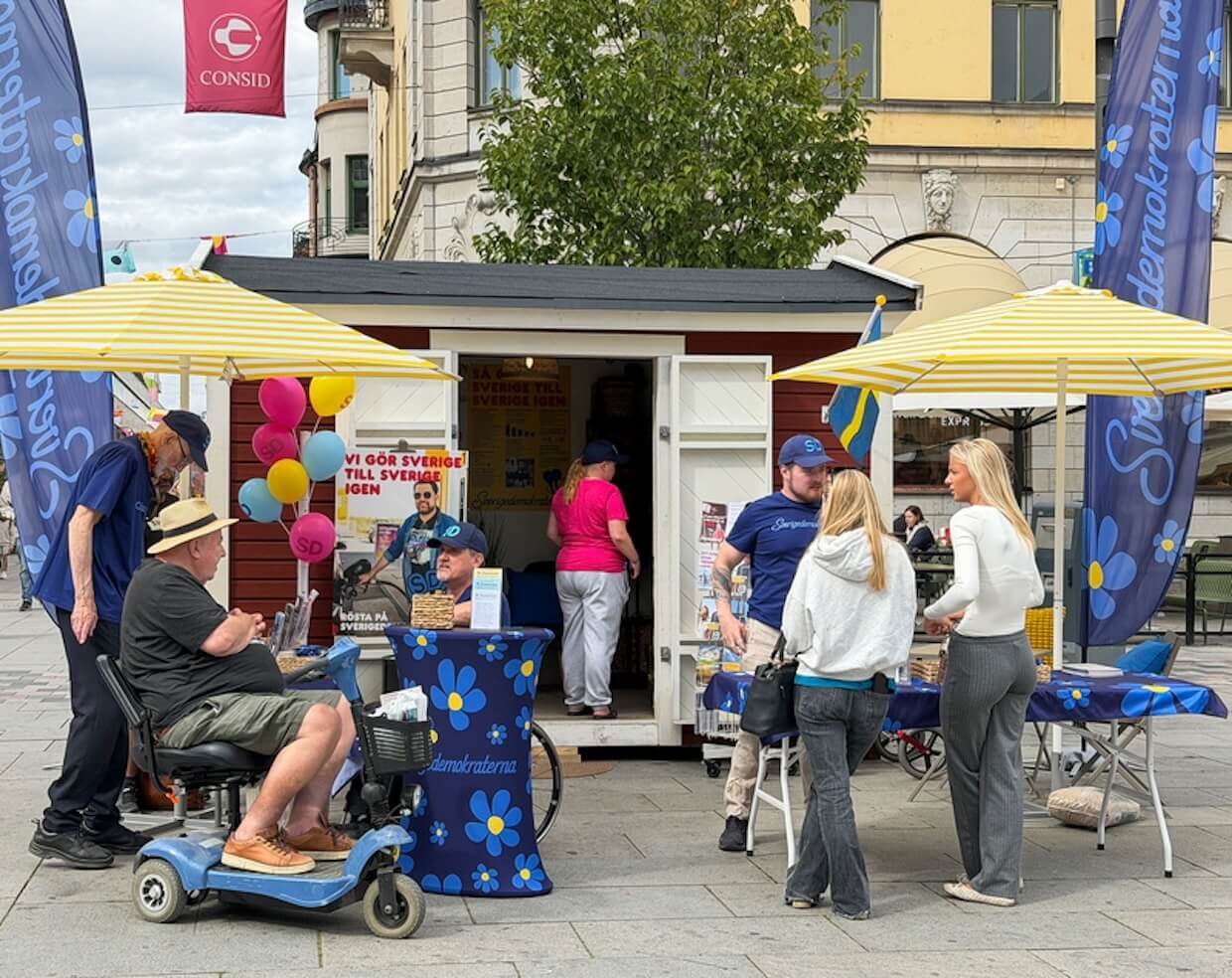
One implication of your stigmatization research is that party labels themselves function as powerful political cues. But what happens when policies first associated with the radical right are subsequently proposed by mainstream parties? Does the removal of the SD label make restrictive proposals more acceptable—and, if so, can mainstream parties become important agents in laundering or legitimizing ideas that were previously considered too radical?
Dr. Sofie Blombäck: That’s certainly what our results indicate. A proposal, regardless of its content, is seen more favorably when it comes from a party other than the Sweden Democrats, or from the voter’s own preferred party. So, this goes back to the idea of elite cues. If your preferred party proposes a policy, you are more likely to agree with it than if it is proposed by a party you disagree with. This is compounded by the stigma attached to a party like the Sweden Democrats.
For some voters, a proposal is never going to be acceptable if it comes from the Sweden Democrats, almost regardless of whether it involves free puppies and ice cream for everyone; they are going to regard it with suspicion. But the flip side is exactly what you are pointing to: the other parties, the more mainstream or established parties, want to neutralize the SD. They do not want to lose voters to the Sweden Democrats. The party grew to become the second-largest party and is now the third-largest party in the party system. Of course, the other parties want those voters back, and one way of doing that is by giving voters what they want in terms of policy. But that, of course, also removes some of the stigma.
There is other research by researchers such as Elisabeth Ivarsflaten that points to the fact that we have an internal stigma as well. We do not want to believe ourselves to be racist, for example. Nobody wants to be thought of by others as racist, but we also do not want to think of ourselves that way. So, we need some way of convincing ourselves that supporting a specific policy does not make us a bad person, a racist, or an elitist, or whatever the bad thing may be. If you can say that someone else who is not racist, not elitist—whatever the bad thing is—is also supporting this policy, then it becomes easier to believe that I’m not racist either. This can probably work in quite a few different ways.
The Mainstream Right’s Cooperation with SD Is a Double-Edged Sword
This raises a strategic problem for the mainstream right. The Moderates and other Tidö parties governed with SD support and adopted substantial elements of its agenda, yet SD still received 17.48 percent while the Tidö bloc narrowly lost its parliamentary majority. Does the Swedish case suggest that accommodation can simultaneously normalize the radical right and fail to neutralize it electorally? What does this tell us about the conventional assumption that mainstream parties can compete away populist radical-right support by moving toward its positions?
Dr. Sofie Blombäck: One way many political scientists in Sweden have tried to understand the other Tidö parties’ shift toward the Sweden Democrats is through basic electoral math. After the 2018 election, the Center Party (C) and the Liberals (L) signaled that, when forced to choose between a government dependent on the SD and one involving the Social Democrats—the traditional adversary of the parties on the right—they chose the Social Democrats.
That left the Moderate Party (M) and the Christian Democrats (KD) in a position where they could no longer see a viable path to government without the Sweden Democrats. If they could not rely on parties in the center of the party system to help them govern with SD support, they still needed the Sweden Democrats because the party was large enough that any Moderate-led government would at least require it not to actively oppose them. Mathematically, unless something changed significantly, that seemed to imply permanent opposition for the Moderates and Christian Democrats.
So, in that situation, the obvious option was to open up to collaboration. We have seen similar developments in other Western European countries, where mainstream parties on the right have included populist-right parties because they needed them electorally to gain office. In a sense, this is basic coalition theory 101.
But, of course, that also gives a party like the Sweden Democrats considerable leverage. They could demand policy concessions in 2022, and if a right-wing government were to be formed now—which does not appear to be the first option, though we do not yet know—they would demand inclusion as a full coalition member.
That, in turn, means that the other parties on the right are effectively signaling that the Sweden Democrats are not a pariah party and are no longer beyond the pale. This can limit SD’s growth, as I mentioned earlier, by allowing the other parties to win back voters who may be Moderates at heart but wanted stricter migration policy. Those voters can now return to the Moderate Party, potentially placing a ceiling on the Sweden Democrats’ support.
At the same time, however, this also signals to the perhaps 75 percent of Sweden Democrat voters who are hardcore party identifiers that it is acceptable to be a Sweden Democrat. They are no longer voting for a stigmatized party, and their party can exert real policy influence, so they are not, in that sense, wasting their vote. So, it is a double-edged sword, but coalition theory helps explain why the other parties still feel compelled to make this choice.
The Swedish Party System Has Tilted Diagonally
Your broader work on representative democracy emphasizes the importance of ideological contestation and the linkage between parties and citizens. If established parties increasingly converge on restrictive immigration and integration policies, while voters who disagree migrate toward V, MP, C, or other alternatives, could Sweden be witnessing a new form of realignment rather than simply a temporary swing between blocs? What would constitute convincing evidence that a new cleavage structure has emerged?
Dr. Sofie Blombäck: This has already taken place in Sweden, and I would go back to the 2018 election as the crucial point. If we think of left-right economic policy as one dimension and the GAL-TAN (Green, Alternative, Libertarian / Traditional, Authoritarian, Nationalist) cultural dimension as another—covering migration, environmental policy, and various other issues—the Swedish party system has tilted diagonally.
For several elections in the early 2000s, we had a quite rigid two-bloc system, with M, KD, L, and C on one side, and the Social Democrats (S), Greens (MP), and Left Party (V) on the other. This was stable enough that some of my colleagues compared Sweden to almost a two-party system because the two blocs were so dominant. Then the Sweden Democrats entered and disrupted this left-right division. The Sweden Democrats were mobilizing on the other dimension, the GAL-TAN dimension.
For a couple of elections, the other parties tried to pretend that SD was not there, isolating the party and carrying on with left-right politics as usual. But what happened in 2018 was that the two parties in the center, C and L, had both promised not to support or join any government dependent on SD because, in their words, SD was a racist party. The then-L leader even said, “I have promised my children that I will never do this.” At the same time, they had promised voters that they would not support a Social Democratic and left-wing government because they did not like its left-wing economic policies.
Then came the longest government formation in Swedish history. Usually, government formation takes a week. This time, it took months. In the end, despite the fact that both parties would have preferred some sort of centrist coalition, they were forced to choose because the other parties refused to go along with the idea of a grand coalition in the middle.
So, when it came down to it, C and L chose to align with the parties they agreed with on the GAL end of the GAL-TAN scale rather than with the parties they agreed with on the economic right. This marked the first step toward what we are now beginning to see as a new two-bloc system, where the parties on the right-TAN side have included SD, while the Center Party has remained on the left-GAL side and the Liberals have moved back. They have now let go of their red line on the Sweden Democrats.
So, it is not that this is supplanting the way Swedish politics usually works. We tend to like bloc politics, apparently, but the content of the blocs has changed, both in terms of the parties involved and their ideological content.
The Left Party Is Not Guaranteed a Place in a Left-Wing Government
The Left Party (V) increased its support to 8.40 percent and 30 seats. In your earlier research on V, you argued that the party’s position in the party system depends heavily on how other parties, especially the Social Democrats, relate to it. Does the 2026 result strengthen V as an autonomous pole of the Swedish left, or does its influence still depend fundamentally on whether Social Democrats treat it as a legitimate governing partner rather than merely a parliamentary support party?
Dr. Sofie Blombäck: This is another issue that remains very much up in the air. Right now, the main stumbling block for Magdalena Andersson, the Social Democratic Party leader, is that she has been asked by the outgoing parliament speaker to try to form a government. But she would need support from the Left Party and the Greens, as well as the Center Party, and the Center Party is not at all a fan of the Left Party. They have basically ruled out collaborating with them. They say they do not want to cooperate with either of the extremes in the party system: not the Left Party and not the Sweden Democrats.
The Left Party, meanwhile, is once again saying that it will not support a government in which it is not included. They have tried this before with the Social Democrats but have never succeeded. In the end, they have had to settle for budget cooperation and basically trade their parliamentary support for policy influence.
When we speculate about this around the coffee table at work, we tend to think that the Left Party may once again have to give in, because the Center Party is in a stronger negotiating position. It has more options. The party would still prefer some kind of centrist grand coalition, although that does not seem likely at the moment.
In a sense, they are in the same situation they faced in 2018. They either have to accept left-wing economic policies or accept the inclusion of the Sweden Democrats in government. So, my money is still on some form of left-wing government, but the Left Party is not guaranteed to be included in it. The accusations of electoral impropriety that have come to the forefront over the past week have not helped. Nor has the fact that, before the election, the Left Party had to basically expel some candidates who had been caught making statements considered anti-Semitic or too supportive of Hamas.
There have also been signals from the Social Democrats that they are not sure whether the Left Party is ready to be a governing party. The question, then, is what the Left Party will do. Unless the Social Democrats, in particular, can persuade it to change its position of refusing to support a government without being included in the coalition, the Left Party will probably be left with two options: either tolerate a right-wing government dependent on the Sweden Democrats or force an extra election.
That is something that simply does not happen in Swedish politics. All the parties are convinced that voters will not be happy if they fail to form a government and will punish whoever is perceived to be responsible. That being said, there is a scenario in which the Left Party might calculate that left-wing voters would appreciate a principled stand and that it might be able to peel off some additional voters from the Social Democrats. But I think that is unlikely.
Voters Can Move to the Left Party or Greens to Signal Disagreement with the Social Democrats
The Social Democrats remained the largest party but fell to 28.02 percent, while V and the Greens gained. How should we interpret this redistribution within the left? Could it indicate that S’s attempts to adopt more restrictive positions on immigration have weakened its ability to monopolize the progressive electorate, creating political space for parties that articulate clearer alternatives on migration, welfare, climate, or civil liberties?
Dr. Sofie Blombäck: In one sense, the decline of the Social Democrats reflects a long-running and geographically widespread trend that we have seen across many Western European countries. There is also a demographic challenge for the party. Many of its most loyal supporters are elderly, and the very old tend to vote at lower rates than younger citizens. Once you get past the age of 85, for example, making it to a polling station may simply become less of a priority.
At the same time, Swedish bloc politics has a long tradition of voters identifying more strongly with a political bloc than with a particular party. So, there is a group of voters who see themselves primarily as left-bloc voters. These voters may move between the Social Democrats, the Greens, the Left Party, and perhaps even the Feminist Initiative, depending on the election.
Part of that choice can be strategic. There is a long tradition of voting in ways that help keep all the parties in a preferred bloc above the electoral threshold. That has not really been an issue on the left in this election. It mattered much more on the right, where the Liberals were expected perhaps not to reach the 4 percent threshold but ultimately made it to around 5 percent.
Another form of strategic voting within the blocs is to signal the direction in which voters want the bloc to move. If you are a broadly left-wing voter but disagree with the Social Democrats’ attempt to neutralize the immigration and law-and-order issues by moving quite close to the Moderate Party, you can vote for the Left Party or the Green Party to signal that disagreement. Similarly, if you are particularly concerned about what the government has done with Swedish climate policy, you might move to the Green Party. You are still supporting a change of government, and you are still expecting Magdalena Andersson to become Prime Minister, but you are also signaling that you want the government to tilt more toward the green side.
So, this is a challenge for the larger parties in both blocs. They tend to compete for the median voter while simultaneously facing pressure from parties on their flanks. This is simply part of how Swedish politics works.
Both SD and V Are Now Firmly Entrenched in Swedish Parliamentary Democracy
This produces an interesting symmetry. SD challenges the mainstream from the radical right, while V seeks influence from the left. From a party-system perspective, what are the analytical dangers of treating the populist or radical right and the radical left as equivalent phenomena? Which dimensions—attitudes toward liberal democracy, pluralism, minorities, political equality, capitalism, nationalism, or institutional constraints—should scholars use to distinguish different forms of anti-establishment politics?
Dr. Sofie Blombäck: It depends somewhat on why we are interested in studying the symmetry. From a purely coalition-formation and bloc-politics perspective, the symmetry is quite clear. Both sides of the political spectrum have struggled with similar problems: each has a party on the flank that the more centrist members of the coalition do not like. This was even more pronounced in 2022, when the Liberals were still on the fence about the Sweden Democrats. This time, they climbed down off the fence on the Sweden Democrats’ side.
From that perspective, the challenge is quite similar. In terms of what this says about politics or political attitudes, however, they are very different parties. Both have problematic pasts, and this is often brought up, especially by politicians on the right and other opinion makers, when discussing the Left Party. It used to be the Communist Party many decades ago and was not regarded as a reliable party. During the national government in World War II, for example, the communists were excluded. They were not seen as trustworthy when all the other parties formed a joint coalition.
There is a history there. But it is, of course, much further back in time than the history of the Sweden Democrats. You then have people disagreeing over what the bigger problem is: communist roots or skinhead neo-Nazi roots. That is one part of the debate: are these equally bad or not? The other part concerns what the parties have done to rehabilitate themselves.
Both parties have had scandals involving candidates or local politicians who have been excluded for saying or doing things, often through posts on social media. That seems to be the downfall for many of these candidates because it is there in print. But I would say this has been more prevalent among the Sweden Democrats.
Of course, the argument from parties on the left—that it is ridiculous to compare the two—is not helped by instances during this election in which they have seemed not to really know who is on the ballot, particularly candidates placed quite far down the ballot in various parts of the country. This is usually something parties try to address by vetting candidates quite thoroughly.
But we also have the problem in Sweden, as in other countries, of declining party membership. Parties increasingly struggle to find people willing to stand for office, especially local office, in many smaller municipalities. If you are faced with having no candidate at all or with a candidate you do not know very well, you might opt to give that person a chance. This is a problem that many smaller parties struggle with.
The final point I would make is that I do not think we can really regard either of these parties as anti-establishment anymore. They have both been part of governing arrangements, even if they have not formally been in government. This is especially true of the Left Party, which has played such a role for decades.
They are also trying very hard to become governing parties. In that sense, they are no longer mobilizing around the idea that “all the other parties are equally bad, and we are the ones here to shake up the system and do something new.” It is more that they are positioned at the ideological extremes, while both are nevertheless firmly entrenched in Swedish parliamentary democracy.
The SD Could Survive Isolation, but Governing Remains the Final Threshold
Your research on new political parties emphasizes that their long-term success depends not only on voter demand but also on political opportunity structures, established-party acceptance, leadership, and institutional conditions. Does SD’s trajectory illustrate how decisive established-party acceptance can be? To what extent did the transformation from cordon sanitaire to formalized parliamentary cooperation alter SD’s position more fundamentally than additional electoral growth would have done?
Dr. Sofie Blombäck: Most of the research I’ve done on this has focused on new parties in the context of the European Parliament, but I think it also translates to the national level. What I found was that acceptance by mainstream parties was very important, with populist radical-right parties being something of an exception to this rule. There are several cases across Europe in which such parties have managed to survive despite being isolated and placed behind a cordon sanitaire by other parties.
This is more speculative, but I would imagine that this is because they have been able to tap into voter demand for a particular type of policy among people who may be angry or dissatisfied enough that they are not deterred by knowing their party is unlikely to exercise much policy influence in the short term.
Of course, it is difficult to know what the counterfactual would have been if this invitation into the mainstream from parties on the right had not occurred. But the Sweden Democrats had contested elections for more than 10 years before they were first elected to Parliament, and for more than 20 years before they were first invited into the Tidö cooperation. Clearly, the party was capable of surviving on its own.
When we study new parties, however, we tend to think of their lifespan in terms of crossing different thresholds, and the Sweden Democrats have not yet crossed the final threshold of actually governing. They have not done so at the national level, although they have at the municipal level in some cases. In a way, that is the final hurdle to becoming a fully institutionalized part of the party system.
We Need to Look at Both What a Party Says and What It Actually Does
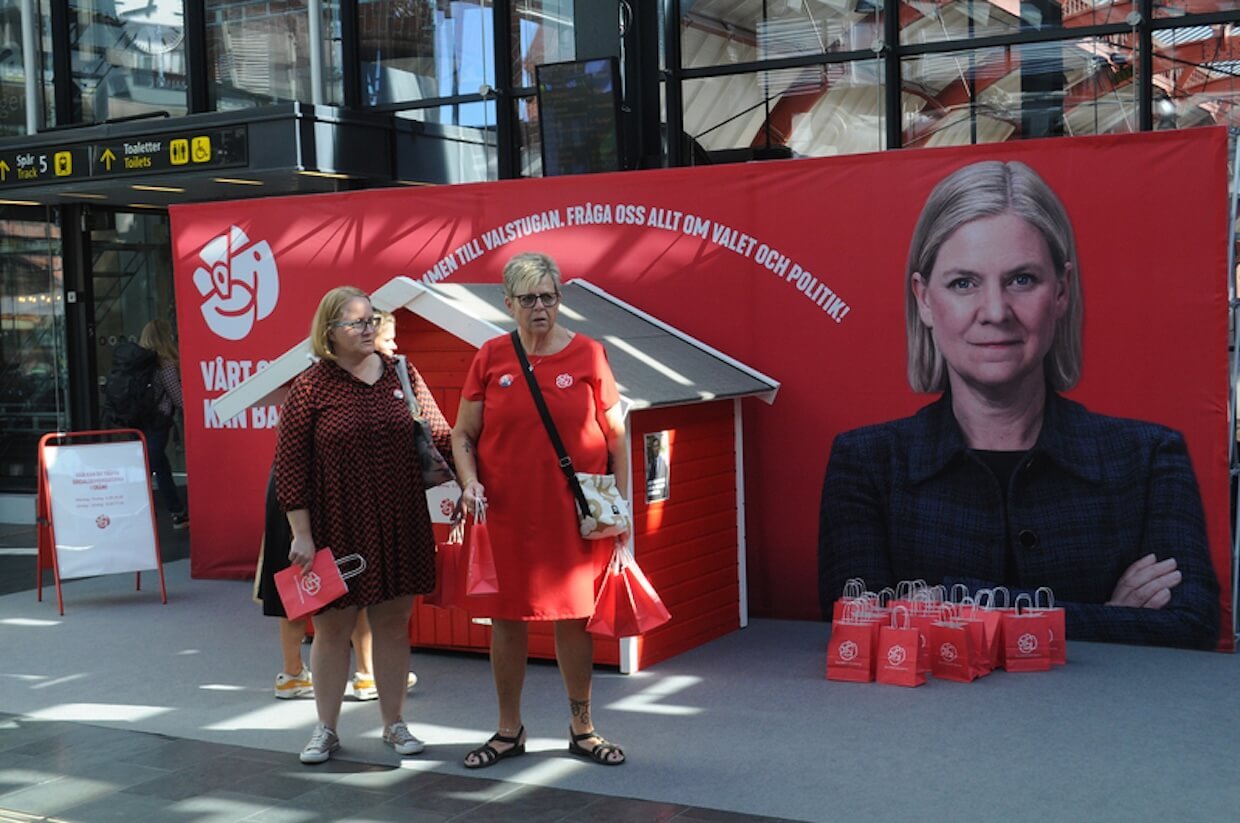
At the same time, the election raises a broader question about extremism. SD has spent years attempting to distance itself from its historical extremist origins while becoming an established parliamentary actor. What criteria should political scientists use when deciding whether a formerly extremist party has genuinely moderated, merely professionalized its communication, or instead succeeded in moving the boundaries of acceptable politics around itself?
Dr. Sofie Blombäck: We would need to look at both what the party says and what it does, but also at what the electorate thinks and does. This is quite straightforward to study. You can take the election manifestos and party programs of a party like the Sweden Democrats and trace the moderation of its positions, the shift in language from overtly racist rhetoric to more dog-whistle-style language, and some broader moderation of its stances.
Another example, unrelated to immigration, is the party’s position on Swedish EU membership. It was the last party to shift toward being, if not supportive, at least accepting of Swedish EU membership. That was a precondition for being invited to cooperate with the Moderates, who consider it very important that a partner be reliable on foreign policy.
That is one shift you can observe both in what the party says and in what it does. It no longer opposes Swedish negotiating positions in the EU. These positions have to be presented to Parliament, and the Sweden Democrats used to hold a record for the number of times they disagreed and argued that Sweden should take a different position on various issues of EU policy. Now they have joined in supporting what the government has done.
So, this is a case of the party saying something and then following through in the way it votes and acts. Of course, the final hurdle would be to see what the party would actually do if it were given the post of Minister for Migration, which is something it very clearly wanted and expected to receive if the Tidö side won.
That is one way of looking at it. Another is to examine what voters think of the party. Stefan Dahlberg, my colleague with whom I co-authored the piece on stigmatization, has continued this line of research with other colleagues, looking at shifts in voter attitudes toward migration and support for the Sweden Democrats. In a recent paper, they identify some changes in the general level of acceptance for anti-migration attitudes at the very local level.
So, I would hesitate to identify a single criterion. In my own research, I tend to pay attention to what parties say they want to do and what they believe, but also to what they are actually willing to do. This is especially important when it comes to compromise, because it does not seem to be on the cards that the Sweden Democrats will gain a majority on their own. Nor does it seem likely that any party will do so in Sweden. We have eight parties in Parliament, after all.
So, it is not just a matter of what you say you believe, but also what you are willing to compromise on. In the Tidö agreement, the Sweden Democrats did not have to compromise much on their core issues. Because they were not allowed to join the government, they were given a great many policy concessions. If they were included in a coalition, I would imagine that the other parties might push back more. But that remains to be seen.
Migration and Identity Are More Difficult Areas for Broad Compromise
Your recent work on elite deliberation finds that political actors can engage in respectful, common-good-oriented discussion even when partisan commitments and economic constraints limit the space for genuine accommodation. Could deliberative mechanisms of this kind help reduce polarization around migration and identity, or are such conflicts qualitatively different because they involve moral boundaries, belonging, religion, and national identity rather than primarily distributive disagreements?
Dr. Sofie Blombäck: It’s a good question. We conducted our research at the local level, where many of these issues are simply not present. Local politics in Sweden often revolves around questions such as how to organize schools or elder care, or how to attract more business to the area, whereas issues of migration and nationality are firmly situated at the national level.
A further complication in simply transposing what we found at the local level to the national level is that scrutiny is much more intense in national politics. One of the key elements of this more deliberative style of decision-making is that all parties are willing to sit down and have these kinds of discussions, and that they are willing and able to do so without negotiating through the media. These are meetings held behind closed doors, and even in the municipality where we conducted our study, you could see a clear difference between how politicians spoke in public council meetings and how they interacted in non-public deliberative meetings.
More broadly, this ties into the debate on affective polarization, which is very much at the forefront these days. There is this question of who you can still talk to in the sense of, “I may disagree with your stances, but I still respect you as a person.” And I don’t think election campaigns are really the best place to look for that.
The flip side is that the Swedish Parliament has a long tradition of reaching broad consensus. But, as your question suggests, many of those broad agreements concern economic and redistributive issues where compromise is possible. Halfway between 0 and 100 is 50, but halfway between permanent residence permits and no permanent residence permits—there is no such thing as a half-permanent residence permit.
For that reason, these questions may be more difficult when it comes to forming broad agreements. But even here, there is historical precedent. Back in 2010, the then-Alliance government on the right formed an agreement with, among others, the Green Party on migration policy in order to neutralize the Sweden Democrats. They preferred to collaborate with parties on the other side of the bloc in order to neutralize the issue.
That agreement did not hold—or rather, positions shifted—but such arrangements are not unheard of.
The 2026 Election May Be More a Story of Continuity Than Dramatic Change
Sweden has often been portrayed as a high-trust, consensus-oriented democracy. Yet the rise of SD, sharper conflicts over Islam and immigration, and growing bloc fragmentation seem to challenge that self-image. Does the 2026 election suggest a weakening of the traditional Swedish consensus model—or could stronger ideological contestation actually improve representative democracy by giving citizens clearer alternatives rather than producing the depoliticization that your work on party linkage warns against?
Dr. Sofie Blombäck: It’s a double-edged sword. Normatively, we want voters to have choices. One way of looking at the Swedish tradition of bloc politics is that it tries to do both: you have broad blocs within which parties can cooperate, while voters can still choose among the different parties within those blocs.
I think it’s too early to draw firm conclusions from the 2026 election. One early interpretation that many political scientists have pointed to is that, despite a highly contentious campaign—particularly in the final couple of weeks, since the summer itself was relatively calm—the overall shifts in the election results were not that dramatic.
It can, of course, be politically dramatic if there is a change from a right-wing to a left-wing government. But the difference between the two blocs is only around 50,000 votes, and it was something similar in the previous election. So, in terms of voter movement between the blocs, the shift is not especially large. One story we are already seeing, therefore, is one of continuity rather than dramatic change.
Another point is that, since the Sweden Democrats emerged as an electoral force at the subnational level—in municipalities and regions—we have seen an increase in cross-bloc cooperation, often aimed at neutralizing the Sweden Democrats or other political challenges that established parties do not like. We have around 150 local parties, ranging from very pragmatic to highly populist, across Sweden’s municipalities.
In the last electoral period, almost 50 out of 290 municipalities were governed jointly by the Social Democrats and the Moderates, something that would be almost unthinkable at the national level today. Two elections ago, it was also unusual at the local level, but it has now become quite normal.
So, it is far too early to say that these developments will necessarily lead to increased polarization and the erosion of the Swedish collaborative model. They might weaken it. But one development I find more worrying is not the election result itself, but what has happened in the Swedish Parliament during the last parliamentary period.
Several of the informal norms that help Parliament function have weakened. For decades, the parties had an arrangement whereby, if a politician from one side of the aisle was sick or had another official duty—perhaps attending a meeting of the Council of Europe or the UN—a politician from the other side would abstain from voting in order to preserve the balance of power.
During the last parliamentary period, the Sweden Democrats were included in this system because they were part of the government side in Parliament. They then broke with the agreement on a vote concerning migration. They argued that they had reasons for doing so, but the result was that the other parties, particularly those on the left, said that if they could no longer trust the Sweden Democrats to uphold the bargain, they could not continue to abide by it either. It is essentially a kind of prisoner’s dilemma.
Another example concerns the Committee on the Constitution, which handles complaints against government ministers. It was unable to agree on a unified statement regarding this year’s list of complaints. That tradition is much less long-standing, but the process had gradually become less politicized. Several parliaments, and especially several speakers of Parliament, had tried to make it less political and more almost judicial in character.
That development has now also fallen away. It may simply be a temporary blip because this was an election year, but it is indicative of a less deliberative and less consensus-oriented form of parliamentary conduct. No-confidence votes have also increased, and so on.
So, I will be very interested to see what happens once the new Parliament is seated.
On Security and International Cooperation, Sweden Still Presents a United Front
Your research with Thomas Karv shows that Swedish public opinion toward the EU has evolved significantly and that major external shocks can reshape political attitudes. In an era of war in Europe, NATO membership, migration pressures, and heightened security concerns, could security politics displace immigration as the principal terrain of radical-right mobilization—or might the radical right increasingly connect external security, borders, anti-Islam, migration, and national sovereignty into a single political narrative?
Dr. Sofie Blombäck: This is a good example of traditional Swedish consensus politics. The issues of security and international cooperation have been fairly effectively neutralized by the fact that both the Social Democrats and the Moderates strongly supported Sweden’s application to join NATO in 2022, after Russia’s full-scale invasion of Ukraine. Both potential governing parties, or prime ministerial parties, have been very clear that politics stops at the water: on these issues, Sweden presents a united front.
There is also the fact that the Moderates have demanded that the Sweden Democrats not rock the boat when it comes to European cooperation and related matters. That has been a precondition for considering the party a possible partner in a coalition or other form of government cooperation.
It is also the case that the Sweden Democrats are perhaps less Russia-friendly than some of their counterparts elsewhere in Europe, even though there was a scandal shortly before the election involving a Sweden Democrat politician and their partner being potentially connected to the Kremlin. So, the issue remains problematic in that sense.
In the previous election, however, there was an almost securitization of immigration and crime through the wave of shootings and bombings linked to organized crime, which the Sweden Democrats and others very strongly connected to immigration.
In a sense, this has created a “be careful what you wish for” situation for the government parties, because these incidents have declined. Of course, the Tidö parties want credit for reducing the number of shootings and bombings, but voters are now effectively saying, “Yes, I don’t care about bombings and shootings anymore; now I care about something else. I want a better economy or something.”
So, the government parties are not really being rewarded for bringing those incidents down, and as a result, that argument has been much less visible in this election.
SD Entering Government Would Mark the End of Its Pariah Status
And finally, Professor Blombäck, looking beyond one election, what indicators should we watch to determine whether September 13 represents a durable turning point or merely a temporary interruption in Sweden’s long-term political realignment? Would the most revealing signs be SD’s future vote share, the persistence of its policy influence, continued mainstream adoption of its positions, the strength of V and other alternatives, changing attitudes toward immigrants and Muslims, or the ability of mainstream parties to rebuild stronger representative linkages with citizens?
Dr. Sofie Blombäck: I think what could really mark a shift is if the government formation turns out to involve neither of the two teams or blocs that we have discussed throughout this election cycle. There have been persistent attempts by some parties to form a more centrist type of government that is not dependent on either V or SD.
If that were to happen, it would change the balance within the party system and would probably also have electoral repercussions next time around. So, in terms of the Swedish political system as a whole, that would probably be the most momentous development that could emerge from this election.
In terms of what this says about SD and the attitudes and policies associated with it, if, for some reason, we end up with a new Tidö agreement—it is not completely out of the question, even if it is not the most likely scenario—and SD is included in government, that would probably be what we remember from this election. It would mark the end of the party’s pariah status and could also have repercussions across a wide range of policy areas.