In this commentary, Dr. Hafza Girdap examines Turkey’s intensifying anti-gender politics through the interconnected concepts of gendered populism, gendered authoritarianism, and differentiated citizenship. Using the September 2026 “My Family Is Safe” crackdown as a focal point, she argues that family, morality, sexuality, childhood, and national belonging are increasingly mobilized to distinguish ‘legitimate citizens’ from threatening “Others.” Central to her framework is the proposition that “gendered populism” constructs and mobilizes the boundaries of legitimate belonging; “gendered authoritarianism” institutionalizes and enforces those boundaries; and the “established citizen” embodies the normative subject whom these processes simultaneously produce and claim to protect. The article situates contemporary anti-LGBTQ+ repression within a longer transformation of citizenship, political homophobia, and family-centered authoritarian governance in Turkey.
By Hafza Girdap
In September 2026, Turkish authorities launched a nationwide crackdown under the strikingly familial title “My Family Is Safe” (Ailem Güvende). According to the Turkish Minister of Justice, investigations encompassed 162 individuals, nine associations, and 13 businesses across 15 provinces. Police raids, arrests, searches, seizures, and restrictions on websites and social media accounts disproportionately affected LGBTQ+ organizations, activists, journalists, and spaces associated with queer communities. The authorities have framed the crackdowns through allegations including obscenity, prostitution, exposure of children to inappropriate content, and questionable financial relationships, while presenting the broader campaign as part of the state’s protection of children, families, and social order.
The prosecution of journalist Tuğba Tekerek makes the expanding boundaries particularly visible of this campaign. Tekerek was detained in connection with an article she had written two years ago for Kaos GL magazine/website about LGBTQ+ experiences surrounding elections in Georgia; she was subsequently arrested pending trial on suspicion of obscenity. The significance of these developments therefore extends beyond the immediate policing of sexuality. They raise a larger sociological question about how family, morality, gender, sexuality, childhood, and national belonging become politically interconnected categories through which ‘legitimate’ and ‘illegitimate’ subjects are distinguished (Girdap, 2026).
It is important to note that the current campaign is not an isolated episode but a particularly visible manifestation of a longer transformation in the gendered politics of citizenship in Turkey. Well before the current anti-LGBTQ+ crackdown, women’s rights had increasingly been reframed through a family-centered policy discourse in which women were positioned predominantly through motherhood and wifehood; feminist organizations and LGBTQ+ identities were simultaneously subjected to delegitimizing discourses (Sarac et al, 2023). Following the failed coup attempt of July 2016, these processes intensified as women’s organizations were closed, women associated with political opposition were subjected to gender-specific forms of punishment, and women’s identities and familial relationships themselves became sites through which political repression could operate. Post-coup migration similarly demonstrates that state-led and state-sanctioned gendered violence increasingly targeted not only women but also people positioned outside dominant understandings of national belonging on the basis of gender and sexual identity, ethnicity, religion, and political affiliation.
The campaign surrounding the Istanbul Convention provides an especially important bridge between these earlier developments and the present moment. As I have previously argued, contemporary right-wing populism frequently makes gender and sexuality central to the production of political antagonism: the heteronormative family is elevated as the normative model of social organization, while reproductive rights, LGBTQ+ identities, and gender ideology are constructed as challenges to it. In Turkey, the government’s renaming of the Ministry of Women and Family as the Ministry of Family and Social Policy symbolically relocated women within the family, while political discourse increasingly presented motherhood, children, religion, and the traditional family as markers of legitimate gendered belonging. The subsequent representation of the Istanbul Convention as a threat to the family demonstrates how gender discourse can participate in constructing an antagonistic ‘Other’ while simultaneously legitimizing the consolidation of political authority.
I conceptualize this process as gendered populism operating through gendered authoritarianism (Girdap, 2026). Gender here is not merely another policy domain upon which authoritarian politics happens to act. Rather, it becomes one of the mechanisms through which political membership itself is imagined and regulated. Populist distinctions between the ‘legitimate people’ and ‘threatening Others’ acquire gendered, sexualized, familial, religious, and moral content. Authoritarian power can subsequently translate those distinctions into institutional practices through law, policing, prosecution, censorship, restrictions on civil society, and regulation of public visibility. The family consequently functions not simply as a private institution or conservative value but as a political technology of boundary-making: protecting the family simultaneously requires defining which families, gender performances, sexualities, bodies, relationships, and forms of public participation are recognizable as legitimate.
Drawing on the conception of gendered citizenship, Turkish citizenship has historically been organized through hegemonic masculinities and heteronormative requirements of belonging, while nationalism, militarism, religion, ethnicity, and gender intersect in producing differentiated access to social and political membership (Unlu, 2023). Turkishness, thus, is not merely a formal legal identity but an institutionalized regime of belonging in which gendered, racialized, ethnic, and religious hierarchies regulate who can inhabit the national subject without having their belonging questioned. This distinction between formal citizenship and substantive belonging is particularly important: minority women and LGBTQ+ individuals may be citizens in law while remaining positioned outside a narrower heteronormative conception of the socially legitimate Turkish citizen (Girdap, 2026).
I therefore employ the concept of the established citizen to capture this relationship between formal membership and normative belonging. The established citizen is not simply the person who possesses Turkish citizenship. Rather, it is the subject whose gender, sexuality, familial position, religion, ethnicity, political comportment, and relationship to dominant national narratives most readily conform to the historically shifting expectations of legitimate Turkishness. Importantly, this ideal is neither historically fixed nor produced exclusively by contemporary political Islam. Competing hegemonic masculinities, including modernist-secularist, Islamist, ultranationalist, and other political formations, have differed in their prescriptions while repeatedly making women’s bodies, appearance, sexuality, reproduction, and public participation sites upon which competing projects of nationhood are enacted (Özbay & Soybakis, 2020). Gendered authoritarianismtherefore does not invent gendered citizenship; it intensifies, reorganizes, and politically mobilizes its already existing boundaries.
Seen through this framework, the September 2026 crackdown poses a question considerably larger than whether the Turkish state is becoming more hostile toward LGBTQ+ people. It asks who can inhabit citizenship without having to continually establish their legitimacy. When family, morality, childhood, sexuality, national values, foreign influence, and public order converge within the same political vocabulary, the boundary between protecting an institution and policing a population becomes analytically crucial.
The current moment can therefore be read as an intensified stage in a longer process through which gendered populismidentifies the normative people, gendered authoritarianism disciplines those positioned beyond its boundaries, and the established citizen ideal supplies the gendered and moral architecture of belonging. Hence, rather than treating today’s crackdown as the beginning of a new politics, I ask what its vocabulary of family, morality, danger, and protection reveals about the gendered architecture of citizenship that made this politics possible in the first place.
Homophobic Populism, Populist Homophobia, and Anti-Gender Politics
Political homophobia is not merely hostility toward LGBTQ+ identities; it can function as a technology of political boundary-making through which the ‘legitimate people,’ the ‘threatening Other,’ and the moral boundaries of national belonging are constructed (Unal, 2024). Drawing on the concept of ontological security, Unal (2024) examines people’s need for a relatively stable sense of self, identity, continuity, and social world. Populist crisis discourse can generate ontological insecurity by presenting family, nation, morality, and culture as endangered. From the perspective developed here, this insight adds another dimension to the established citizen: the established citizen is not only the citizen who conforms to normative expectations but can also be constructed as the citizen who must be protected.
The contemporary mobilization against LGBTQ+ rights should be understood not as an isolated national political development but as part of a broader transnational anti-gender movement whose organizational strategies and discursive repertoires have developed through earlier anti-abortion campaigns (Kahlina et al., 2025; Ojeda et al., 2024). In this transformation, political struggles previously organized around opposition to abortion have increasingly expanded toward opposition to transgender rights, LGBTQ+ visibility, feminism, and what activists and political actors describe as gender ideology. Since the 2010s, populist leaders in diverse political contexts have adopted increasingly aggressive anti-LGBTQ+ and anti-feminist positions, often using gender and sexuality as politically mobilizing issues. While these strategies frequently seek alliances with conservative religious constituencies, their appeal is not limited to religious voters; anti-gender politics can also mobilize secular constituencies through broader narratives concerning family, children, morality, social stability, and national values (Corrales & Kiryk, 2022).
Homophobic populism, the strategic adoption of homo- and transphobic positions by populist political actors seeking electoral and political advantages, can create what amounts to a marriage of convenience among anti-pluralist populists, socially conservative secular actors, and conservative religious groups (Corrales & Kiryk, 2022). Populist politicians may promise socially conservative gender and sexuality policies in exchange for electoral support and, importantly, the political acquiescence of religious authorities toward other illiberal or anti-pluralist practices. Homophobic populism therefore operates simultaneously as an electoral strategy and a co-optation strategy. Gender and sexuality become useful not only for attracting socially conservative constituencies but also for constructing alliances that can facilitate broader challenges to political pluralism and democratic constraints.
A related but analytically distinct phenomenon is populist homophobia. Whereas homophobic populism describes political actors’ strategic deployment of homo- and transphobia, populist homophobia refers more specifically to the discursive mechanism through which anti-LGBTQ+ politics is translated into populist language (Corrales & Kiryk, 2022). Its central rhetorical mechanism is harm or victim inversion: groups that have historically experienced marginalization are reconstructed as powerful actors allegedly threatening the majority (Corrales & Kiryk, 2022). LGBTQ+ communities consequently cease to appear as minorities seeking equal rights and instead become represented as an intrusive or privileged elite whose demands are portrayed as radical, foreign, coercive, or dangerous to children, families, religion, and society.
This inversion is particularly important because it enables anti-gender politics to be articulated through the language of protection rather than exclusion. Opposition to LGBTQ+ rights can be presented not explicitly as hostility toward sexual and gender minorities but as the defense of apparently universal public goods: children, families, parental autonomy, religious freedom, morality, social stability, or even sustainable development. Within this discursive structure, the political subject is reorganized through a binary opposition: “ordinary people / families / children” versus “gender ideology / LGBTQ+ activists / foreign influence / threatening elites.”
Gender and sexuality thus become central terrains upon which the populist distinction between ‘a legitimate people’ and ‘an illegitimate Other’ is constructed. Unal (2024) similarly identifies the distinction between the ‘morally superior us’and the ‘morally corrupt them’ as central to populist constructions of ‘the people.’ ‘The Other’ is not merely different but is represented as threatening the homogeneous nation. Once positioned outside ‘the good people,’ such groups may become targets of stigmatization through discourse, policy, and legislation.
This framework also explains why cultural panic is politically consequential beyond LGBTQ+ rights themselves (Corrales & Kiryk, 2022). By representing gender and sexuality as existential threats to families and children, political actors can encourage voters to prioritize cultural and moral conflicts over material questions such as economic redistribution (Corrales & Kiryk, 2022). Anti-gender mobilization can therefore facilitate a broader political realignment in which disputes concerning sexuality become vehicles for constructing political identities, consolidating coalitions, and legitimizing anti-pluralist politics. The restriction of LGBTQ+ rights is consequently not necessarily the endpoint of homophobic populism; rather, attacks on gender and sexuality may function as an entry point through which broader restrictions on pluralism become politically acceptable.
These distinctions provide an important theoretical foundation for the gendered populism argument in this article that captures a broader process in which gender, sexuality, reproduction, and family are not peripheral themes within populist politics but constitutive mechanisms for defining ‘the people.’ The imagined legitimate citizen is produced relationally against subjects represented as violating normative gender, sexual, reproductive, familial, or moral expectations. Anti-gender discourse therefore does more than identify political enemies: it establishes normative boundaries around belonging.
Unal (2024) identifies three modalities through which political homophobia operated during Turkey’s 2023 election campaign: culturalist and nativist othering at the intersection of Islam and anti-genderism; the vilification of political opponents as “inner enemies”; and movement toward the legal and institutional incorporation of political homophobia. These modalities are particularly significant for understanding how anti-gender discourse can move from rhetorical boundary-making toward institutionalized forms of exclusion.
When this discursive politics becomes embedded in institutions, it intersects with what I conceptualize as gendered authoritarianism. The distinction is analytically important: gendered populism constructs and mobilizes the boundary; gendered authoritarianism institutionalizes and enforces it. The former identifies who supposedly threatens the family, children, morality, nation, or “the people”; the latter can translate those representations into law, policing, prosecution, censorship, surveillance, restrictions on organizations, and other mechanisms of state power. The relationship can therefore be conceptualized as:
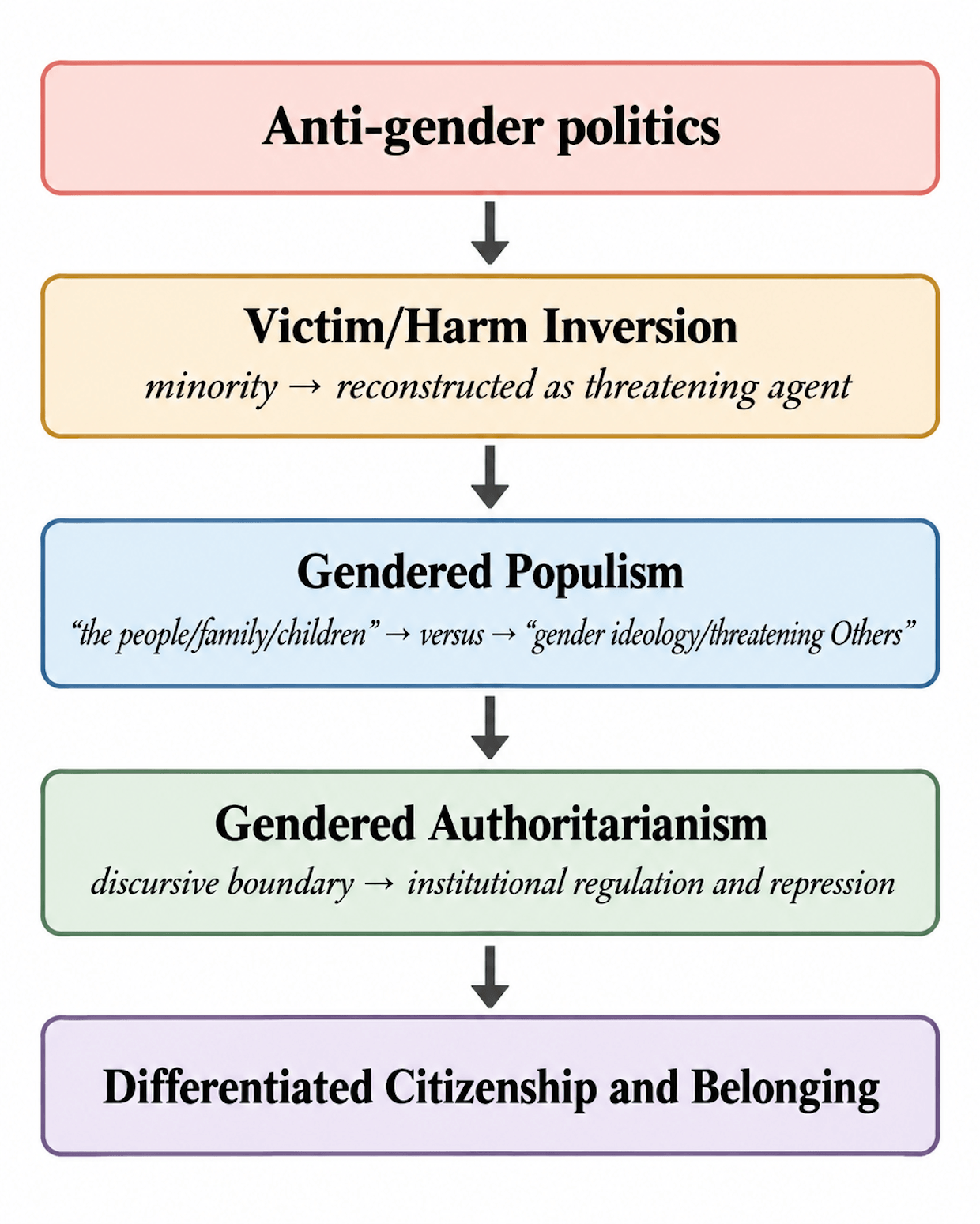 If populist anti-gender politics establishes the heteronormative family as a symbolic representation of the legitimate social order, conformity to particular gendered and sexual norms can become intertwined with the conditions of legitimate national membership. Family is therefore not simply something the state claims to protect; it becomes a political template through which ‘the legitimate citizen’ is imagined.
Unal’s (2024) concept of the crisisification of policymaking further helps explain how this boundary-making can become institutionalized. Crisisification describes the transformation of policymaking around a continuing sense of urgency, exceptionality, and insecurity, through which crisis becomes normalized rather than treated as an exceptional condition. Within the framework proposed here, this process provides an important link between gendered populism and gendered authoritarianism: once gender and sexuality are constructed as existential threats to family, morality, and nation, extraordinary forms of state intervention can increasingly be presented as necessary acts of protection.
This framework allows the analysis of Turkey to move from contemporary anti-LGBTQ+ mobilization toward the deeper historical question at the center of this article: How have gender, sexuality, family, religion, ethnicity, and political loyalty historically structured the boundaries between the established citizen and those whose belonging remains conditional, contested, or punishable?
The political function of anti-gender populism is therefore not exhausted by the production of an LGBTQ+ ‘Other.’Through that ‘Other,’ the normative citizen is simultaneously produced. Political homophobia tells us not only who does not belong but also who the state imagines as properly belonging.
References
Corrales, Javier and Jacob Kiryk. (2022.) "Homophobic Populism." In: Oxford Research Encyclopedia. https://doi.org/10.1093/acrefore/9780190228637.013.2080
Girdap, H. (2026). “Gendered authoritarianism, social death, and state violence in post-2016 Türkiye.” Journal for Humanitarian Conflict Resolution, 1(1).
Girdap, H. (2026). “Contextual racialisation of women in Turkey: Their response through embodied identification.” In: Shilan Fuad Hussain (Ed.), Women, power, and gender in the Middle East. Routledge.
Kahlina, K.; Ristivojevic, D. & Rudgren, H. (2025). “Transnational politics of anti-gender mobilizations.” Redescriptions: Political Thought, Conceptual History and Feminist Theory, 28(1).
Ojeda, T.; Holzberg, B. & Holvikivi, A. (2024). “A transnational feminist approach to anti-gender politics.” In: A. Holvikivi, B. Holzberg, & T. Ojeda (Eds.), Transnational anti-gender politics: Feminist solidarity in times of global attacks (pp. 1–32). Palgrave Macmillan.
Özbay, C. & Soybakis, O. (2020). “Political masculinities: Gender, power, and change in Turkey.” Social Politics: International Studies in Gender, State & Society, 27(1), 27–50.
Sarac, B. N.; Girdap, H. & Hiemstra, N. (2023). “Gendered state violence and post-coup migration out of Turkey.” Women’s Studies International Forum, 99, 102796.
Unlu, B. (2023). “The Turkishness contract and the formation of Turkishness.” In: F. M. Gocek & A. Alemdaroglu (Eds.), Kurds in Dark Times. Syracuse University Press.

From ‘My Family Is Safe’ to Gendered Authoritarianism: Redrawing the Boundaries of Belonging in Turkey
In this commentary, Dr. Hafza Girdap examines Turkey’s intensifying anti-gender politics through the interconnected concepts of gendered populism, gendered authoritarianism, and differentiated citizenship. Using the September 2026 “My Family Is Safe” crackdown as a focal point, she argues that family, morality, sexuality, childhood, and national belonging are increasingly mobilized to distinguish ‘legitimate citizens’ from threatening “Others.” Central to her framework is the proposition that “gendered populism” constructs and mobilizes the boundaries of legitimate belonging; “gendered authoritarianism” institutionalizes and enforces those boundaries; and the “established citizen” embodies the normative subject whom these processes simultaneously produce and claim to protect. The article situates contemporary anti-LGBTQ+ repression within a longer transformation of citizenship, political homophobia, and family-centered authoritarian governance in Turkey.
By Hafza Girdap
In September 2026, Turkish authorities launched a nationwide crackdown under the strikingly familial title “My Family Is Safe” (Ailem Güvende). According to the Turkish Minister of Justice, investigations encompassed 162 individuals, nine associations, and 13 businesses across 15 provinces. Police raids, arrests, searches, seizures, and restrictions on websites and social media accounts disproportionately affected LGBTQ+ organizations, activists, journalists, and spaces associated with queer communities. The authorities have framed the crackdowns through allegations including obscenity, prostitution, exposure of children to inappropriate content, and questionable financial relationships, while presenting the broader campaign as part of the state’s protection of children, families, and social order.
The prosecution of journalist Tuğba Tekerek makes the expanding boundaries particularly visible of this campaign. Tekerek was detained in connection with an article she had written two years ago for Kaos GL magazine/website about LGBTQ+ experiences surrounding elections in Georgia; she was subsequently arrested pending trial on suspicion of obscenity. The significance of these developments therefore extends beyond the immediate policing of sexuality. They raise a larger sociological question about how family, morality, gender, sexuality, childhood, and national belonging become politically interconnected categories through which ‘legitimate’ and ‘illegitimate’ subjects are distinguished (Girdap, 2026).
It is important to note that the current campaign is not an isolated episode but a particularly visible manifestation of a longer transformation in the gendered politics of citizenship in Turkey. Well before the current anti-LGBTQ+ crackdown, women’s rights had increasingly been reframed through a family-centered policy discourse in which women were positioned predominantly through motherhood and wifehood; feminist organizations and LGBTQ+ identities were simultaneously subjected to delegitimizing discourses (Sarac et al, 2023). Following the failed coup attempt of July 2016, these processes intensified as women’s organizations were closed, women associated with political opposition were subjected to gender-specific forms of punishment, and women’s identities and familial relationships themselves became sites through which political repression could operate. Post-coup migration similarly demonstrates that state-led and state-sanctioned gendered violence increasingly targeted not only women but also people positioned outside dominant understandings of national belonging on the basis of gender and sexual identity, ethnicity, religion, and political affiliation.
The campaign surrounding the Istanbul Convention provides an especially important bridge between these earlier developments and the present moment. As I have previously argued, contemporary right-wing populism frequently makes gender and sexuality central to the production of political antagonism: the heteronormative family is elevated as the normative model of social organization, while reproductive rights, LGBTQ+ identities, and gender ideology are constructed as challenges to it. In Turkey, the government’s renaming of the Ministry of Women and Family as the Ministry of Family and Social Policy symbolically relocated women within the family, while political discourse increasingly presented motherhood, children, religion, and the traditional family as markers of legitimate gendered belonging. The subsequent representation of the Istanbul Convention as a threat to the family demonstrates how gender discourse can participate in constructing an antagonistic ‘Other’ while simultaneously legitimizing the consolidation of political authority.
I conceptualize this process as gendered populism operating through gendered authoritarianism (Girdap, 2026). Gender here is not merely another policy domain upon which authoritarian politics happens to act. Rather, it becomes one of the mechanisms through which political membership itself is imagined and regulated. Populist distinctions between the ‘legitimate people’ and ‘threatening Others’ acquire gendered, sexualized, familial, religious, and moral content. Authoritarian power can subsequently translate those distinctions into institutional practices through law, policing, prosecution, censorship, restrictions on civil society, and regulation of public visibility. The family consequently functions not simply as a private institution or conservative value but as a political technology of boundary-making: protecting the family simultaneously requires defining which families, gender performances, sexualities, bodies, relationships, and forms of public participation are recognizable as legitimate.
Drawing on the conception of gendered citizenship, Turkish citizenship has historically been organized through hegemonic masculinities and heteronormative requirements of belonging, while nationalism, militarism, religion, ethnicity, and gender intersect in producing differentiated access to social and political membership (Unlu, 2023). Turkishness, thus, is not merely a formal legal identity but an institutionalized regime of belonging in which gendered, racialized, ethnic, and religious hierarchies regulate who can inhabit the national subject without having their belonging questioned. This distinction between formal citizenship and substantive belonging is particularly important: minority women and LGBTQ+ individuals may be citizens in law while remaining positioned outside a narrower heteronormative conception of the socially legitimate Turkish citizen (Girdap, 2026).
I therefore employ the concept of the established citizen to capture this relationship between formal membership and normative belonging. The established citizen is not simply the person who possesses Turkish citizenship. Rather, it is the subject whose gender, sexuality, familial position, religion, ethnicity, political comportment, and relationship to dominant national narratives most readily conform to the historically shifting expectations of legitimate Turkishness. Importantly, this ideal is neither historically fixed nor produced exclusively by contemporary political Islam. Competing hegemonic masculinities, including modernist-secularist, Islamist, ultranationalist, and other political formations, have differed in their prescriptions while repeatedly making women’s bodies, appearance, sexuality, reproduction, and public participation sites upon which competing projects of nationhood are enacted (Özbay & Soybakis, 2020). Gendered authoritarianismtherefore does not invent gendered citizenship; it intensifies, reorganizes, and politically mobilizes its already existing boundaries.
Seen through this framework, the September 2026 crackdown poses a question considerably larger than whether the Turkish state is becoming more hostile toward LGBTQ+ people. It asks who can inhabit citizenship without having to continually establish their legitimacy. When family, morality, childhood, sexuality, national values, foreign influence, and public order converge within the same political vocabulary, the boundary between protecting an institution and policing a population becomes analytically crucial.
The current moment can therefore be read as an intensified stage in a longer process through which gendered populismidentifies the normative people, gendered authoritarianism disciplines those positioned beyond its boundaries, and the established citizen ideal supplies the gendered and moral architecture of belonging. Hence, rather than treating today’s crackdown as the beginning of a new politics, I ask what its vocabulary of family, morality, danger, and protection reveals about the gendered architecture of citizenship that made this politics possible in the first place.
Homophobic Populism, Populist Homophobia, and Anti-Gender Politics
Political homophobia is not merely hostility toward LGBTQ+ identities; it can function as a technology of political boundary-making through which the ‘legitimate people,’ the ‘threatening Other,’ and the moral boundaries of national belonging are constructed (Unal, 2024). Drawing on the concept of ontological security, Unal (2024) examines people’s need for a relatively stable sense of self, identity, continuity, and social world. Populist crisis discourse can generate ontological insecurity by presenting family, nation, morality, and culture as endangered. From the perspective developed here, this insight adds another dimension to the established citizen: the established citizen is not only the citizen who conforms to normative expectations but can also be constructed as the citizen who must be protected.
The contemporary mobilization against LGBTQ+ rights should be understood not as an isolated national political development but as part of a broader transnational anti-gender movement whose organizational strategies and discursive repertoires have developed through earlier anti-abortion campaigns (Kahlina et al., 2025; Ojeda et al., 2024). In this transformation, political struggles previously organized around opposition to abortion have increasingly expanded toward opposition to transgender rights, LGBTQ+ visibility, feminism, and what activists and political actors describe as gender ideology. Since the 2010s, populist leaders in diverse political contexts have adopted increasingly aggressive anti-LGBTQ+ and anti-feminist positions, often using gender and sexuality as politically mobilizing issues. While these strategies frequently seek alliances with conservative religious constituencies, their appeal is not limited to religious voters; anti-gender politics can also mobilize secular constituencies through broader narratives concerning family, children, morality, social stability, and national values (Corrales & Kiryk, 2022).
Homophobic populism, the strategic adoption of homo- and transphobic positions by populist political actors seeking electoral and political advantages, can create what amounts to a marriage of convenience among anti-pluralist populists, socially conservative secular actors, and conservative religious groups (Corrales & Kiryk, 2022). Populist politicians may promise socially conservative gender and sexuality policies in exchange for electoral support and, importantly, the political acquiescence of religious authorities toward other illiberal or anti-pluralist practices. Homophobic populism therefore operates simultaneously as an electoral strategy and a co-optation strategy. Gender and sexuality become useful not only for attracting socially conservative constituencies but also for constructing alliances that can facilitate broader challenges to political pluralism and democratic constraints.
A related but analytically distinct phenomenon is populist homophobia. Whereas homophobic populism describes political actors’ strategic deployment of homo- and transphobia, populist homophobia refers more specifically to the discursive mechanism through which anti-LGBTQ+ politics is translated into populist language (Corrales & Kiryk, 2022). Its central rhetorical mechanism is harm or victim inversion: groups that have historically experienced marginalization are reconstructed as powerful actors allegedly threatening the majority (Corrales & Kiryk, 2022). LGBTQ+ communities consequently cease to appear as minorities seeking equal rights and instead become represented as an intrusive or privileged elite whose demands are portrayed as radical, foreign, coercive, or dangerous to children, families, religion, and society.
This inversion is particularly important because it enables anti-gender politics to be articulated through the language of protection rather than exclusion. Opposition to LGBTQ+ rights can be presented not explicitly as hostility toward sexual and gender minorities but as the defense of apparently universal public goods: children, families, parental autonomy, religious freedom, morality, social stability, or even sustainable development. Within this discursive structure, the political subject is reorganized through a binary opposition: “ordinary people / families / children” versus “gender ideology / LGBTQ+ activists / foreign influence / threatening elites.”
Gender and sexuality thus become central terrains upon which the populist distinction between ‘a legitimate people’ and ‘an illegitimate Other’ is constructed. Unal (2024) similarly identifies the distinction between the ‘morally superior us’and the ‘morally corrupt them’ as central to populist constructions of ‘the people.’ ‘The Other’ is not merely different but is represented as threatening the homogeneous nation. Once positioned outside ‘the good people,’ such groups may become targets of stigmatization through discourse, policy, and legislation.
This framework also explains why cultural panic is politically consequential beyond LGBTQ+ rights themselves (Corrales & Kiryk, 2022). By representing gender and sexuality as existential threats to families and children, political actors can encourage voters to prioritize cultural and moral conflicts over material questions such as economic redistribution (Corrales & Kiryk, 2022). Anti-gender mobilization can therefore facilitate a broader political realignment in which disputes concerning sexuality become vehicles for constructing political identities, consolidating coalitions, and legitimizing anti-pluralist politics. The restriction of LGBTQ+ rights is consequently not necessarily the endpoint of homophobic populism; rather, attacks on gender and sexuality may function as an entry point through which broader restrictions on pluralism become politically acceptable.
These distinctions provide an important theoretical foundation for the gendered populism argument in this article that captures a broader process in which gender, sexuality, reproduction, and family are not peripheral themes within populist politics but constitutive mechanisms for defining ‘the people.’ The imagined legitimate citizen is produced relationally against subjects represented as violating normative gender, sexual, reproductive, familial, or moral expectations. Anti-gender discourse therefore does more than identify political enemies: it establishes normative boundaries around belonging.
Unal (2024) identifies three modalities through which political homophobia operated during Turkey’s 2023 election campaign: culturalist and nativist othering at the intersection of Islam and anti-genderism; the vilification of political opponents as “inner enemies”; and movement toward the legal and institutional incorporation of political homophobia. These modalities are particularly significant for understanding how anti-gender discourse can move from rhetorical boundary-making toward institutionalized forms of exclusion.
When this discursive politics becomes embedded in institutions, it intersects with what I conceptualize as gendered authoritarianism. The distinction is analytically important: gendered populism constructs and mobilizes the boundary; gendered authoritarianism institutionalizes and enforces it. The former identifies who supposedly threatens the family, children, morality, nation, or “the people”; the latter can translate those representations into law, policing, prosecution, censorship, surveillance, restrictions on organizations, and other mechanisms of state power. The relationship can therefore be conceptualized as:
Unal’s (2024) concept of the crisisification of policymaking further helps explain how this boundary-making can become institutionalized. Crisisification describes the transformation of policymaking around a continuing sense of urgency, exceptionality, and insecurity, through which crisis becomes normalized rather than treated as an exceptional condition. Within the framework proposed here, this process provides an important link between gendered populism and gendered authoritarianism: once gender and sexuality are constructed as existential threats to family, morality, and nation, extraordinary forms of state intervention can increasingly be presented as necessary acts of protection.
This framework allows the analysis of Turkey to move from contemporary anti-LGBTQ+ mobilization toward the deeper historical question at the center of this article: How have gender, sexuality, family, religion, ethnicity, and political loyalty historically structured the boundaries between the established citizen and those whose belonging remains conditional, contested, or punishable?
The political function of anti-gender populism is therefore not exhausted by the production of an LGBTQ+ ‘Other.’Through that ‘Other,’ the normative citizen is simultaneously produced. Political homophobia tells us not only who does not belong but also who the state imagines as properly belonging.
References
Corrales, Javier and Jacob Kiryk. (2022.) "Homophobic Populism." In: Oxford Research Encyclopedia. https://doi.org/10.1093/acrefore/9780190228637.013.2080
Girdap, H. (2026). “Gendered authoritarianism, social death, and state violence in post-2016 Türkiye.” Journal for Humanitarian Conflict Resolution, 1(1).
Girdap, H. (2026). “Contextual racialisation of women in Turkey: Their response through embodied identification.” In: Shilan Fuad Hussain (Ed.), Women, power, and gender in the Middle East. Routledge.
Kahlina, K.; Ristivojevic, D. & Rudgren, H. (2025). “Transnational politics of anti-gender mobilizations.” Redescriptions: Political Thought, Conceptual History and Feminist Theory, 28(1).
Ojeda, T.; Holzberg, B. & Holvikivi, A. (2024). “A transnational feminist approach to anti-gender politics.” In: A. Holvikivi, B. Holzberg, & T. Ojeda (Eds.), Transnational anti-gender politics: Feminist solidarity in times of global attacks (pp. 1–32). Palgrave Macmillan.
Özbay, C. & Soybakis, O. (2020). “Political masculinities: Gender, power, and change in Turkey.” Social Politics: International Studies in Gender, State & Society, 27(1), 27–50.
Sarac, B. N.; Girdap, H. & Hiemstra, N. (2023). “Gendered state violence and post-coup migration out of Turkey.” Women’s Studies International Forum, 99, 102796.
Unlu, B. (2023). “The Turkishness contract and the formation of Turkishness.” In: F. M. Gocek & A. Alemdaroglu (Eds.), Kurds in Dark Times. Syracuse University Press.
Latest News
Prof. Sátyro: Bolsonarismo Has Already Become Bigger Than Bolsonaro Himself
MEP Gedin: The EU Is Losing Its Voice When It Comes to Upholding International Law
MEP Benifei: An Alliance of Interests Between the Extreme Right and Techno-Oligarchs Threatens Our Democracies
The Antifeminist Paradox: Eduarda Campopiano and the Political Rewards of Reaction in Brazil
Prof. Schlozman: American Voters Are Tired of Trumpism
Prof. Sátyro: Bolsonarismo Has Already Become Bigger Than Bolsonaro Himself
MEP Gedin: The EU Is Losing Its Voice When It Comes to Upholding International Law
MEP Benifei: An Alliance of Interests Between the Extreme Right and Techno-Oligarchs Threatens Our Democracies
Category
Prof. Sátyro: Bolsonarismo Has Already Become Bigger Than Bolsonaro Himself
MEP Gedin: The EU Is Losing Its Voice When It Comes to Upholding International Law
MEP Benifei: An Alliance of Interests Between the Extreme Right and Techno-Oligarchs Threatens Our Democracies
The Antifeminist Paradox: Eduarda Campopiano and the Political Rewards of Reaction in Brazil
Prof. Schlozman: American Voters Are Tired of Trumpism
ECPS Panel on US Midterms: Trumpism, Democratic Resilience, and the Rise of Democratic Socialism