
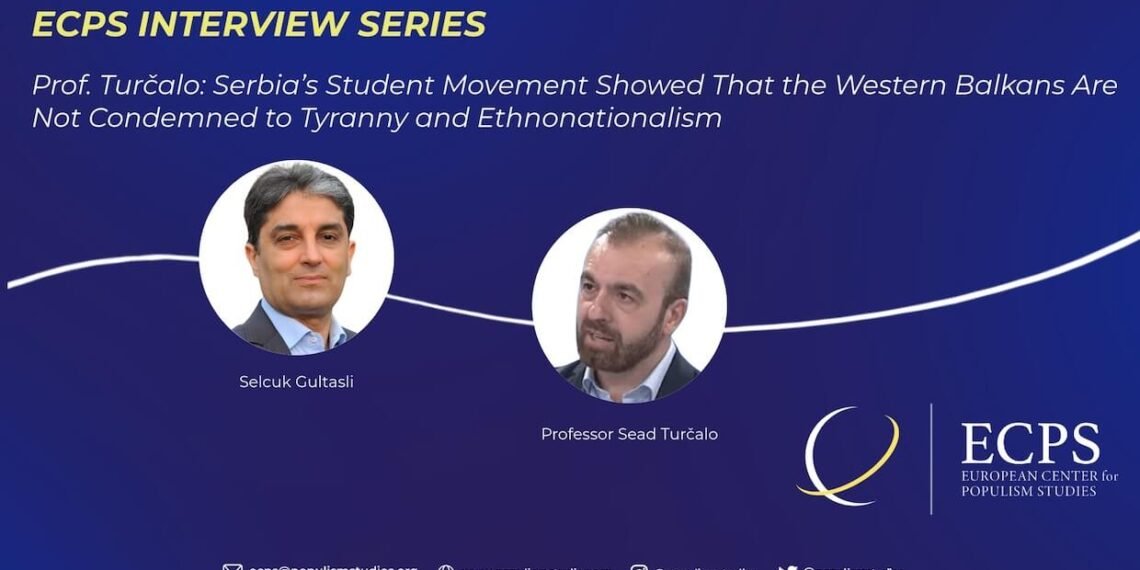
In an in-depth interview with the ECPS, Professor Sead Turčalo, Dean of the Faculty of Political Sciences at the University of Sarajevo, examines the contrasting implications of Serbia’s student-led democratic breakthrough and Bosnia and Herzegovina’s October 2026 elections. While Serbia’s Students’ List victory challenges entrenched authoritarianism, Bosnia’s results reveal the enduring resilience of ethnonational power-sharing. Professor Turčalo analyzes how Dayton’s institutional architecture reproduces ethnic divisions, how external patronage sustains Dodikism, and why democratic change in Belgrade could reshape regional politics. Emphasizing that Western Balkan societies are not condemned to tyranny and ethnonationalism, he advocates constitutional reform reconciling civic equality with collective cultural protections, offering a pathway from Dayton’s negative peace toward genuine constitutional democracy.
Interview by Selcuk Gultasli*
Serbia’s October 25, 2026, parliamentary elections marked a historic political turning point in the Western Balkans. Emerging from nearly two years of protests following the November 2024 Novi Sad railway station tragedy, the student-led movement secured approximately 53% of the vote and 140 of 250 parliamentary seats, defeating Aleksandar Vučić’s political bloc. In contrast, Bosnia and Herzegovina’s October 4 elections revealed the enduring resilience of ethnonational politics: Denis Bećirović secured reelection to the Presidency, HDZ BiH consolidated its dominance among Croat voters, and Milorad Dodik’s SNSD maintained its hegemonic position in Republika Srpska.
While Serbia’s electoral breakthrough signaled the potential of civic mobilization to challenge entrenched political structures, Bosnia’s results demonstrated how electoral competition can reproduce rather than overcome ethnonational divisions. Together, these contrasting outcomes raise fundamental questions about whether civic mobilization, institutional accountability, and democratic pluralism can challenge authoritarianism and entrenched ethnonational power-sharing across the region.
In an in-depth interview with the European Center for Populism Studies (ECPS), Professor Sead Turčalo, Dean of the Faculty of Political Sciences at the University of Sarajevo, examines the implications of Serbia’s democratic breakthrough for Bosnia and Herzegovina’s post-Dayton political order. His research encompasses ethnonationalism, the far right, radicalization, historical revisionism, genocide denial, and the geopolitical pressures shaping the Western Balkans.
For Professor Turčalo, Serbia’s electoral transformation carries significance beyond its borders. “What it achieved in this election reminded the entire region that citizens in the Western Balkans are not culturally condemned to tyranny and ethnic nationalism,” he argues. “They want institutions that answer to the law rather than to a party boss.” He characterizes the Students’ List victory as a historic civic rupture, emphasizing its rejection of identity polarization in favor of the rule of law and institutional accountability.
Yet Professor Turčalo cautions against assuming that democratic change in Belgrade will automatically transform Bosnia’s political institutions. The October 4 elections exposed the enduring tension between electoral competition and deeply institutionalized ethnic politics. According to Professor Turčalo, Dayton’s consociational architecture continues to reproduce the very divisions it was designed to manage: “The system therefore does not merely reflect ethnic divisions; it actively reproduces them as a precondition for exercising state power in Bosnia.”
Serbia’s transition nevertheless offers an opportunity to reconsider the regional foundations of Dodikism. Professor Turčalo argues that ending Belgrade’s political, financial, and symbolic support for Milorad Dodik could fundamentally alter the balance between external patronage and domestic obstruction. However, entrenched nationalist networks and constitutional veto structures remain formidable obstacles.
Looking beyond immediate electoral developments, Professor Turčalo advocates “a sequenced, functionalist transition toward a hybrid model that reconciles individual civic equality with strictly bounded collective cultural protections.” His proposals include implementing European Court of Human Rights rulings, eliminating discriminatory electoral restrictions, narrowing ethnic veto powers, and strengthening judicial independence and EU conditionality.
In sum, Professor Turčalo sees Serbia’s democratic opening and Bosnia’s growing exhaustion with ethnonational partitocracy as potentially complementary forces for transformation—creating an opportunity to move “from Dayton’s negative peace toward a genuine constitutional democracy in our country.”