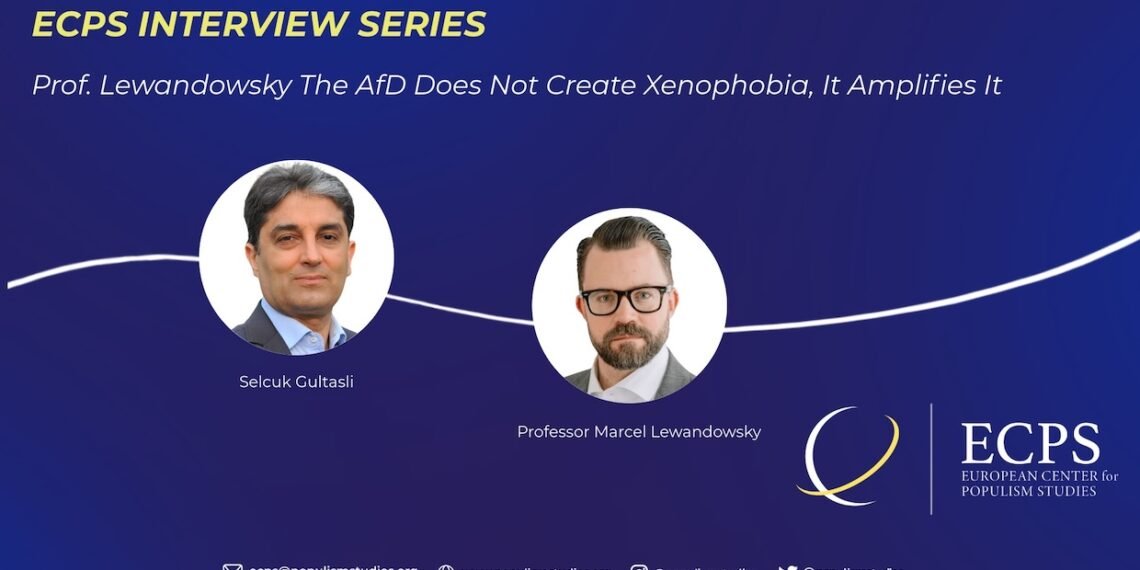
In an interview with the ECPS, Professor Marcel Lewandowsky, Professor of Government and Public Policy at Martin Luther University Halle-Wittenberg, examines the consolidation of Germany’s Alternative for Germany (AfD) and its implications for liberal democracy. Challenging the interpretation of the AfD as merely a protest party, he argues that its electoral resilience reflects deeply rooted political alienation, anti-immigrationattitudes, and dissatisfaction with democratic representation. Professor Lewandowsky explains how perceptions of economic crisis activate existing xenophobic sentiments, which the AfD amplifies through populist narratives and scapegoating. He also warns that mainstream parties may inadvertently strengthen the radical right by adopting its rhetoric. Ultimately, he emphasizes that restoring democratic confidence requires socioeconomic reforms, renewed political representation, and stronger democratic engagement.
Interview by Selcuk Gultasli*
Germany is undergoing a profound political realignment. Amid economic stagnation, immigration controversies, and growing distrust of established parties, the Alternative for Germany (AfD) has consolidated its position as a major political force. Its unprecedented gains in the September 2026 state elections, particularly in eastern Germany, challenge the resilience of democratic institutions and the traditional Brandmauer against the radical right. While populist movements elsewhere have experienced electoral setbacks, the AfD continues to expand its appeal, raising fundamental questions about democratic representation, political alienation, and the normalization of radical-right politics.
In an interview with the European Center for Populism Studies (ECPS), Professor Marcel Lewandowsky, Professor of Government and Public Policy at Martin Luther University Halle-Wittenberg, whose research focuses on populism, authoritarianism, and democratic politics, examines the structural foundations of the AfD’s electoral resilience and the challenges facing Germany’s liberal democracy.
Rejecting the conventional interpretation of the AfD as merely an expression of anti-establishment protest, Professor Lewandowsky argues that “the AfD has never been just a protest party. It has always been able to fill a representation gap in the party system.” Its electoral strength, he explains, reflects not only dissatisfaction with democratic institutions but also a durable alignment between voters’ ideological preferences and the party’s political agenda, particularly on immigration.
Central to his analysis is the relationship between economic insecurity, preexisting authoritarian attitudes, and populist crisis narratives. Rather than generating xenophobia independently, the AfD exploits perceptions of economic and cultural threat to reinforce existing prejudices. As Professor Lewandowsky emphasizes, “They do not create it, but they amplify it.” This dynamic becomes particularly consequential when mainstream parties adopt similar rhetoric, inadvertently strengthening the radical right’s ownership of migration as a political issue.
The interview also challenges assumptions about democratic dissatisfaction and electoral accountability. Drawing on experimental research, Professor Lewandowsky explains how voters may prioritize preferred policies over liberal-democratic principles, while AfD supporters display exceptional loyalty even when their party faces political scandals. His research further complicates the presumed relationship between loneliness and radical-right support, finding that social isolation is more closely associated with electoral abstention than with AfD voting.
Looking ahead, Professor Lewandowsky identifies political representation as central to democratic renewal. Criticizing mainstream parties for following rather than shaping the political agenda, he argues that economic and social reforms must address underlying grievances while rebuilding citizens’ confidence in democratic institutions. Above all, he insists that “political parties are at the center of saving democracy.”
In sum, the interview explores whether Germany’s established parties can reclaim their representative functions—or whether the AfD’s consolidation signals an enduring transformation of the country’s political landscape.