
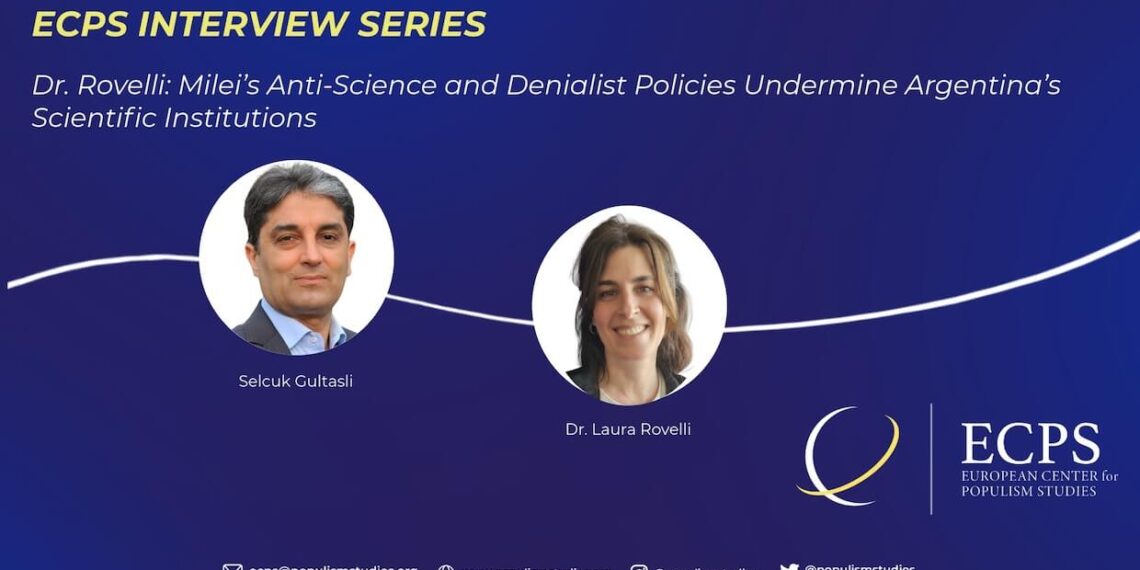
Argentina is facing an unprecedented assault on its scientific and educational institutions under President Javier Milei’s libertarian administration. Sweeping budget cuts, halted research careers, and the dismantling of science and human rights agencies have destabilized the country’s knowledge ecosystem. As Dr. Laura Rovelli warns, “the government has deployed anti-science and denialist rhetoric that seeks to discredit and undermine the institutions of science and higher education.” This interview explores how Milei’s radical anti-statist agenda erodes academic autonomy, weakens evidence-based policymaking, and reshapes public education amid growing attacks on universities accused of being “ideologically captured.” Dr. Rovelli also highlights emerging networks of resistance—unions, students, feminist groups, and scholars—mobilizing to defend academic freedom, public knowledge, and democratic life.
Interview by Selcuk Gultasli
Argentina is experiencing one of the most turbulent periods for its scientific, educational, and democratic institutions since the return of democracy in 1983. The administration of President Javier Milei—elected on a platform of radical libertarianism, state retrenchment, and market fundamentalism—has initiated sweeping transformations that profoundly reshape the country’s knowledge ecosystem. As part of these reforms, universities, research councils, and scientific bodies have faced defunding, institutional downgrading, and political delegitimization. According to Dr. Laura Rovelli, an independent researcher at CONICET and Professor at the National University of La Plata (UNLP), the government’s approach is not merely administrative restructuring but a broader ideological project. As she warns, “the government has deployed anti-science and denialist rhetoric that seeks to discredit and undermine the institutions of science and higher education.”
In this extensive interview, Dr. Rovelli analyzes how Milei’s program of market deregulation, dollarization, and shrinking of the state challenges the very idea of knowledge as a public good in Argentina’s democracy. She describes a context in which political fragmentation and austerity policies deepen long-standing inequalities and erode the social meaning of rights—especially the right to education. University autonomy, she explains, is being weakened through severe budget cuts, salary reductions, canceled scholarships, and halted research careers, leaving more than 1,200 approved researchers unable to take up their positions.
Beyond material erosion, Dr. Rovelli highlights the symbolic and epistemic dimensions of the crisis. The dismantling of ministries and agencies devoted to science, gender equality, and human rights is accompanied by a discursive offensive aimed at delegitimizing academic expertise. Denialist narratives—targeting gender, climate change, inequality, and public health—have become central to Milei’s political identity and echo global far-right trends linked to Donald Trump and Jair Bolsonaro. This, she argues, represents a broader pattern of “global anti-statist populism,” even as Milei introduces a uniquely Argentine “anti-national component.”
Yet, amid the crisis, Dr. Rovelli identifies emerging forms of resistance and democratic renewal. Trade unions, student organizations, feminist movements, and academic networks have mobilized nationwide and internationally. Universities remain “privileged loci of dispute and possibility,” capable of defending epistemic diversity and rebuilding the common good through legal challenges, collective action, and alliances with social movements.
By foregrounding the struggles surrounding knowledge, education, and public goods, this interview offers a timely and nuanced perspective on Argentina’s democratic future. It reveals how the battle over science and universities has become a defining arena in the contest between neoliberal retrenchment and democratic-popular visions of society.
