The European Union’s pursuit of strategic autonomy has emerged as one of the defining geopolitical debates of the twenty-first century, reflecting the growing convergence of security, economics, technology, and global power competition. In this intellectually stimulating lecture, Associate Professor Reuben Wong examined how Europe’s search for greater strategic independence has been reshaped by an increasingly volatile international environment marked by intensifying US–China rivalry, Russia’s revisionism, and rapid technological transformation. Challenging conventional assumptions about Europe’s transatlantic relationship and its approach toward China, he argued that strategic autonomy requires not only stronger defense and economic security instruments but also a fundamental reassessment of Europe’s place within an emerging multipolar order. The lecture offered participants a provocative and nuanced framework for understanding the future of European geopolitics.
Reported by ECPS Staff
The third day of the ECPS Academy Summer School 2026 marked a decisive transition from examining the political economy of international trade toward confronting the broader geopolitical forces reshaping Europe’s external relations. Convened under the overarching theme, “Europe Between Oceans: The EU in the Age of Geoeconomics, Populism, and Strategic Competition,” the programme explored how the European Union is increasingly compelled to navigate an international environment characterized not only by intensifying strategic rivalry between the United States and China but also by the erosion of long-standing assumptions about globalization, security, and the liberal international order. Against this backdrop, Associate Professor Reuben Wong of the National University of Singapore delivered a thought-provoking lecture entitled “Strategic Autonomy, De-risking, and EU Economic Security Tools,” inviting participants to reconsider Europe’s geopolitical position through an analytical lens that combined European integration studies with the strategic realities of contemporary international politics.
From the outset, Assoc. Prof. Wong made clear that his objective was not merely to catalogue the European Union’s emerging economic security instruments or explain the technical dimensions of de-risking. Rather, he sought to interrogate the underlying assumptions shaping European strategic thinking at a moment when the continent finds itself simultaneously confronting geopolitical uncertainty, technological transformation, and shifting distributions of global power. Drawing upon his long-standing scholarship on European foreign policy, as well as his experience observing both European and Asian strategic debates, Assoc. Prof. Wong encouraged participants to move beyond familiar policy slogans and instead examine the deeper questions surrounding Europe’s identity, capabilities, and long-term strategic interests.
One of the lecture’s distinguishing features was the perspective from which it was delivered. Speaking from Singapore—a country whose foreign policy has long depended upon balancing relations among competing major powers—Assoc. Prof. Wong approached debates over European strategic autonomy with a degree of analytical distance rarely encountered within discussions dominated by either Brussels or Washington. Rather than treating Europe’s geopolitical dilemmas as uniquely European, he situated them within a broader transformation of the international system, where established powers increasingly confront rising competitors, traditional alliances are being reassessed, and economic interdependence has itself become a source of strategic vulnerability. This external vantage point enriched the discussion by encouraging participants to question assumptions that often remain implicit within European policy circles.
Assoc. Prof. Wong also began by highlighting the conceptual ambiguity surrounding two of the most frequently invoked expressions in contemporary European policy discourse: strategic autonomy and de-risking. Although both terms have become central to debates on European foreign and economic policy, they often carry different meanings depending upon the context in which they are employed. Assoc. Prof. Wong observed that discussions of de-risking almost invariably evoke Europe’s increasingly complex relationship with China. The concept reflects growing concerns regarding excessive dependence on Chinese supply chains, critical raw materials, strategic technologies, intellectual property protection, and infrastructure deemed essential to European economic resilience. De-risking, therefore, does not necessarily imply economic decoupling from China but rather seeks to reduce strategic vulnerabilities while preserving mutually beneficial commercial relations.
By contrast, Assoc. Prof. Wong suggested that strategic autonomy has historically been associated less with China than with Europe’s relationship with the United States. At its core lies the question of whether the European Union possesses the political, military, and institutional capacity to pursue its own foreign policy independently of American strategic preferences. While the expression has acquired renewed prominence following Russia’s invasion of Ukraine and amid renewed uncertainty surrounding American global leadership, Assoc. Prof. Wong reminded participants that the debate itself stretches back to the end of the Cold War. Since the early 1990s, European leaders have repeatedly grappled with the challenge of transforming the Union from an economic giant into a credible geopolitical actor capable of defending both its interests and its values.
Rather than presenting these concepts as separate policy debates, Assoc. Prof. Wong argued that they should be understood as interconnected responses to a rapidly changing international environment. Strategic autonomy addresses Europe’s dependence on external security guarantees, while de-risking reflects growing awareness of economic dependencies that may equally constrain political decision-making. Together, they illustrate the European Union’s broader search for resilience in a world where geopolitical competition increasingly extends beyond military affairs to encompass trade, technology, investment, industrial policy, and digital infrastructure.
Throughout this opening section of the lecture, Assoc. Prof. Wong established the intellectual framework that would guide the remainder of his presentation: understanding Europe’s future requires examining not only the policies it adopts, but also the assumptions it holds about power, alliances, and the changing architecture of the international system. By placing strategic autonomy and economic security within this wider geopolitical context, he invited participants to reconsider whether Europe’s existing conceptual frameworks remain adequate for navigating an era defined by intensifying great-power competition and accelerating technological transformation.
The Long Search for Strategic Autonomy: From European Aspirations to Geopolitical Reality

Having established the conceptual foundations of strategic autonomy and de-risking, Assoc. Prof. Wong proceeded to examine the historical evolution of Europe’s quest for greater geopolitical independence. Rather than portraying strategic autonomy as a recent response to heightened tensions with China or the return of Donald Trump to the White House, he situated it within a much longer trajectory of European integration that has unfolded since the end of the Cold War. His historical reconstruction demonstrated that contemporary debates over European defense, foreign policy, and economic security are best understood not as abrupt policy innovations but as the latest chapter in a decades-long effort to reconcile Europe’s political ambitions with its enduring strategic dependencies.
At the center of Assoc. Prof. Wong’s discussion stood a deceptively simple definition of strategic autonomy: the ability of a state—or, in the European Union’s unique case, a union of sovereign states—to pursue its preferred foreign policy and defend its interests without excessive dependence on external powers. Although straightforward in formulation, Assoc. Prof. Wong argued that this definition immediately exposes one of the European Union’s most enduring dilemmas. Unlike conventional nation-states, the EU has long aspired to exercise geopolitical influence while lacking many of the instruments traditionally associated with great-power status, particularly unified military capabilities and a fully integrated foreign policy apparatus. Consequently, strategic autonomy has remained as much an aspiration as an accomplished reality.
This ambition has shaped European foreign policy thinking since the early 1990s, when the collapse of the bipolar international order appeared to create new opportunities for Europe to emerge as an independent strategic actor. The establishment of the Common Foreign and Security Policy (CFSP) represented one of the most ambitious manifestations of this aspiration. By seeking to coordinate foreign policy among member states, the EU hoped to complement its growing economic integration with greater diplomatic coherence and international influence. Yet, as Assoc. Prof. Wong reminded participants, translating institutional innovation into effective geopolitical action proved considerably more difficult than its architects had anticipated.
To illustrate this challenge, Assoc. Prof. Wong revisited one of the defining moments in post-Cold War European diplomacy: the violent disintegration of Yugoslavia. At the outset of the crisis, European leaders famously declared that the conflict represented “the hour of Europe,” signaling their confidence that the continent possessed both the responsibility and the capability to resolve security crises in its own neighborhood. Events quickly exposed the limitations of that ambition. As the conflicts escalated into prolonged warfare, ethnic cleansing, and genocide, European diplomatic initiatives failed to prevent violence, while decisive military intervention ultimately depended upon the United States and NATO. For Assoc. Prof. Wong, the Yugoslav wars became an enduring reminder that Europe’s geopolitical aspirations remained constrained by its continued reliance on American military power.
This lesson profoundly shaped subsequent debates over European defense integration. Assoc. Prof. Wong devoted particular attention to the 1998 Saint-Malo Declaration, jointly issued by British Prime Minister Tony Blair and French President Jacques Chirac, which called for the European Union to develop autonomous military capabilities capable of responding to regional crises. Although frequently celebrated as a milestone in the evolution of European security policy, Assoc. Prof. Wong argued that the declaration also revealed fundamental differences regarding the meaning of strategic autonomy itself.
France, he explained, traditionally viewed strategic autonomy through the lens of genuine strategic independence. Rooted in Gaullist thinking and reinforced by decades of skepticism toward excessive reliance on Washington, successive French governments argued that Europe should possess independent military capabilities, autonomous command structures, and the political freedom to undertake operations without depending upon NATO. Strategic autonomy, from this perspective, required Europe to become a fully-fledged geopolitical actor capable of acting on its own behalf.
Britain’s interpretation differed significantly. While London supported stronger European defense cooperation, it remained firmly committed to preserving NATO as the cornerstone of European security. British policymakers generally understood strategic autonomy not as an alternative to the Atlantic Alliance but as a complementary mechanism that would enable European states to contribute more effectively to collective defense without duplicating NATO structures. As Assoc. Prof. Wong noted, this more Atlanticist understanding was shared by many other European governments, particularly those in Northern and Central Europe, which regarded American security guarantees as indispensable to continental stability.
These competing interpretations, Assoc. Prof. Wong argued, help explain why European defense integration has repeatedly advanced in incremental rather than transformative ways. Although successive crises—including the Arab Spring, Russia’s intervention in Georgia, the annexation of Crimea, and ultimately Russia’s full-scale invasion of Ukraine—have reinforced calls for greater European strategic capacity, member states have continued to differ over the extent to which strategic autonomy should supplement or gradually replace dependence on the United States.
Drawing upon his own experience as a diplomat and scholar observing European capitals, Assoc. Prof. Wong enriched this historical analysis with comparative reflections on how different countries interpreted the post-Cold War strategic environment. He recalled that policymakers in Paris were already contemplating a future in which American reliability could no longer be taken for granted, prompting early efforts to strengthen European defense capabilities. By contrast, officials in London, Bonn, and many other European capitals struggled to imagine a European security architecture detached from American leadership. These contrasting strategic cultures, he suggested, continue to shape debates over European defense to this day.
The return of Donald Trump to the White House has injected renewed urgency into these long-standing discussions. While strategic autonomy had often been treated as an ambitious long-term objective, changing transatlantic dynamics have increasingly transformed it into what many European leaders now perceive as an immediate strategic necessity. Yet Assoc. Prof. Wong cautioned against viewing contemporary developments solely through the lens of personalities or electoral cycles. The deeper issue, he argued, concerns whether Europe has sufficiently adapted to a changing international system in which alliances can no longer be assumed to be permanent or unconditional.
In one of the lecture’s most intellectually provocative moments, Assoc. Prof. Wong introduced a distinctly realist interpretation of contemporary international politics. Reflecting upon the evolution of European strategic thinking, he suggested that the European Union had spent much of the post-Cold War era operating under liberal assumptions regarding the durability of democratic solidarity and the permanence of the rules-based international order. Those assumptions, he argued, increasingly require reconsideration. States, including democratic allies, ultimately pursue their own interests, and alliances endure only so long as they continue to serve mutually beneficial strategic purposes. From this perspective, expecting the United States to indefinitely shoulder the burden of European security irrespective of its own changing priorities may represent less a realistic strategic assessment than an increasingly untenable political assumption.
By tracing the historical evolution of strategic autonomy through successive geopolitical crises, Assoc. Prof. Wong demonstrated that Europe’s present predicament is neither accidental nor entirely new. Rather, contemporary debates reflect the culmination of unresolved tensions that have accompanied European integration for more than three decades. The challenge facing the European Union today, therefore, is not simply to devise new policy instruments, but to determine whether it is finally prepared to align its strategic ambitions with the capabilities required to sustain genuine geopolitical autonomy.
Between Washington and Beijing: Reassessing Europe’s Strategic Environment
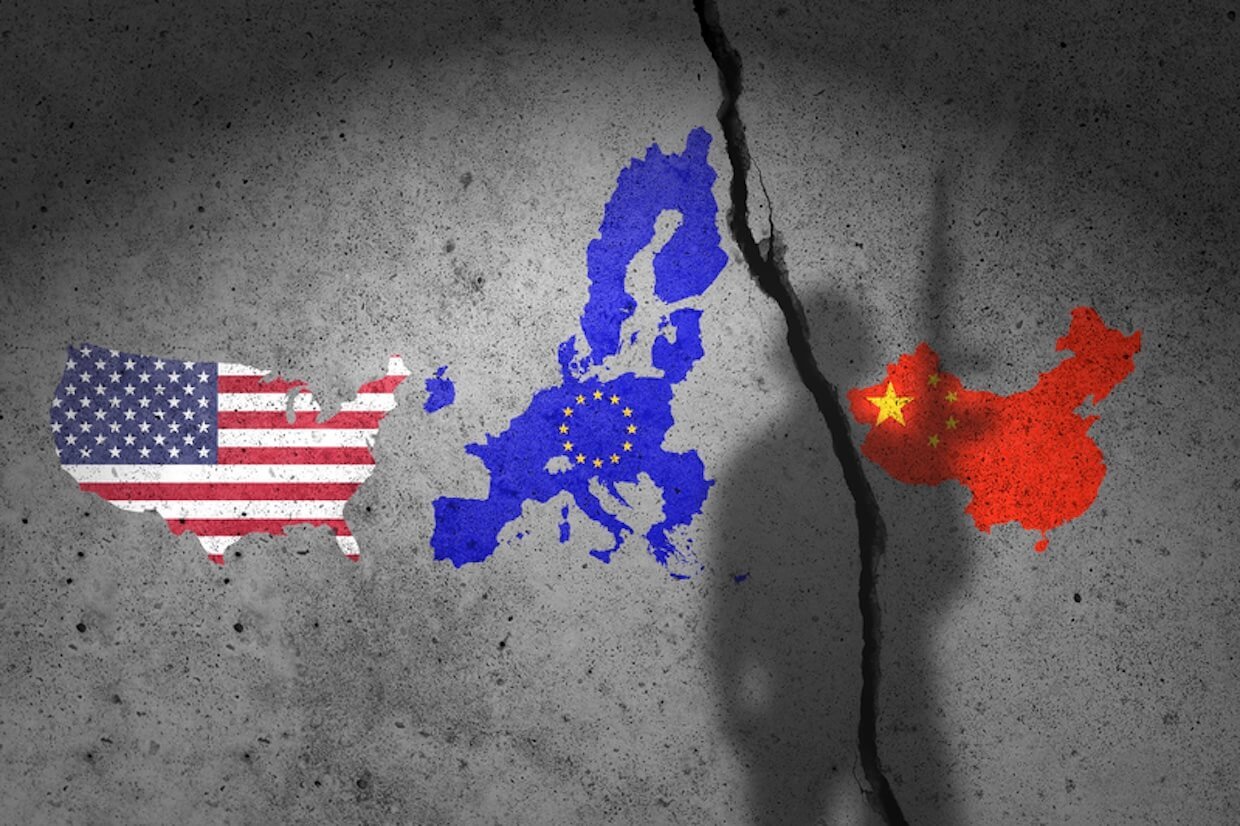
Having traced the historical evolution of strategic autonomy, Assoc. Prof. Wong shifted the discussion toward the rapidly changing international environment within which the European Union must now pursue that ambition. Rather than treating Europe’s security dilemmas as the product of a single crisis, he situated them within a broader transformation of global politics marked by shifting power balances, intensifying great-power competition, and the gradual erosion of assumptions that had underpinned the post-Cold War international order. Throughout this section of the lecture, Assoc. Prof. Wong argued that Europe’s strategic predicament cannot be understood solely through its relations with either Washington or Beijing; instead, it emerges from the increasingly complex triangular relationship among the European Union, the United States, and China.
Assoc. Prof. Wong began by observing that Europe finds itself confronting an unprecedented convergence of external pressures. Relations with Russia have deteriorated dramatically following Moscow’s invasion of Ukraine, fundamentally altering Europe’s security landscape. At the same time, the return of Donald Trump to the American presidency has reopened longstanding questions regarding the reliability of the transatlantic alliance, while relations with China have become increasingly complicated by disputes over trade imbalances, technological competition, industrial policy, human rights, and concerns over Beijing’s growing strategic partnership with Russia. Rather than confronting a single geopolitical rival, Europe now faces the far more demanding challenge of managing simultaneous tensions with multiple major powers whose interests increasingly intersect.
The lecture devoted particular attention to the implications of changing transatlantic relations. Assoc. Prof. Wong argued that the debate over European strategic autonomy has acquired renewed urgency not simply because of Russia’s military aggression but because uncertainty regarding American strategic commitments has become significantly more pronounced. Referring to the early months of Trump’s second presidency, he recalled disputes over tariffs, trade policy, and even Washington’s controversial rhetoric regarding Greenland. These developments, he suggested, reinforced concerns among European policymakers that the United States was becoming an increasingly unpredictable partner whose strategic priorities might diverge from those of its European allies.
Yet Assoc. Prof. Wong was careful to emphasize that such developments should not be interpreted merely as the consequence of one administration or one political leader. Instead, he invited participants to consider whether Europe has been too slow to recognize broader structural changes in international politics. Drawing upon a realist understanding of international relations, he argued that great powers do not maintain costly alliances indefinitely out of sentiment or historical loyalty alone. Rather, alliances endure because they continue to serve concrete strategic and material interests. From this perspective, the expectation that the United States will remain permanently committed to underwriting European security regardless of shifting geopolitical priorities may no longer represent a sustainable assumption.
This argument marked one of the lecture’s most provocative departures from conventional European policy discourse. Assoc. Prof. Wong suggested that, for much of the post-Cold War period, European strategic thinking had been shaped by liberal assumptions concerning democratic solidarity, institutional cooperation, and the durability of the rules-based international order. While these assumptions contributed significantly to European integration itself, he argued that they have become increasingly difficult to reconcile with contemporary geopolitical realities. The resurgence of great-power rivalry, growing economic nationalism, and renewed emphasis on national interest all point toward a more competitive international environment in which states, including democratic allies, increasingly prioritize their own strategic calculations.
It was within this broader realist framework that Assoc. Prof. Wong introduced what was arguably the lecture’s most controversial proposition. Contrary to prevailing narratives within many European political circles, he suggested that the United States, rather than China, has increasingly become the principal source of strategic uncertainty confronting Europe. Several years earlier, such an assessment might have appeared implausible. Yet Assoc. Prof. Wong argued that recent developments require a reassessment of long-held assumptions about the respective roles of Washington and Beijing within the international system.
To support this contention, Assoc. Prof. Wong contrasted the behavior of the two powers in relation to the international rules-based order. While acknowledging the numerous disagreements that continue to characterize relations between Europe and China, he nevertheless argued that Beijing has, in several important respects, sought to operate within existing international institutions and norms established after the Second World War. By contrast, he suggested that recent American policies have increasingly challenged many of the very principles that Washington itself had historically championed, including support for multilateral institutions, international trade regimes, and predictable alliance commitments. In Assoc. Prof. Wong’s assessment, the paradox of the current international order lies in the fact that the principal architect of the post-war liberal system now appears increasingly willing to revise or abandon elements of that system, while China often presents itself as a defender of institutional stability and economic globalization.
This interpretation naturally challenged participants to reconsider familiar geopolitical narratives. Assoc. Prof. Wong acknowledged that many European policymakers continue to view China primarily through the lenses of strategic competition, human rights concerns, and systemic rivalry. Nevertheless, he encouraged his audience to distinguish between legitimate concerns regarding China’s growing influence and broader assumptions that automatically portray Beijing as the principal disruptor of the international order. Historical experience, institutional inertia, and deeply embedded transatlantic political cultures, he suggested, have made it difficult for many Europeans to recognize the extent to which the geopolitical landscape has evolved.
At the same time, Assoc. Prof. Wong cautioned against reducing international politics to a simplistic binary competition between Washington and Beijing. Instead, he argued that Europe’s strategic interests require a far more nuanced understanding of both powers. China should neither be romanticized nor automatically treated as an adversary whose rise inevitably threatens European prosperity. Equally, the United States should not be assumed to remain an unchanging guarantor of European security simply because of decades of successful transatlantic cooperation. Strategic autonomy, therefore, demands that Europe develop the analytical capacity to evaluate both relationships on the basis of its own interests rather than inherited geopolitical assumptions.
The lecture also situated China’s rise within the longer trajectory of global power redistribution. Assoc. Prof. Wong argued that China should no longer be understood merely as an emerging power but rather as a fully-fledged superpower whose influence increasingly shapes international politics, global markets, technological innovation, and diplomatic agendas. Referring to recent high-level interactions between Washington and Beijing, he suggested that historians may ultimately identify the latest summit between the two governments as a symbolic moment in which the United States implicitly acknowledged China as a strategic peer. The absence of unequivocal American dominance in these negotiations reflected, in his view, a broader transition toward a more multipolar international system.
Within such a system, Europe can no longer rely upon geopolitical habits formed during the Cold War or the immediate post-Cold War decades. Instead, Assoc. Prof. Wong argued that the European Union must cultivate a more independent strategic identity grounded in realistic assessments of its own capabilities, interests, and external environment. This requires moving beyond reflexive alignments with either superpower while simultaneously preserving constructive relations with both. For Europe, the challenge is not to choose between Washington and Beijing, but to develop sufficient strategic confidence to cooperate, compete, and disagree with each according to its own long-term interests.
By the conclusion of this section, Assoc. Prof. Wong had fundamentally reframed the strategic autonomy debate. Rather than presenting it as a defensive response to external threats alone, he portrayed it as a process of intellectual and political maturation through which the European Union must redefine its place within an increasingly fragmented international order. Strategic autonomy, in this sense, is less about distancing Europe from particular partners than about equipping it with the capacity to navigate a world in which geopolitical certainty has become the exception rather than the rule.
Normative Power, Market Power, and Europe’s Technological Challenge
Having examined Europe’s shifting geopolitical environment, Assoc. Prof. Wong turned to one of the lecture’s central analytical questions: whether the European Union still possesses the capacity to shape the international order through its traditional strengths. Rather than focusing exclusively on military capabilities or diplomatic influence, Assoc. Prof. Wong explored Europe’s changing position as a producer of international norms, regulatory standards, and market rules. In doing so, he revisited two of the most influential concepts in European Union scholarship—Normative Power Europeand Market Power Europe—before questioning whether the material foundations that once sustained these forms of influence remain sufficiently robust in an era of accelerating technological competition and shifting global economic power.
Assoc. Prof. Wong began by discussing the influential work of political scientist Ian Manners, whose concept of Normative Power Europe has long occupied a central place in debates on the European Union’s international role. Manners argued that the EU’s distinctive influence derives not primarily from military power but from its capacity to define what constitutes legitimate behavior in international politics. Through the promotion of democracy, human rights, rule of law, multilateralism, environmental protection, and good governance, the Union has sought to exercise influence by shaping norms rather than imposing coercion. This vision has become deeply embedded within both academic literature and European policymaking, reinforcing the idea that the EU represents a unique kind of international actor whose strength lies in persuasion rather than force.
While acknowledging the significance of this intellectual tradition, Assoc. Prof. Wong encouraged participants to distinguish between aspiration and empirical reality. The European Union undoubtedly seeks to project normative influence, he argued, but successful norm entrepreneurship requires willing audiences capable of accepting and internalizing those standards. In practice, the EU has proven most effective when engaging countries that aspire to join the Union or maintain exceptionally close institutional and economic ties with it. The accession process itself illustrates the remarkable power of European conditionality, whereby candidate states undertake extensive political, legal, and economic reforms in exchange for eventual membership. Beyond this sphere of attraction, however, Europe’s capacity to shape political norms becomes considerably more limited.
To illustrate this point, Assoc. Prof. Wong referred to states that possess sufficient political autonomy, demographic weight, or strategic leverage to resist European pressure. Russia represented the clearest example of a country unwilling to organize its domestic or foreign policy according to European expectations. Yet Assoc. Prof. Wong also cited Turkey, Iran, and other significant regional powers that, despite maintaining important economic relationships with the EU, have repeatedly demonstrated their willingness to reject European normative preferences when these conflict with domestic political priorities or broader strategic interests. Such examples, he argued, reveal that normative influence ultimately depends upon underlying distributions of political and economic power rather than normative appeal alone.
If Europe’s ability to export political values has become increasingly constrained, Assoc. Prof. Wong suggested that its more enduring source of influence has historically resided elsewhere. Here he introduced Chad Damro’s concept of Market Power Europe, which shifts attention from political ideals to economic scale. Unlike normative power, which rests upon persuasion and legitimacy, market power derives from the size, wealth, and regulatory sophistication of the European single market. As one of the world’s largest integrated economic areas, the EU has long possessed the ability to establish product standards, environmental regulations, competition rules, labor protections, and consumer safety requirements that multinational corporations frequently adopt worldwide. Access to the European market has thus encouraged firms and governments alike to conform to European regulatory frameworks, extending the Union’s influence well beyond its territorial borders.
For Assoc. Prof. Wong, however, even this formidable source of influence can no longer be taken for granted. Market power ultimately depends upon economic dynamism, technological leadership, and sustained commercial relevance. Here he painted a considerably more cautious picture of Europe’s future. While the European Union remains one of the world’s largest economies, its relative share of global trade has steadily declined over recent decades as emerging economies—particularly China and increasingly India—have assumed a larger role in global production, investment, and innovation. Whereas Europe once accounted for roughly a quarter of world trade, its share has gradually diminished, reflecting broader structural changes in the global economy.
This decline carries consequences extending well beyond trade statistics. Assoc. Prof. Wong argued that countries which dominate emerging industries also acquire disproportionate influence over the standards governing those industries. Historically, Europe’s industrial strength enabled it to shape international regulations across numerous sectors, from manufacturing and pharmaceuticals to environmental protection and consumer rights. Yet leadership in future technologies increasingly belongs elsewhere. As innovation shifts toward artificial intelligence, advanced semiconductors, electric vehicles, renewable energy systems, and digital infrastructure, regulatory influence will increasingly follow technological leadership rather than historical institutional prestige.
Artificial intelligence emerged as perhaps the most illustrative example of this transformation. Assoc. Prof. Wong observed that Europe possesses world-class universities, research institutions, and highly skilled scientific communities. Nevertheless, these strengths have not translated into globally dominant AI platforms capable of competing directly with American and Chinese technological giants. While companies such as OpenAI, Google, Anthropic, DeepSeek, Alibaba, Tencent, and Baidu increasingly shape the global AI ecosystem, Europe has yet to produce comparable commercial champions operating at similar scale. Consequently, Assoc. Prof. Wong argued, Europe risks finding itself in the position of regulating technologies whose fundamental architecture, commercial logic, and technical standards are being established elsewhere.
The discussion then broadened to encompass the wider technological transformation underway in China. Assoc. Prof. Wong challenged participants to reconsider widespread perceptions that continue to portray China primarily as a manufacturing economy dependent upon copying foreign technologies. Drawing upon personal experiences from his recent visits, he described a society that has rapidly become one of the world’s foremost laboratories of technological innovation. Cashless payment systems, integrated digital platforms, sophisticated logistics networks, and autonomous delivery technologies illustrated the extent to which China has advanced in areas where many developed economies still rely upon older infrastructures. These examples were not presented merely as anecdotes but as evidence of China’s growing capacity to shape future technological ecosystems.
Particularly striking was Assoc. Prof. Wong’s discussion of China’s digital economy. Recounting his surprise when physical cash and even international credit cards proved largely unusable during his visits, he highlighted how mobile payment platforms such as Alipay and WeChat Pay have fundamentally transformed everyday economic life. Likewise, China’s extensive deployment of automated logistics—including robotic delivery services in hotels and urban environments—served to illustrate the speed with which technological innovation has been integrated into ordinary commercial practice. Such developments, he argued, underscore the increasingly significant gap separating technological adoption in parts of Asia from prevailing assumptions still common in Europe.
These observations naturally fed into Assoc. Prof. Wong’s broader concern regarding Europe’s future competitiveness. If technological innovation increasingly determines not only economic prosperity but also the capacity to establish international standards, Europe faces a narrowing window within which it can preserve meaningful regulatory influence. Regulatory excellence alone cannot indefinitely compensate for declining industrial leadership. Without stronger innovation ecosystems and greater participation in frontier technologies, Europe’s capacity to shape global governance may gradually erode despite its sophisticated legal and institutional frameworks.
The lecture also encouraged participants to place China’s contemporary rise within a broader historical context. Assoc. Prof. Wong reminded his audience that Chinese strategic thinking continues to be profoundly shaped by the historical memory of the so-called Century of Humiliation, during which successive unequal treaties, foreign occupations, and imperial interventions severely constrained Chinese sovereignty. Although China escaped formal colonization in the manner experienced by many Asian and African societies, Assoc. Prof. Wong argued that nineteenth-century European and Japanese interventions nonetheless left enduring historical scars. The visible architectural legacies of foreign concessions in cities such as Shanghai continue to serve as reminders of a period during which external powers exercised extraordinary influence over Chinese territory and governance.
By invoking this historical perspective, Assoc. Prof. Wong sought neither to justify nor to excuse contemporary Chinese policies. Rather, he encouraged participants to appreciate how historical memory informs present-day strategic behavior. European concerns regarding China’s growing global influence are undoubtedly significant, he acknowledged, yet Chinese policymakers likewise interpret international politics through a historical narrative centered upon sovereignty, national rejuvenation, and the determination never again to experience external subordination. Understanding these competing historical narratives, Assoc. Prof. Wong suggested, constitutes an essential prerequisite for developing more sophisticated European engagement with China.
From De-risking to Strategic Partnership: Reimagining Europe’s Economic Security
In the concluding section of his lecture, Assoc. Prof. Wong shifted from diagnosing Europe’s strategic predicament to exploring the policy choices available to the European Union as it seeks to strengthen its economic resilience in an increasingly contested geopolitical environment. Returning to the second concept introduced at the beginning of the session—de-risking—he examined how the EU’s emerging economic security agenda fits within the broader pursuit of strategic autonomy. Rather than viewing economic security solely through the lens of defensive measures against perceived external threats, Assoc. Prof. Wong argued that Europe’s long-term success will depend upon combining resilience with openness, regulation with innovation, and strategic caution with international cooperation.
Although he acknowledged that discussions surrounding de-risking are frequently associated with reducing Europe’s dependence on China, Assoc. Prof. Wong cautioned against equating de-risking with comprehensive economic decoupling. Such an approach, he implied, would neither be economically sustainable nor strategically desirable. Instead, he presented de-risking as an effort to identify and mitigate vulnerabilities in areas where excessive dependence on external suppliers could undermine Europe’s political autonomy or economic stability. Critical raw materials, advanced semiconductors, digital infrastructure, strategic technologies, and resilient supply chains have all become central components of this emerging economic security agenda. Yet, Assoc. Prof. Wong argued, the effectiveness of these policies ultimately depends upon whether they enhance Europe’s own competitiveness rather than merely restrict external actors.
The discussion naturally turned to the policy instruments increasingly available to the European Union. While Assoc. Prof. Wong did not provide an exhaustive catalogue of individual legislative measures, he emphasized that Europe has gradually assembled a more sophisticated economic security toolbox capable of responding to external coercion and strategic pressure. These instruments include mechanisms to scrutinize foreign investment, strengthen supply-chain resilience, regulate emerging technologies, protect critical infrastructure, and respond collectively to economic coercion by third countries. Such measures, he suggested, represent an important evolution in European policymaking, reflecting the growing recognition that economic interdependence can generate strategic vulnerabilities as well as mutual benefits.
A particularly revealing illustration of this evolving approach emerged from Assoc. Prof. Wong’s discussion of the tensions that followed the return of Donald Trump to the White House. Referring to disputes surrounding Greenland and the renewed threat of punitive tariffs against European partners, Assoc. Prof. Wong observed that these developments produced an unusually unified response from several EU member states. He highlighted the symbolic decision by a number of European governments to express support for Denmark following Washington’s increasingly assertive rhetoric regarding Greenland. Although these gestures carried limited immediate military significance, they nevertheless reflected an important political signal: European solidarity could no longer be assumed to operate only against external competitors traditionally perceived as strategic rivals. For perhaps the first time in NATO’s history, Assoc. Prof. Wong noted, several European governments found themselves collectively signaling resistance to political pressure originating from the United States itself.
This episode, he argued, underscored the growing relevance of Europe’s economic security instruments. Faced with the prospect of American tariffs and economic coercion, the European Union demonstrated its willingness to contemplate robust countermeasures capable of imposing significant economic costs in return. Assoc. Prof. Wong referred to the Union’s capacity to deploy powerful retaliatory trade instruments, observing that although such measures would inevitably entail substantial economic consequences for both sides, they nevertheless constitute an increasingly important source of European strategic leverage. Economic statecraft, in other words, has become an indispensable complement to traditional diplomacy within the EU’s broader pursuit of strategic autonomy.
Yet Assoc. Prof. Wong was equally careful to stress that Europe’s future cannot be secured through defensive instruments alone. Protection, regulation, and retaliatory capabilities may reduce vulnerability, but they cannot substitute for technological dynamism or sustained economic competitiveness. It was at this point that he introduced what emerged as one of the lecture’s most forward-looking themes: digital sovereignty. Rather than understanding digital sovereignty as an attempt to isolate Europe from global technological ecosystems, Assoc. Prof. Wong presented it as the capacity to shape the governance of technologies that increasingly underpin modern economies. Artificial intelligence, digital platforms, data governance, and algorithmic regulation have all become critical arenas in which geopolitical competition increasingly unfolds.
For Assoc. Prof. Wong, Europe continues to possess a valuable—albeit narrowing—opportunity to influence the regulatory architecture governing these emerging technologies. Although European firms have not produced global AI champions comparable to those found in the United States or China, the Union still retains considerable regulatory authority through the size and attractiveness of its internal market. By establishing clear standards concerning transparency, accountability, privacy, competition, and digital governance, Europe may continue to shape aspects of global technological development even where it no longer leads in technological innovation itself. However, Assoc. Prof. Wong repeatedly emphasized that this window of opportunity is unlikely to remain open indefinitely if Europe’s technological capabilities continue to lag behind those of its principal competitors.
This concern naturally led to one of the lecture’s most distinctive policy recommendations. Rather than seeking to insulate European markets from external technological leaders, Assoc. Prof. Wong advocated a more pragmatic strategy centered on selective international cooperation. In particular, he argued that Europe should deepen engagement with technologically advanced partners across Asia, including China, Japan, South Korea, and other innovation-driven economies. Such partnerships, he suggested, would enable Europe to participate more actively in emerging technological ecosystems while simultaneously strengthening its own competitiveness.
In advancing this argument, Assoc. Prof. Wong challenged approaches that rely primarily upon restrictive regulation or defensive protectionism. Attempting to legislate foreign technologies out of European markets, he argued, risks isolating Europe from the very innovations that are reshaping the global economy. Instead, Europe should seek opportunities for collaboration with market leaders, recognizing that technological leadership increasingly depends upon interconnected networks of research, investment, industrial production, and commercial cooperation rather than purely national capabilities.
To illustrate this point, Assoc. Prof. Wong referred to developments within the global electric vehicle industry. He observed that successful firms increasingly pursue partnerships across national boundaries rather than relying exclusively upon domestic production or political protection. As an example, he pointed to the willingness of companies such as Tesla to cooperate with leading Chinese electric vehicle manufacturers, demonstrating that commercial realities often encourage collaboration even amid broader geopolitical competition. Europe, he suggested, should draw lessons from such developments. Instead of viewing technological interdependence solely as a source of vulnerability, policymakers should also recognize its potential to accelerate innovation and strengthen long-term competitiveness.
Underlying this recommendation was Assoc. Prof. Wong’s broader conviction that Europe must cultivate a more confident understanding of its own strategic interests. Throughout the lecture, he consistently argued against framing international politics in rigid ideological or binary terms. Europe need not choose between unconditional alignment with Washington and comprehensive confrontation with Beijing. Nor should strategic autonomy be interpreted as strategic isolation. Rather, genuine autonomy requires the capacity to cooperate, compete, and disagree with multiple partners according to Europe’s own evolving interests and priorities.
As the lecture drew to a close, Assoc. Prof. Wong returned to the central theme that had connected each stage of his analysis: the European Union’s search for strategic autonomy in an era of profound geopolitical transformation. He suggested that this search cannot be reduced to military capability alone, nor can it be achieved solely through economic regulation or institutional reform. Strategic autonomy ultimately demands a broader intellectual shift in how Europe understands power itself. In a world where technological leadership, supply chains, innovation ecosystems, and digital infrastructure increasingly determine geopolitical influence, economic security has become inseparable from foreign policy and strategic decision-making.
The lecture concluded on a cautiously optimistic note. While Assoc. Prof. Wong openly acknowledged Europe’s relative decline in several domains—including demographic growth, technological innovation, and global market share—he rejected narratives of inevitable European marginalization. The Union continues to possess significant assets: one of the world’s largest integrated markets, highly developed regulatory institutions, advanced research capacities, and an enduring commitment to multilateral cooperation. Whether these strengths can be translated into sustained geopolitical influence, however, will depend upon Europe’s willingness to adapt to an international environment that increasingly rewards flexibility, innovation, and strategic pragmatism rather than reliance upon inherited assumptions.
Taken as a whole, Assoc. Prof. Wong’s lecture offered far more than an assessment of the European Union’s emerging economic security policies. It presented a comprehensive reflection on Europe’s place within a rapidly evolving international order, urging participants to reconsider established geopolitical narratives and to approach strategic autonomy not as a slogan but as an ongoing process of political, economic, and intellectual adaptation. By combining insights from European integration studies, international relations theory, and an Asian perspective on global power shifts, the lecture challenged participants to think beyond conventional dichotomies and to appreciate the complexity of Europe’s strategic choices in what is becoming an increasingly multipolar and geoeconomically contested world.
Conclusion
Associate Professor Reuben Wong’s lecture offered a sophisticated and timely examination of one of the European Union’s most pressing strategic dilemmas: how to preserve political autonomy, economic resilience, and regulatory influence amid an increasingly fragmented international order. Moving beyond conventional policy debates, he challenged participants to reconsider Europe’s assumptions about alliances, power, and globalization through a realist yet forward-looking analytical framework.
By juxtaposing strategic autonomy with de-risking, normative influence with market power, and geopolitical competition with technological transformation, Assoc. Prof. Wong demonstrated that Europe’s future will depend not only on strengthening its economic security instruments but also on redefining its strategic identity in a rapidly evolving multipolar world. Perhaps the lecture’s greatest contribution lay in its distinctly Asian perspective, which encouraged participants to look beyond transatlantic paradigms and appreciate the profound shifts taking place in global power distribution.
Ultimately, the session reinforced the Summer School’s central message that Europe’s future between the Atlantic and the Indo-Pacific will be determined not by choosing between competing great powers, but by developing the confidence, capabilities, and strategic vision necessary to engage an increasingly interconnected and contested world on its own terms.