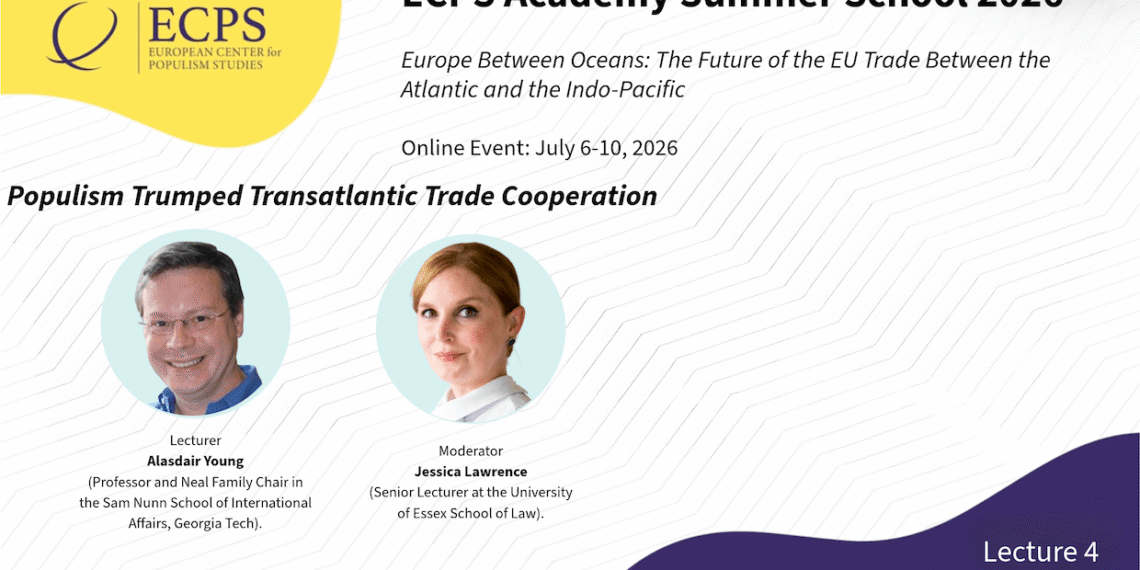
Can the transatlantic trading order survive the rise of populism? In his lecture at the ECPS Academy Summer School 2026, “Europe Between Oceans: The EU in the Age of Geoeconomics, Populism, and Strategic Competition,” Professor Alasdair Young argues that Donald Trump’s second presidency marks a fundamental break with more than seventy years of EU–US trade cooperation. Moderated by Dr. Jessica Lawrence, the session explores how populist narratives, protectionism, geopolitical rivalry, and legal innovation are transforming the politics of international trade. Combining historical perspective with international political economy and trade law, Professor Young demonstrates that the future of transatlantic relations will depend not only on commercial negotiations but also on reconciling economic openness with democratic legitimacy, strategic autonomy, and global stability.
Reported by ECPS Staff
The transformation of transatlantic trade relations has become one of the defining features of the contemporary international political economy. For more than seven decades, the economic partnership between the European Union and the United States served as one of the principal pillars of the liberal international order, underpinning global trade liberalization, multilateral governance, and unprecedented levels of economic integration. Although the relationship periodically experienced disputes over agricultural regulation, industrial subsidies, market access, and monetary policy, these conflicts were generally managed within a shared commitment to rules-based cooperation and institutional compromise. Today, however, intensifying geopolitical rivalry, the resurgence of economic nationalism, the growing politicization of trade, and the rise of populist politics have fundamentally altered the assumptions that long sustained transatlantic economic cooperation. Understanding this transformation therefore requires moving beyond conventional analyses of tariffs and trade balances to examine the deeper political, institutional, and ideological forces reshaping the global trading system.
These questions lay at the heart of the ECPS Academy Summer School 2026, held under the theme “Europe Between Oceans: The EU in the Age of Geoeconomics, Populism, and Strategic Competition.” Bringing together leading scholars and participants from around the world, the programme explored how geopolitical competition, strategic autonomy, democratic polarization, and technological rivalry are redefining Europe’s external relations and the future of global governance. Within this broader intellectual framework, Professor Alasdair Young, Neal Family Chair at the Sam Nunn School of International Affairs at the Georgia Institute of Technology, delivered a historically grounded and theoretically sophisticated lecture entitled “Populism Trumped Transatlantic Trade Cooperation.” Drawing upon decades of research on European Union trade policy and international political economy, Professor Young argued that the second Trump administration represents not simply another period of transatlantic commercial tension but a fundamental break with the cooperative logic that has characterized EU–US trade relations since the creation of the post-war trading order. By situating recent tariff disputes within the longer evolution of the General Agreement on Tariffs and Trade (GATT), the World Trade Organization (WTO), and the broader history of transatlantic economic integration, he demonstrated that contemporary protectionism reflects a deeper transformation in the politics of international trade itself.
The session was expertly moderated by Dr. Jessica Lawrence, Senior Lecturer at the University of Essex School of Law, whose scholarship on international economic law, World Trade Organization governance, European Union internal market regulation, and the intersection of trade with broader public policy objectives provided an ideal intellectual point of departure for the discussion. Her introductory remarks effectively framed the lecture by emphasizing that recent developments—from the so-called “Liberation Day” tariffs and regulatory disputes to growing tensions over sustainability standards, digital governance, and industrial policy—should be understood not as isolated trade disagreements but as manifestations of broader geopolitical and institutional change. By encouraging participants to consider whether transatlantic trust has been fundamentally weakened, whether the WTO can continue to anchor the global trading system, and whether regional arrangements may increasingly displace multilateral governance, Dr. Lawrence situated Professor Young’s lecture squarely within the Summer School’s overarching exploration of geoeconomics, populism, and strategic competition.
Combining historical analysis, international political economy, trade law, and comparative politics, Professor Young challenged participants to rethink the relationship between populism and international commerce. He argued that Donald Trump’s protectionist agenda cannot be adequately explained through conventional accounts centered on sectoral interests or geopolitical competition alone. Instead, it reflects a distinctive populist conception of trade in which imports, trade deficits, and international economic interdependence are interpreted as evidence of exploitation by foreign actors enabled by domestic political elites. Equally significant was his analysis of the European Union’s response, which demonstrated that Europe’s acceptance of an asymmetrical trade agreement reflected not diplomatic weakness, but the complex strategic constraints imposed by wider security considerations, including NATO and the war in Ukraine. Offering a rich synthesis of historical perspective and contemporary policy analysis, the lecture provided participants with a compelling analytical framework for understanding how populism, protectionism, legal innovation, and geopolitical rivalry are collectively reshaping one of the world’s most consequential economic partnerships and, with it, the future of the liberal international economic order.