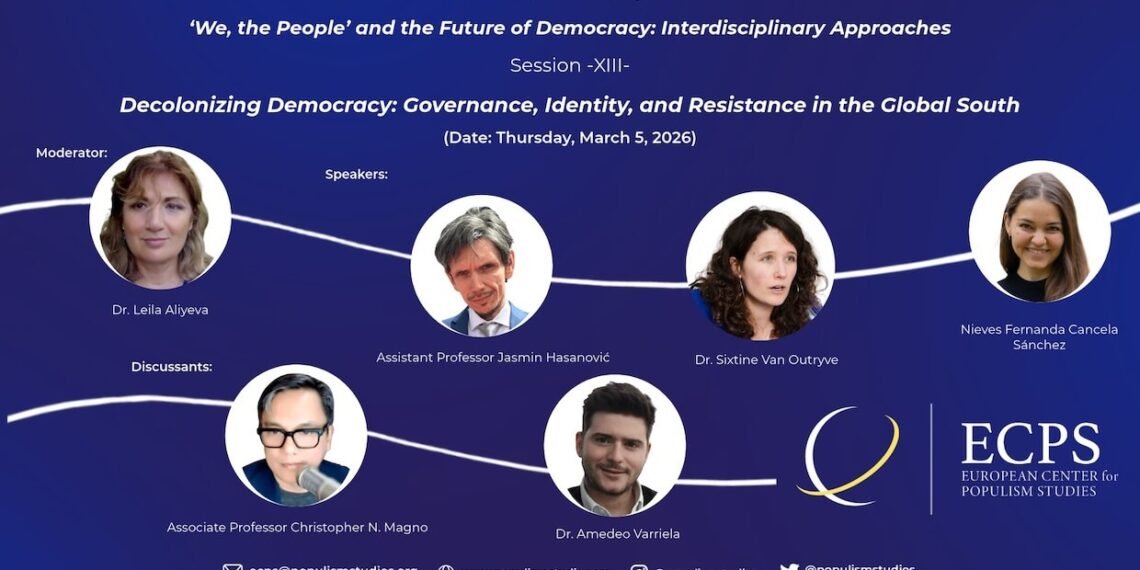
Session 13 of the ECPS Virtual Workshop Series examined how “the people” are constructed, contested, and institutionalized across diverse political arenas. Chaired by Dr. Leila Alieva (Oxford School for Global and Area Studies), the panel brought together interdisciplinary perspectives on populism, democratic participation, and representation. Assistant Professor Jasmin Hasanović analyzed the ethnic dynamics of populist subject formation in Bosnia and Herzegovina’s post-Dayton political order. Dr. Sixtine Van Outryve explored how participants in France’s Yellow Vests movement sought to institutionalize grassroots assembly-based democracy. Nieves Fernanda Cancela Sánchez examined the exclusion of stateless and marginalized communities from international diplomacy, arguing for a “right to diplomacy.” Together, the contributions illuminated the evolving and contested meaning of “the people” in contemporary democratic politics.
Reported by ECPS Staff
On Thursday, March 5, 2026, the European Center for Populism Studies (ECPS) convened the thirteenth session of its Virtual Workshop Series, “We, the People” and the Future of Democracy: Interdisciplinary Approaches, under the title “Constructing and Deconstructing the People in Theory and Praxis.” Bringing together scholars from political science, democratic theory, and critical diplomacy studies, the session addressed one of the most urgent questions in contemporary political analysis: how “the people” are imagined, institutionalized, contested, and reconfigured across different political settings. From post-conflict power-sharing arrangements and assembly-based democratic experiments to the exclusions embedded in international diplomacy, the panel examined the shifting boundaries of political representation in a time of democratic strain and institutional transformation.
The participants of the session were introduced by Reka Koleszar, ECPS intern. Chairing the session, Dr. Leila Alieva of the Oxford School for Global and Area Studies framed the discussion as the product of an increasingly mature and sophisticated intellectual agenda within the workshop series. As she observed, by the thirteenth session the series had reached a “quite intricate level of analysis,” with all three presentations deeply interconnected in their exploration of “the genesis, evolution, and formation of populism, and concepts and images related to that.” She underscored the broader strengths of the ECPS project—above all its multidisciplinary, comparative, and constructivist orientation. In a post-Cold War environment marked by uncertainty, complexity, and multiple interacting forces across political, social, and international levels, such a broad approach is particularly necessary. The rise of populism, she suggested, cannot be adequately understood within the limits of a single discipline; rather, it must be approached through the combined lenses of political science, international relations, democratic theory, and broader social inquiry.
Under Dr. Alieva’s chairmanship, the panel featured three speakers whose papers illuminated distinct yet overlapping dimensions of democratic representation. Assistant Professor Jasmin Hasanović (University of Sarajevo) explored the ethnic dynamics of populist subject formation in Bosnia and Herzegovina, offering a new framework for understanding inter-ethnic, intra-ethnic, and cross-ethnic populisms within a post-Dayton consociational order. Dr. Sixtine Van Outryve(Radboud Universiteit; UCLouvain) examined how participants in the Yellow Vests movement in France sought to institutionalize direct democracy through popular assemblies, thereby pushing beyond protest toward constituent democratic experimentation. Nieves Fernanda Cancela Sánchez (UNPO) extended the discussion into the international arena by arguing that diplomatic representation itself must be rethought as a pillar of democracy, especially for unrepresented nations, Indigenous peoples, and politically marginalized communities.
The session also benefited from the incisive engagement of its two discussants, Associate Professor Christopher N. Magno (Gannon University) and Dr. Amedeo Varriale (University of East London). Their interventions not only drew out the conceptual strengths of the presentations but also situated them within wider comparative debates on populism, democratic innovation, sovereignty, and political exclusion. Together, chair, speakers, and discussants produced a rich exchange that revealed both the diversity of contemporary democratic struggles and the common tensions that run through them. As Dr. Alieva noted in her concluding reflections, the discussion demonstrated that populism often functions as a sign of deeper institutional pressure—an indication that inherited political forms are struggling to respond to changing social realities. Session 13 thus offered a compelling interdisciplinary inquiry into how democratic subjects are made, constrained, and reimagined across multiple arenas of political life.