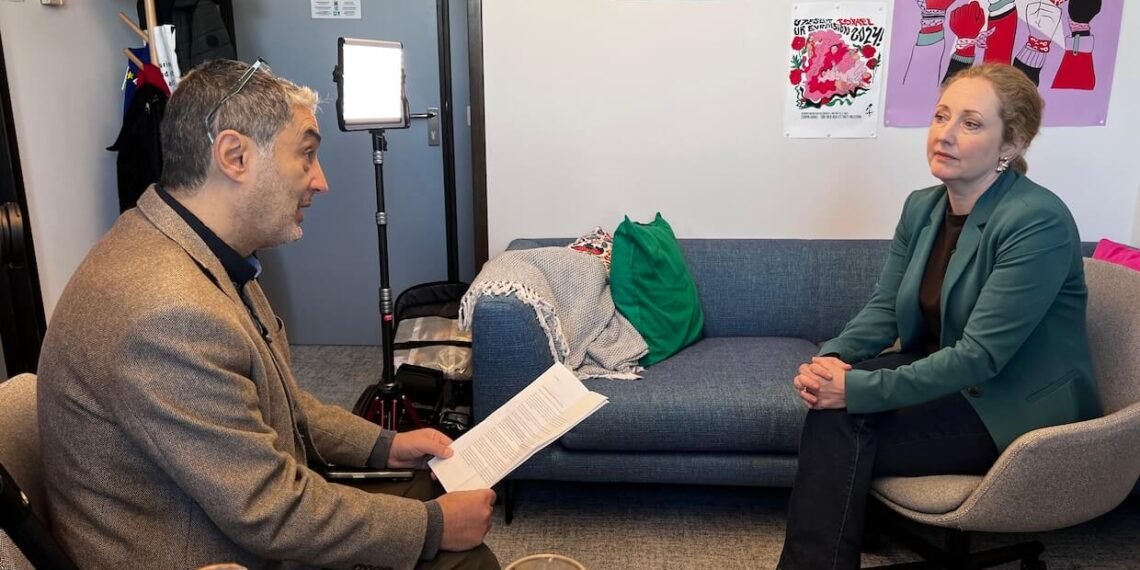
MEP Hanna Gedin argues that the EU’s credibility as a defender of democracy, human rights, and international law is being weakened by political double standards and the growing normalization of radical-right ideas. In this ECPS interview, she warns that “the EU is losing its voice when it comes to upholding international law” and points to inconsistencies in migration policy and relations with Israel and Turkey. Gedin also urges the European left not to adapt to the far right, but to build its own agenda around inequality, housing, energy, and the cost of living. “You need to have your own agenda,” she says, and to “make life a good life without adapting to the far right and their narrative.”
Interview by Selcuk Gultasli
In this wide-ranging interview with the European Center for Populism Studies (ECPS), Hanna Gedin, Member of the European Parliament for Sweden’s Vänsterpartiet (Left Party, V) and Vice-Chair of The Left Group, reflects on Sweden’s post-election political deadlock, the normalization of radical-right ideas in European policymaking, the erosion of international law, and the strategic dilemmas facing the democratic left. Gedin, who works on the internal market, industry, energy, women’s rights, and gender equality, situates these questions within a broader critique of inequality, restrictive migration policy, and the weakening of Europe’s normative credibility.
The interview begins with the struggle to translate Sweden’s new parliamentary majority into a viable center-left government. Gedin rejects the idea that Vänsterpartiet should once again support a government from outside, insisting that “if our votes are needed, if our mandates are needed, of course we should be in the government.” She argues that the Center Party (C) “needs to choose,” because “there is no middle way.” At the same time, she acknowledges the deep economic divide between the two parties but maintains that cooperation remains possible on issues ranging from feminism and climate to international law and support for communities outside major cities.
A central theme of Gedin’s remarks is the extent to which the radical right has reshaped mainstream political agendas. She argues that Swedish parties have been “adapting and moving closer to the Sweden Democrats,” while politics has increasingly shifted away from “bread and butter” concerns toward culture-war issues. For Gedin, the answer is not imitation but political differentiation: “For the left, it’s really important not to adapt.” Instead, she insists, “You need to have your own agenda,” centered on the cost of living, inequality, housing, and material security.
This concern extends to migration policy at both Swedish and European levels. Gedin describes a “shift and an adaptation to the radical right” in EU migration politics and recalls far right and right-wing MEPs cheering “Send them back, send them back” during a vote on return hubs. Yet she also points to Sweden’s debate over teenage deportations as evidence that public attitudes can shift when abstract migration categories acquire “names and faces.”
The interview’s sharpest normative critique concerns international law. Gedin argues that “the EU is losing its voice when it comes to upholding international law” and warns of “a complete erosion of international law” driven by double standards. She contrasts the EU’s firm response to Russia’s war against Ukraine with what she sees as a much weaker approach toward Israel, arguing that such inconsistency undermines European credibility globally.
Ultimately, Gedin presents a distinctly materialist response to the rise of the far right. She argues that the left must make politics concrete: reduce inequality, address rents and energy costs, tax the very rich, and “make life a good life without adapting to the far right and their narrative.”