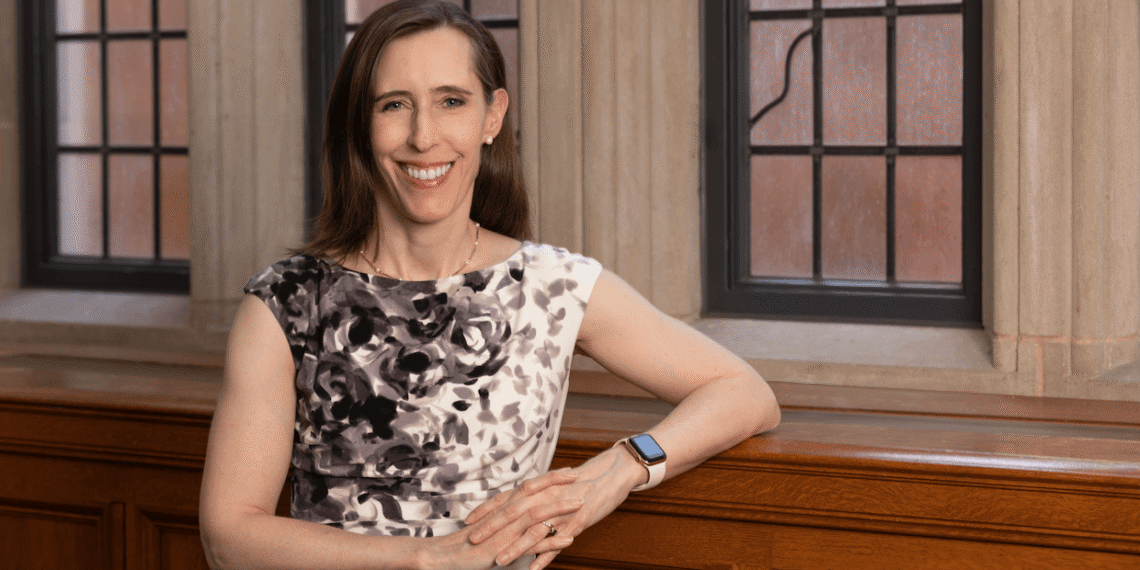
Giving an interview to the ECPS, Professor Oona A. Hathaway reflects on the resilience and fragility of the post-1945 international legal order at what she describes as a moment of both peril and possibility. She identifies the prohibition on the use of force as the “bedrock of the modern legal order,” yet warns that today’s geopolitical climate is marked by “extraordinary instability” and mounting challenges from major powers. International law, she argues, ultimately depends on shared belief: “what makes international law work is that states believe it works.” If repeated unilateral uses of force erode that belief, a “reverse norm cascade” could follow. Yet Professor Hathaway also stresses that crisis can generate renewal—an opportunity to reimagine and reconstruct a more equitable and effective international legal order rather than surrender to fatalism.
Interview by Selcuk Gultasli
Giving an interview to the European Center for Populism Studies (ECPS), Professor Oona A. Hathaway—Gerard C. and Bernice Latrobe Smith Professor of International Law at Yale Law School; Professor of Political Science in Yale’s Department of Political Science; Faculty at the Jackson School of Global Affairs; Director of the Yale Law School Center for Global Legal Challenges; and president-elect of the American Society of International Law—reflects on the resilience and fragility of the post-1945 international legal order at a moment she describes as both perilous and generative. The organizing theme of the interview is captured in the headline, “A Moment of Peril—and Possibility—to Reimagine the International Legal Order.” For Professor Hathaway, the contemporary crisis is not simply episodic noncompliance but a potentially systemic turning point—one that tests whether the prohibition on the use of force, which she calls the “bedrock of the modern legal order,” can endure under conditions of populism, geopolitical rivalry, and eroding rule-of-law commitments.
Professor Hathaway situates today’s tensions within a longer arc of normative transformation. The post-1945 order, she argues, was both a “genuine normative revolution that restrained power” and a system sustained by the strategic interests of dominant states. Yet the present moment raises acute questions about its durability. In her view, “what makes international law work is that states believe it works,” and the danger is that repeated unilateral uses of force could tip the system toward a “reverse norm cascade,” in which states “no longer believe that these rules matter and therefore no longer act as if they matter.” The concern is not only erosion, but the possibility of a broader unraveling in which the rules cease to structure expectations.
Several sections of the interview underscore why “today’s instability is unprecedented in the postwar international legal order.” Professor Hathaway emphasizes that in the post–World War II era “we’ve ever been at a moment of such instability and uncertainty” as when the most powerful state appears “clearly willing to use military force in violation of the UN Charter that it once championed.” This connects directly to another theme: “when rule-makers break the rules, the damage is far greater.” As Professor Hathaway notes, US violations are “particularly destructive,” not least because of the “failure of the international community to respond or push back forcefully,” shaped by entrenched assumptions about US stewardship and deep economic interdependence.
Yet Professor Hathaway also insists that breakdown need not foreclose renewal. “It is a moment of extreme challenge,”she concludes, “but it is also a moment of opportunity and creativity.” The task, she suggests, is to resist fatalism and instead “think together about what a more equitable and effective international legal order might look like”—because “it is up to us to decide which it will be.”
Here is the edited version of our interview with Professor Oona A. Hathaway, revised slightly to improve clarity and flow.
A Normative Revolution—and a Strategic Settlement

Professor Oona Hathaway, thank you so much for joining our interview series. Let me start right away with the first question: Your scholarship traces the historic shift from a world in which war was lawful to one structured by the prohibition on the use of force. How should we understand the post-1945 legal order—as a genuine normative revolution restraining power, or as a contingent equilibrium sustained by the strategic interests of dominant states?
Professor Oona A. Hathaway: I think both, actually. I don’t think they are inconsistent with one another. It was a genuine normative revolution that restrained power. There was the 1928 Kellogg-Briand Pact, which initially outlawed war. It obviously didn’t succeed—we had World War II—but it began a process of both deconstructing the previous legal order and constructing something new that set in motion the creation of a new legal system. That was then reaffirmed in the United Nations Charter, in the prohibition on the use of force in Article 2(4). It was really restating the prohibition on war from the Kellogg-Briand Pact. But it was created by dominant states because they believed in these ideas. They believed in the prohibition on the use of force and that might doesn’t make right, and they had just fought a war with the Nazis over this principle of non-domination and the rejection of using military force to seize territory from other states.
But it was also in their interests, because they had gone through massive territorial expansion. The United States, of course, had acquired what is now the entire continental United States, plus Alaska and Hawaii, and has a number of other islands that are part of it as well, including Puerto Rico. It was therefore in the interest of these states—and, of course, at the time this was created, Britain still had a major empire, and France still had a major empire. China, of course, dominated a vast territory. It was a good time to say you can’t conquer territory through the use of force. It was a good time for these states to say, “let’s stop moving those borders around, let’s firm up these borders, and let’s say no one can take territory from anyone else.” Once you’ve already completed your accumulation of territory, it’s in your best interest to call a halt to the game.
So, it was in their interests, but it was also in their values; it was consistent with the values they fought the war for. They then sustained it both because they believed in the values of the system and because the system served their interests. It made for a much more peaceful and prosperous world. So, I don’t necessarily see the two as inconsistent with one another.
When the Bedrock Norm Is Strained, the Entire System Is at Risk
You describe the prohibition on force as the “bedrock” of the modern international order. To what extent did its success depend less on legal internalization than on the alignment between US hegemony and rule-based constraints, and what happens when that alignment dissolves?
Professor Oona A. Hathaway: You’re right. I do believe that the prohibition on force is the bedrock of the modern legal order. It’s right at the beginning of the United Nations Charter, and in the book The Internationalists, which I wrote with my co-author Scott Shapiro, we talk about how that is the core norm of the system on which everything else rests.
So it depended on internalization, and that process that I described from 1928 to 1945 was a process of thinking through what it means to shift an order on its axis—to change it from a world order where force is permitted, where might makes right, where states can use military force to resolve disputes with one another, as used to be the case before 1928, before war was outlawed, to a world in which that’s no longer allowed, and then everything else has to flip on its head. Conquest was legal; now conquest has to be illegal. Gunboat diplomacy was legal; now gunboat diplomacy has to be illegal. And that requires a massive shift that I think they didn’t fully appreciate in 1928, but that unfolded from 1928 to 1945 and was internalized through the Charter and all the subsequent rules that were adopted.
But it is also the case, again, that this was in the interest of the United States. The United States both believed in these principles, but these principles also served a hegemonic state. It is a good thing if states are not trying to use military force to take territory from one another if what you want is not to have to be running around as a global power intervening to try to put out wars between states. So it is both the case that these were rules that were internalized and that they served US interests.
Now, what happens when that alignment dissolves? I mean, the US has made clear it doesn’t necessarily adhere to those legal principles any longer and has taken actions that are in violation of the UN Charter, most recently the intervention in Venezuela. We might see a military operation in Iran before long that would also be illegal. I think it puts major stress on the system, to the point that I’m not sure the legal order, as it is, can survive it. You know, it’s not just the US; it’s also Russia’s invasion of Ukraine and China’s seizing of islands, rocks, and reefs in the South China Sea. There are a lot of assaults, but in a way the US, because it has been such a critical supporter of the international legal order, turning on that order in the way that it seems to be is a blow that may be hard to recover from.
A Normative Revolution Forged by Power, Values, and Interest
Does the contemporary erosion of the prohibition on the use of force—as exemplified by Russia’s full-scale invasion of Ukraine and the United States’ unilateral military operation against Venezuela under the second Trump administration—reflect primarily a failure of international enforcement institutions, a crisis of belief in the legitimacy of international law among major powers, or a deeper transformation in how states conceptualize sovereignty, security, and permissible violence in an era of populism and geopolitical rivalry?
Professor Oona A. Hathaway: I think it’s just too early to say exactly how deep the transformation we’re seeing really is. I’ve written a bit about Russia’s invasion of Ukraine and the Trump administration’s unilateral military operation against Venezuela, as I mentioned before, as truly fundamental challenges to the modern international legal order.
It is the case that international law relies on collective enforcement. And it’s very difficult for that collective enforcement to work when members of the Security Council are themselves violating the rules, because the institutional structures that are in place to enforce them can’t be used. Russia, the US, and China all have veto power and can block any action by the United Nations to enforce the legal rules. At the same time, the states that have traditionally led the charge in enforcing the rules through other means—through what Scott Shapiro and I have called outcasting—have relied on economic and other measures to respond to unlawful action and to encourage collective action, sanctions, and economic pressure. Russia was kicked out of the G8, which became the G7; Russia was expelled from the Council of Europe; and there are many ways in which Russia has been excluded from international institutions it had benefited from as a response to its unlawful actions, in addition to the economic sanctions that have been imposed and the funding and support provided by Ukraine’s allies to help it stand up to Russia. But it is very difficult to do that against a hegemon and a major economic power.
I think you are beginning to see some response by states that may represent the beginnings of an answer to that question, though it is still a little early to tell.
Power Shifts and Populism Are Eroding Restraints on Unilateral Force
How do shifts in global power distribution interact with ideological transformations—particularly nationalism and populism—to weaken constraints on unilateral force?
Professor Oona A. Hathaway: Yes, there are major shifts in global power distribution. There are changes in economic power and changes in military power. You have the rise of China, both as an economic power and as a military power. It’s building a major navy and has become a more significant geopolitical force in a variety of ways. It’s also investing more in international institutions, which is important to note. So it’s not just building up its military; it has also become more active at the UN and other international institutions.
Soi it’s hard to say at this moment where that’s going. Is that going to weaken constraints on unilateral force or not? I think what’s weakening constraints on unilateral force is the use of unilateral force by states like the US and Russia. And it’s not just the use of force, but also the response that you receive. Russia has had a pretty forceful response from the international community. So far, the US has not. There was a relatively modest response to the unilateral intervention in Venezuela.
States are frankly scared of Trump. They’re worried that he’s going to slap tariffs on them if they criticize him. I think the only answer is going to be to act collectively—for states to band together to try to shore up the international system and the prohibition on the use of force in particular. It’s going to be hard for any of them to criticize Trump individually, but acting more collectively and building alternative sources of economic power may be possible. So, for example, what Canada is doing in forming alternative economic partnerships and responding to US tariffs suggests one possible path forward. That is an answer to this problem—maybe the only answer to this problem.
Between the Old World Order and a World With No Rules
Do contemporary developments signal not merely norm erosion but a structural reversion toward an “Old World Order” in which material power once again functions as a source of legal entitlement?
Professor Oona A. Hathaway: In the book The Internationalists, we talk about the Old World Order as the order in which war was lawful and states could use military force to resolve disputes, and what they took, they could keep—so might made right.
One of the questions is whether we are in a moment of reverting back to that. The book describes both this old legal order and how we rejected it and created a new legal order built on the prohibition on force. And the question that certainly emerges at this moment, where we’re seeing states like the United States unilaterally using force, is: are we going to go back? Are we going to return to a world where military force was lawful and where material power functions as a source of legal entitlement?
It’s possible that we will. It’s also possible that there is something even worse. Scott and I wrote a recent piece in Foreign Affairs that argues there is only one thing worse than going back to something like the Old World Order—a legal order built on the idea that might makes right, where states can resolve disputes and enforce claims through military force—and that is a world with no rules at all, where there is no coherent legal system. The old order, for all its faults, was at least coherent and clear.
One of the problems we see with Venezuela, with the Trump intervention there, is that it was really just about one man’s whim. And that is very disruptive and chaotic, because if it becomes permissible for states to decide to go to war for no clear reason, it becomes very hard for other states to avoid war, because they don’t know what they would need to do to avoid falling afoul of a state that might want to use military force.
I recommend that to your readers if they want to take a look at it. They can find all my work, by the way, on oonahathaway.com. All my work is posted there, so if they want to track down any of these pieces, that’s a good place to go.
Populist Sovereignty Claims Are Challenging International Constraints
How do populist leaders’ claims to embody the “true people” reshape state attitudes toward international law, especially regarding multilateral constraints perceived as external impositions on sovereignty?
Professor Oona A. Hathaway: I think I can speak most authoritatively, perhaps, to the Trump administration’s claims to embody “real Americans” as part of the argument that the United States should resist international law and that these multilateral constraints don’t serve America.
And what people are saying, if you look at his approval ratings, which are in free fall, is that he doesn’t actually represent real Americans. People care about the price of groceries, clothes, and other consumer goods. Those have been going up, and people’s real incomes have not been keeping pace with inflation. He came into office on a promise that he would make things more affordable for people, and he has done the opposite.
People were told at the State of the Union Address that things are better than ever, but most people’s experience is inconsistent with that—they actually feel that things are not better than ever. So, what you’re seeing is a contrast between a claim to speak for a set of people and people’s own experience of the effects of those policies.
I like to believe that, as a result, people are going to see that these policies are not in their best interest—that tariffs are not serving the United States and that wars of choice are not in the best interests of the American people—and reject them. So far, it does seem that people are not approving of what’s happening. I think that strategy is not going to be a winning one for the Trump administration for much longer.
The Impact of Populism Depends on the Resilience of Institutions
Is populism inherently destabilizing for rule-based international order, or can populist governments operate within legal frameworks when institutional checks remain robust?
Professor Oona A. Hathaway: Gosh, that’s kind of an impossible question to answer. I don’t know if it’s inherently destabilizing; it depends a little on what one means by populism. Can populist governments operate within legal frameworks when institutional checks remain robust? Absolutely—of course they can.
I think they will respond to the incentives they face. And if there is a major cost to acting in ways that are inconsistent with legal frameworks, it is difficult for populist leaders to sustain violations of international law for long in the face of that. But that’s not uniformly true. This is just a hard question to answer. It is more a case-by-case matter, rather than something that lends itself to a general conclusion about the impact of populism on legal frameworks. It all depends on how strong and how robust those institutional checks remain, and on the nature of those checks. That is highly contingent.
When Law Ceases to Constrain Power, the System Cannot Function
To what extent does democratic backsliding within powerful democracies—through executive aggrandizement and weakened oversight—pose a greater systemic threat to international law than the rise of authoritarian states that never fully internalized those norms?
Professor Oona A. Hathaway: I think that democratic backsliding is a real challenge to international law, in part because what we’re seeing is not just democratic backsliding, but threats to the very idea of the rule of law, both domestically and internationally. When law is no longer a constraint on governmental power—again, whether domestic or international—that obviously makes it impossible for the international system to function.
I don’t know that I would fully accept the idea that authoritarian states never internalized those norms—maybe that’s fair—but they internalized them more than is sometimes appreciated, because the international legal order operates in large part by changing expectations about how others will react to what you do. Authoritarian states see that if they invade their neighbors, there are going to be consequences. Saddam Hussein learned that when he invaded Kuwait and attempted to take it over. The international community responded by rejecting his effort to conquer Kuwait and pushing him back. That was an instance in which an authoritarian ruler learned a hard lesson—that this was a norm the international community was willing to defend.
That was a useful lesson for other authoritarians to observe, and it made a difference in reaffirming the prohibition on the use of force and the idea that states can’t conquer territory, even when they have a dispute with a neighbor—that the way to resolve it isn’t to use military force. So, that authoritarian regimes, too, can be constrained by international law.
The important thing to remember about international law is that you don’t have to think you’re obeying it to obey it. International law works by changing the background norms and expectations that states have. You don’t have to be fully cognizant of the ways in which it is shaping your behavior for it to do so. Even authoritarian states are often abiding by international law in ways they may not fully appreciate or understand, and nonetheless international law remains very powerful in shaping their behavior.
When Rule-Makers Break the Rules, the Damage Is Especially Severe
When a historically law-creating state violates the rules it helped design, how does that differ from violations by revisionist powers in terms of precedent, legitimacy, and global imitation effects?
Professor Oona A. Hathaway: This is obviously the question of whether US violations are more destructive than those of other states, given that the US has historically been a significant law-creating power. It wrote the first draft of the UN Charter, championed the United Nations system after the Second World War, and has been a key player—though it has not perfectly observed those rules. It’s important to point out that this is not the first time the United States has failed to play by the rules it helped put in place. But yes, I do think it is particularly destructive, especially when coupled with the broader set of assaults on the legal order from Russia.
What really matters, and what has been especially destructive so far, is the failure of the international community to respond or push back forcefully against the United States. That’s partly because people are used to thinking of the United States as a good actor, as a steward of the system. They also have deep economic ties that make any kind of criticism or economic sanctions against the United States almost impossible for them to contemplate. But, we are starting to see states recognize that what might once have seemed unimaginable is now imaginable, and that they have to begin thinking about how to reinforce the legal order in a situation where the United States can no longer be counted on to be a positive partner or actor.
So, we might begin to see some pushback, but we haven’t yet, and that is part of why this has been such a destructive moment.
Repeated Unilateral Force Could Trigger a Reverse Norm Cascade
Could repeated unilateral uses of force by leading powers generate a “reverse norm cascade,” transforming restraint from expectation into exception and thereby reshaping customary international law?
Professor Oona A. Hathaway: That’s the fear. The fear is that these unilateral uses of force will eventually overwhelm the system. You can sustain a certain number of blows, but at a certain point the system becomes so weakened that it begins to fall apart. And the question is: when do you cross that line? When do we reach a point where we have a kind of reverse norm cascade, as you put it, in which states no longer believe that these rules matter and therefore no longer act as if they matter? What makes international law work is that states believe it works.
If they no longer believe in it, then it ceases to function. So, enough unilateral uses of force could, at a certain point, lead states to conclude that the system is not working very well and to ask why they should abide by the rules if others are not. That’s when you begin to see the whole structure start to fall apart. Are we there yet? I think not. Three more years of this? Maybe.
Expansive Self-Defense Claims Are Eroding the Prohibition on Force
How might expansive interpretations of self-defense—particularly against nonstate actors—gradually alter the legal architecture governing the use of force?
Professor Oona A. Hathaway: I have written about this as well, and I think we don’t talk about it enough as a challenge to the international legal order—this expansive interpretation of the Article 51 right of self-defense in the Charter. It allows states to respond unilaterally; you don’t have to go to the Security Council to defend yourself. But the language of the Charter refers to situations in which a state has been subject to an armed attack.
There have been increasingly expansive interpretations of the Article 51 right of self-defense, including, as you mentioned, extending it to attacks by nonstate actors, which was not understood as falling within the scope of Article 51 at its inception. This interpretation has been adopted particularly in the post-9/11 era, and you see more and more states embracing it after 2014 and the rise of ISIS in the Middle East. I do think this is extremely corrosive to the international system. It has really eroded the prohibition on the use of force, because at a certain point everything becomes self-defense.
The Charter defined this right of self-defense very narrowly, as a response to armed attack, and it did so for a reason. The drafters were very aware that defensive wars and offensive wars were sometimes very hard to distinguish. They wanted to establish a fairly narrow right for states to respond. They had to include the right of self-defense because many states insisted on it—you shouldn’t have to wait for the Security Council to act if you are literally under attack. But they intentionally meant for it to be a fairly narrow right, because once you start talking about wars of defense based on the idea that another state might pose a threat down the road, the distinction between offensive and defensive wars begins to collapse.
So yes, I do think this has been a real problem. And again, if your readers are interested, if you search my website for “self-defense,” you will find an article I’ve written on exactly this issue. It’s a real problem, and it predates the Trump administration; it is a bipartisan problem. Both Democratic and Republican presidents have presided over that erosion, so this is not an entirely new phenomenon.
When Dual-Use Becomes a Justification, Civilians Bear the Cost
Your research on the targeting of dual-use objects highlights the blurring of civilian and military categories. Does this evolution risk transforming international humanitarian law from a protective regime into a justificatory framework for expanded violence?
Professor Oona A. Hathaway: I’d point your readers to a piece that I wrote in the Yale Law Journal on dual-use objects, called “The Rise of Dual-Use Objects,” with Azmat Khan and a third co-author, Mara Revkin, my former student and an amazing legal academic. This piece shows that the US has increasingly been targeting objects that it recognizes as dual-use, meaning both military and civilian use.
We argue in that piece that the rise of targeting dual-use objects has significantly eroded protections for civilians in wartime. We discuss this generally, but we also use evidence drawn from post-strike analyses of US counterterrorism strikes. We analyzed the targets of those strikes, which were gathered by Azmat Khan, a reporter from The New York Times, through Freedom of Information Act requests to the Department of Defense—requests she had to sue to obtain. So we have very specific data in the piece about what kinds of dual-use objects are being targeted, and we can show that civilians are really at risk in the targeting of these objects.
The argument we make is that this practice is blurring the distinction between civilian and military targets that is so critical to protecting civilians in wartime, and that we need to take significant steps to better protect civilians and to clarify this distinction between military and civilian objects, taking into account the impact on civilians of targeting such sites—not just the civilians who happen to be present at that moment, but also the long-term reverberating effects. You blow up a water treatment plant, and it’s not just the civilian workers there who are harmed; it’s everyone who now lacks access to clean water. You blow up an apartment building, and it’s not only the residents who are killed or injured, but also those who are deprived of housing. You blow up a bridge, and there may be civilians present on it, but afterward people cannot get to work, school, or their families because there is no access from one place to another. So, this is a really critical part of our thinking about how to protect civilians in wartime.
The Unraveling Order Also Opens Space to Imagine a More Equitable One
And lastly, Prof. Hathaway, are we witnessing the collapse of the post-1945 legal order or its transformation into a plural system of competing legal regimes—and what institutional or normative developments would be necessary to prevent the “gradual and then sudden” unraveling you warn about from becoming irreversible?
Professor Oona A. Hathaway: This is a reference to my piece in The New York Times titled “The Great Unraveling,”which looks at what’s happening to the modern legal order and argues that we might be witnessing its collapse. The question is whether we are in the midst of a collapse, on the precipice of one, or whether it has already occurred—and what is coming next. I don’t know that anybody really knows the answer to those questions. I think we’re in uncharted waters. In the post–World War II era, I don’t think we’ve ever been at a moment of such instability and uncertainty in the international legal order as we are today, where you have the most powerful nation in the world clearly willing to use military force in violation of the UN Charter that it once championed, and the prohibition on the use of force that is core to the normative legal order.
But we don’t know how aggressive President Trump is going to be. We don’t know yet if other states are going to follow in the United States’ footsteps and use force against their neighbors in ways that would previously have been clearly forbidden. And we don’t know whether something is going to emerge in its place if this system is collapsing.
We see some signs. We see Canada, for instance, trying to rally middle powers to work together to create an alternative economic system, because a lot of states are deeply concerned about the threat of tariffs from the Trump administration, and that has led them not to speak up or respond when the US acts in ways they view as inconsistent with the international legal order. This is going to be an important part of the response, but it hasn’t taken shape yet. So, the short answer is that we don’t know where this is headed. We are in a moment of extraordinary instability.
Let me end on a somewhat more hopeful note. Although this moment of instability is scary and concerning—for someone like me who believes that the core norm of the international legal order is the prohibition on the use of military force, and who sees that norm as uniquely at risk—it is also a moment when we can start to think about how to construct a new legal order. What might a new legal order look like? What new possibilities might emerge? What can we hope for, dream about, or imagine? How can we make the legal order more equitable?
So, it is a moment of extreme challenge, but it is also a moment of opportunity and creativity. We should be careful not to give up or assume that everything is lost, but instead try to think together about what a more equitable and effective international legal order might look like, and whether this is a moment in which the opportunity is opening to do something new and different. That new and different future could be bad, but it could also be a profound improvement. It is up to us to decide which it will be.