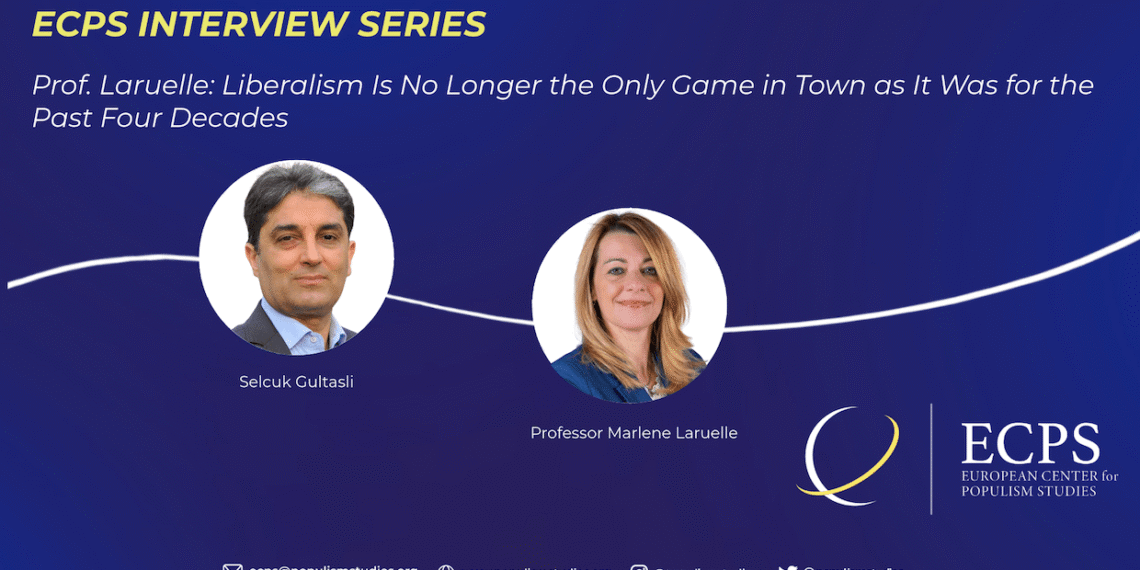
Professor Marlene Laruelle argues that the contemporary challenge to liberal democracy extends far beyond electoral populism. In this wide-ranging ECPS interview, she contends that illiberalism has evolved into a substantive political project that offers alternative visions of identity, belonging, community, and political order. Rejecting the notion that liberal democracy is merely a victim of external threats, Professor Laruelle emphasizes that many illiberal movements emerge from liberalism’s own contradictions, particularly the socio-economic and cultural consequences of neoliberalism. The interview explores the future of Trumpism, Christian nationalism, Russia’s role in global ideological networks, the rise of alternative epistemic communities, and the cultural foundations of “banal illiberalism.” Despite her concerns, Professor Laruelle sees the current moment as an opportunity to rethink and renew democracy.
Interview by Selcuk Gultasli
Giving an interview to the European Center for Populism Studies (ECPS), Professor Marlene Laruelle, Full Professor in the Department of Political Science at Luiss University in Rome and one of the foremost scholars of illiberalism, ideological contestation, and the global challenges facing liberal democracy, argues that contemporary politics can no longer be adequately understood through the lens of populism alone. Instead, she contends that the rise of illiberalism reflects a deeper ideological transformation—one that challenges the normative dominance liberalism has enjoyed since the end of the Cold War and forces democracies to confront fundamental questions about identity, belonging, and political community.
Drawing on her extensive scholarship on illiberalism, Russia, transnational ideological networks, and democratic contestation, Professor Laruelle maintains that “illiberalism is an alternative political project” rather than merely a reactionary or anti-democratic impulse. While populism functions as a mobilizing framework organized around the opposition between “the pure people” and “the corrupt elite,” illiberalism offers a more substantive worldview that questions the foundational assumptions of the liberal order itself. In her view, understanding why illiberalism resonates requires moving beyond electoral behavior and examining the deeper social imaginaries through which citizens seek meaning, moral order, and collective belonging.
A central theme of the interview is Professor Laruelle’s rejection of the notion that illiberalism is simply liberalism’s external adversary. Instead, she argues that “liberalism is generating its own critics from within.” The social and economic consequences of neoliberal globalization, rising inequality, cultural fragmentation, and the erosion of shared forms of citizenship have created a growing demand for political projects that promise identity, security, and community. As she notes, liberal institutions often respond through procedural neutrality and technocratic solutions, while many citizens increasingly seek “belonging” and “meaningful answers.” This mismatch, she suggests, helps explain the appeal of illiberal movements across the democratic world.
Perhaps the most striking argument advanced by Professor Laruelle concerns the durability of the illiberal challenge. Contrary to interpretations that view Trumpism, Orbánism, and related movements as temporary electoral phenomena, she argues that “the illiberal offer is here to stay.” Electoral defeats may alter political leadership, but they do not eliminate the deeper cultural narratives, moral frameworks, and social aspirations that sustain illiberal politics. Indeed, Professor Laruelle believes that contemporary democracies are entering a new era of ideological competition in which “liberalism is no longer the obvious normative answer” and “no longer the only game in town, as it was for the last 30 or 40 years.”
The interview also explores the transnational circulation of illiberal ideas, Christian nationalism and its challenge to liberal pluralism, Russia’s role as an ideological laboratory rather than a “puppet master,” the emergence of alternative epistemic communities in the digital age, and the growing importance of what Professor Laruelle calls the cultural and everyday dimensions of “banal illiberalism.” Throughout, she emphasizes that the future of liberal democracy depends not only on institutional resilience but also on its ability to recover a compelling moral and social vision.
Yet despite her sober diagnosis, Professor Laruelle concludes on a cautiously hopeful note. The current crisis of liberalism, she argues, should also be understood as an opportunity—an invitation to reopen debates about the social contract, political imagination, and the kind of democratic future citizens wish to build together.