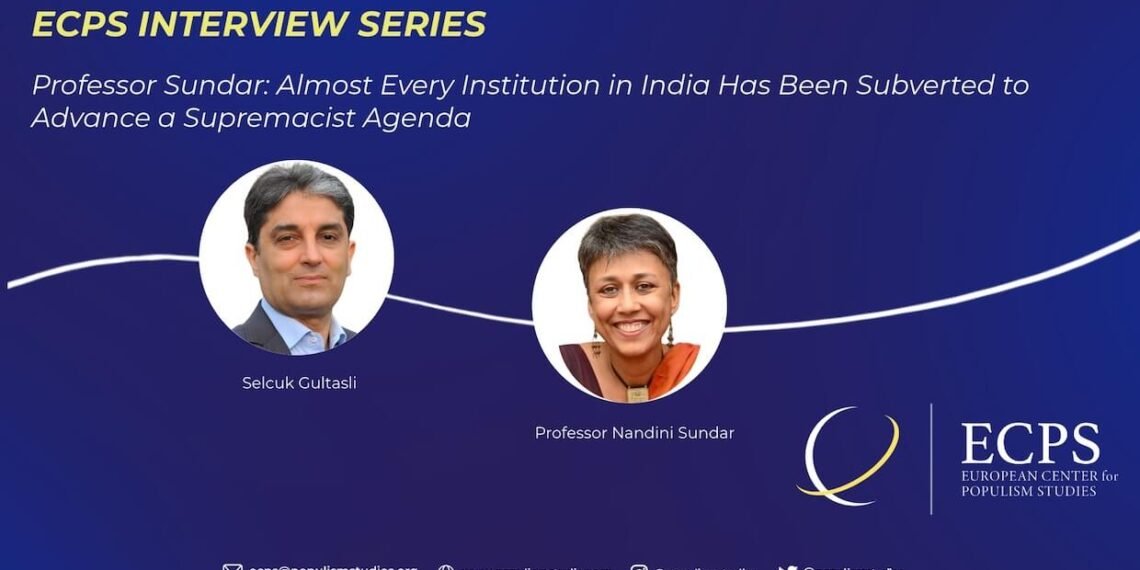
In this interview with the ECPS, Professor Nandini Sundar (Delhi School of Economics, Delhi University) delivers a stark assessment of India’s institutional trajectory under the BJP and its ideological parent, the RSS. Her central claim is unequivocal: “Almost every institution in this country has now collapsed, or has been subverted, in order to further the supremacist agenda.” She situates current developments within the longer history of Hindutva ideology, emphasizing the RSS’s founding goal of a Hindu supremacist state. Professor Sundar argues that a narrative of majoritarian victimhood underpins historical revisionism, institutional capture, and restrictions on academic freedom. She also highlights transnational pressures, noting that a “very active Hindutva diaspora” has targeted scholars abroad, constraining research and debate globally.
Interview by Selcuk Gultasli
In this wide-ranging interview with the European Center for Populism Studies (ECPS), Professor Nandini Sundar— Professor of Sociology at the Delhi School of Economics, Delhi University, and one of India’s most prominent sociologists and a leading voice on democracy, violence, and state power—offers a stark assessment of the trajectory of Indian institutions under the rule of the Bharatiya Janata Party (BJP) and its ideological parent, the Rashtriya Swayamsevak Sangh (RSS). Her central claim is unequivocal: “Almost every institution in this country has now collapsed, or has been subverted, in order to further the supremacist agenda.” Situating contemporary developments within the longer history of Hindutva ideology, Professor Sundar argues that the BJP cannot be understood apart from the RSS, “an unregistered, secretive organization” founded in 1925 “to establish a Hindu supremacist state in which all others would be second-class citizens.”
At the heart of this project, she explains, lies a powerful narrative of majoritarian victimhood. RSS discourse portrays Hindus as historical victims of “800 years of colonialism,” conflating Muslim rule with British imperialism and mobilizing a sense of lost civilizational pride. This paradox—an overwhelming majority imagining itself as dispossessed—underpins a wide array of policies, from historical revisionism to institutional capture. According to Professor Sundar, the claim to represent a wronged majority translates into concrete restrictions on academic freedom through ideological appointments, funding pressures, surveillance, and curricular transformation. Universities, in particular, have been reshaped to ensure that “only our narrative, only our voice, should count,” transforming spaces once associated with pluralism into arenas of political conformity and patronage.
The interview highlights how Hindutva governance operates not only through formal state mechanisms but also through diffuse networks of affiliated organizations and vigilante actors. Student groups such as the ABVP (the Akhil Bharatiya Vidyarthi Parishad) and other RSS-linked formations function simultaneously as political mobilizers and instruments of intimidation, embedding campuses within what Professor Sundar calls a broader “ecosystem of vigilantism.” Meanwhile, democratic institutions—from courts to electoral bodies and media regulators—are portrayed as formally intact yet substantively hollowed out, enabling what she describes as the preservation of democratic form alongside the erosion of democratic substance.
Professor Sundar also draws attention to the transnational dimension of these dynamics. A “very active Hindutva diaspora,” she notes, has targeted scholars abroad, orchestrating harassment campaigns and reputational attacks that restrict academic inquiry on India globally. As a result, she warns, it has become “very difficult for anyone working on India to be able to research, write, and think freely, whether inside the country or outside the country.”
Taken together, her analysis presents Hindutva not merely as a domestic political ideology but as a comprehensive project of institutional transformation, cultural redefinition, and epistemic control. By foregrounding the links between majoritarian resentment, institutional subversion, and the policing of knowledge, this interview offers a sobering account of how democratic systems can be repurposed to sustain exclusionary rule while maintaining the appearance of constitutional continuity.