
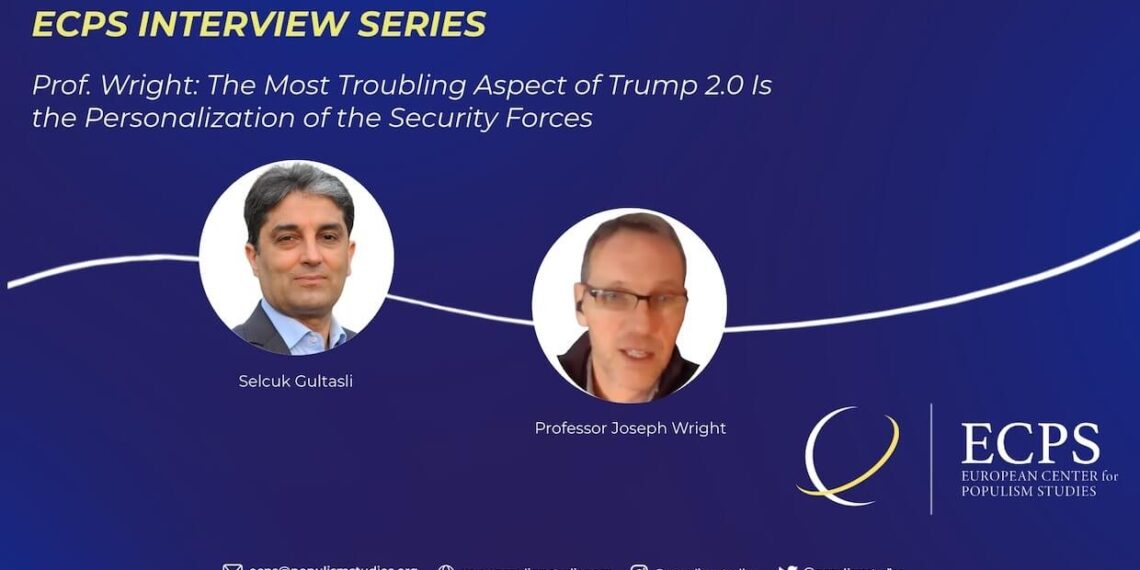
In an interview with the ECPS, Professor Joseph Wright (Penn State University) warns that the most alarming development of “Trump 2.0” is the rapid personalization of the state’s coercive apparatus. “The most troubling aspect… is the personalization of the security forces. That is the single most damaging thing that can happen to a country,” he cautions. Professor Wright notes that ICE has evolved into “a fully militarized internal security organization,” now poised to become one of the world’s largest such forces—capable, he warns, of being deployed “to seize ballot boxes” or “shoot protesters.” While federalism still offers partial safeguards, Professor Wright argues the United States is witnessing early signs of institutional capture characteristic of personalist regimes worldwide.
Interview by Selcuk Gultasli
In a wide-ranging and sobering interview with the European Center for Populism Studies (ECPS), Professor Joseph Wright of Penn State University offers a stark assessment of the United States’ democratic trajectory under a second Trump administration. Drawing on his extensive comparative research on personalist rule, bureaucratic erosion, and autocratization, Professor Wright argues that the defining danger of “Trump 2.0” lies in the accelerating personalization of the state apparatus, and especially of the coercive arms of government. As he warns, “What appears to me to be the most troubling aspect of the personalization of the government [is] the personalization of the security forces. That is the single most damaging thing that can happen to a country.”
Professor Wright situates his analysis within a broader global pattern in which elected strongmen—figures such as Erdoğan, Orbán, and other personalist executives—transform political parties, bureaucracies, and security institutions into instruments of personal power. Applying these insights to the contemporary United States, he identifies three markers of personalist party consolidation: a leader’s control of financial resources, control over candidate nominations, and the elevation of loyalists who depend entirely on the leader for their political survival. “He controls the money… he controls nominations, and… he appoints loyalists,” Professor Wright explains, noting that together these dynamics render party elites “basically unwilling to stand up to him.”
While the United States remains far from the fully consolidated autocracies seen in Turkey or Hungary, Professor Wright warns that early signs of bureaucratic hollowing and selective purges have already emerged. The Department of Justice, he argues, is the clearest example, where loyalist appointments and the abandonment of legal enforcement norms have created “a green light to lots of actors to be able to break the law.” Particularly concerning is the rise of a militarized internal security force centered on ICE, which he describes as “a fully militarized internal security organization” now positioned to become one of the largest coercive bodies in the world. Such a force, he cautions, could be deployed “to seize ballot boxes, to shoot protesters… or deter people from showing up at the voting booths,” mirroring patterns observed in autocratizing regimes elsewhere.
Yet, Professor Wright also emphasizes the continued importance of federalism as a barrier to total centralization. Local law-enforcement autonomy and decentralized election administration remain crucial buffers. Still, he stresses that the danger is not hypothetical but unfolding: “We don’t know where it’s going to go… things have progressed rapidly.”
Taken together, Professor Wright’s analysis offers one of the clearest comparative warnings to date: the durability of American democracy now hinges not only on electoral outcomes, but on whether the country can resist the deepening personalization of its most powerful state institutions.
