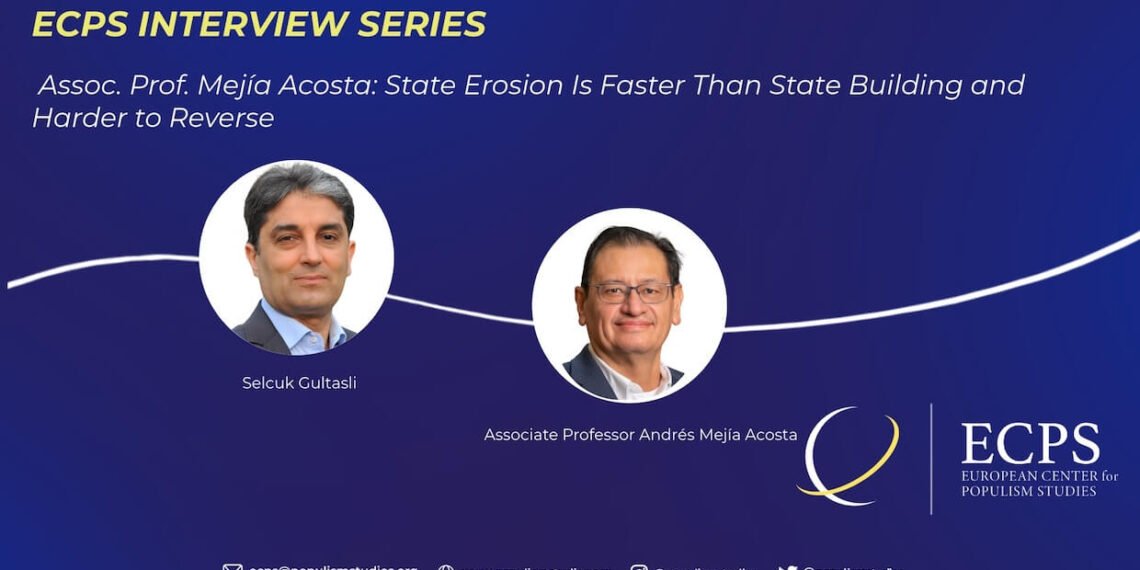
In this interview with the ECPS, Associate Professor Andrés Mejía Acosta (University of Notre Dame, Keough School of Global Affairs) explains why populist leaders often weaken state capacity strategically rather than accidentally. For populists, he argues, “state institutions and agencies get in the way of a more unilateral, discretionary, non-democratic type of governance,” prompting efforts to “ignore, dismantle, bypass, or merge” oversight bodies that constrain executive power. Assoc. Prof. Acosta underscores the asymmetry between construction and destruction: “state building… takes decades and even centuries,” yet “state dismantling… can be done very quickly,” with lasting effects on democratic recovery. He links institutional erosion to patronage politics, discretionary spending, and the weakening of accountability networks—dynamics that make reversals of democratic backsliding harder when “state mechanisms are no longer functioning.”
Interview by Selcuk Gultasli
In this wide-ranging interview with the European Center for Populism Studies (ECPS), Andrés Mejía Acosta, Associate Professor at the University of Notre Dame’s Keough School of Global Affairs, offers a sobering analytical framework for understanding how contemporary populist governance erodes state capacity and, in turn, weakens democratic resilience. Anchored in his influential research on “state hollowing,” Assoc. Prof. Mejía Acosta argues that the weakening of bureaucratic institutions is not an accidental byproduct of populist rule but a deliberate governing strategy. For populist leaders, he explains, “state institutions and agencies get in the way of a more unilateral, discretionary, non-democratic type of governance,” making their dismantling instrumental to consolidating power.
Highlighting the core theme captured in the interview’s title, Assoc. Prof. Mejía Acosta stresses the asymmetry between the slow construction and rapid destruction of state institutions. While comparative politics has long recognized the difficulty of building capable states, he warns that their erosion can occur with alarming speed and lasting consequences: “In the case of state building, we have long understood that it takes decades and even centuries to build and strengthen states, but we are now learning that state dismantling apparently does not take long; it can be done very quickly.” This accelerated dismantling, he argues, produces durable institutional damage that outlives the populist incumbents themselves, making democratic recovery far more difficult. Once oversight agencies, regulatory bodies, and accountability mechanisms are weakened or eliminated, the very infrastructure required for democratic renewal may no longer function.
Throughout the conversation, Assoc. Prof. Mejía Acosta situates state erosion within the broader literature on democratic backsliding while distinguishing it from classical authoritarian consolidation. Whereas backsliding targets elections, mediafreedom, and political competition, state hollowing undermines the administrative and fiscal capacities that sustain governance itself. The result is a mutually reinforcing cycle: weakening representative institutions enables further bureaucratic dismantling, while eroding state capacity deactivates democratic safeguards. As he notes, this dynamic creates long-term structural damage: “This phenomenon of state erosion will have long-term consequences that make reversals of democratic backsliding more difficult. It will be harder to recover democratic practices when state mechanisms are no longer functioning.”
Drawing on empirical examples from Latin America and beyond, Assoc. Prof. Mejía Acosta also emphasizes how populist regimes selectively weaken oversight institutions while expanding discretionary spending, coercive apparatuses, and patronage networks. Agencies responsible for environmental regulation, poverty evaluation, or fiscal monitoring become targets precisely because they constrain executive discretion. In their place emerges a governance model characterized by informality, opacity, and clientelistic redistribution—conditions that entrench incumbents while undermining public accountability.
Yet the interview is not solely diagnostic. Assoc. Prof. Mejía Acosta concludes with cautious optimism about democratic resilience, underscoring the need for cross-sectoral coalitions, institutional reforms, and sustained civic mobilization. As authoritarian tendencies penetrate deeper into governance structures—“as if the authoritarian illness is spreading through the body”—he calls for a global effort to rebuild the institutional foundations of democracy.
Taken together, this interview provides a theoretically rich and empirically grounded account of how populist leaders hollow out states from within—and why the consequences for democracy may endure long after the political moment has passed.