Session 12 of the ECPS Virtual Workshop Series explored how “decolonizing democracy” requires attention to the material and symbolic structures shaping participation, legitimacy, and representation. The presentations framed democracy not as a settled institutional model but as a contested field shaped by colonial legacies, extractive political economies, and identity-based struggles over inclusion and authority. Dr. Oludele Mayowa Solaja’s comparative study of Nigeria and the United Kingdom showed how environmental governance can produce “participation without power,” where formal inclusion coexists with persistent injustice. Dr. Salomon Essaga Eteme’s analysis of Cameroon highlighted how pluralism has intensified communal claims to state ownership, complicating political alternation. Supported by Dr. Gabriel Cyril Nguijoi’s feedback, the session underscored the value of concepts such as biocultural sovereignty and communocratic populism and emphasized the need for context-sensitive, interdisciplinary approaches to democratic renewal in the Global South.
Reported by ECPS Staff
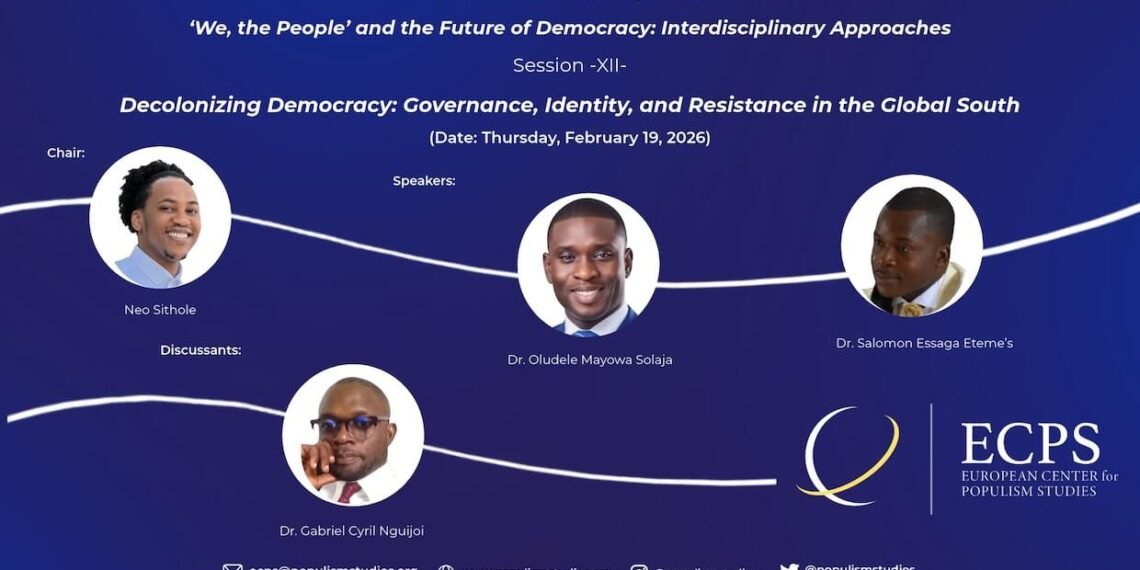
On Thursday, February 19, 2026, the European Center for Populism Studies (ECPS) convened Session 12 of its Virtual Workshop Series, “We, the People” and the Future of Democracy: Interdisciplinary Approaches, under the theme “Decolonizing Democracy: Governance, Identity, and Resistance in the Global South.” The session foregrounded a core problem in contemporary democratic theory and practice: how democratic institutions—often inherited, transplanted, or externally modeled—are reshaped, contested, and resisted in postcolonial contexts marked by extractive political economies, unequal state–society relations, and enduring struggles over recognition and voice.
Moderated by Neo Sithole (University of Szeged), the workshop approached “the people” not as a stable category but as a contested political project—produced through governance arrangements, mobilized through identity, and asserted through resistance. Across the session, democracy emerged less as an institutional endpoint than as a field of struggle in which colonial legacies, state power, and community agency intersect. Rather than treating decolonization as a symbolic discourse, contributors examined its concrete implications for how participation is structured, how resources are governed, and how legitimacy is claimed in environments where the state’s democratic form may coexist with exclusionary or coercive practices.
The session brought together two presentations that, while distinct in focus, converged on a shared concern with democratic deficit: the gap between formal mechanisms of participation and the effective capacity of communities to shape political and material outcomes. First, Dr. Oludele Mayowa Solaja (Olabisi Onabanjo University) examined environmental governance as a critical site of democratic contestation in a paper jointly authored with Busayo Olakitan Badmos (Olabisi Onabanjo University), titled “Decolonial Environmentalism and Democracy: A Comparative Study of Resource Governance in Nigeria and the United Kingdom.” Positioning environmental politics within the broader architecture of power, he explored how colonial histories and technocratic governance models marginalize local knowledge and produce “participation without power,” while proposing biocultural sovereignty as a pathway toward more inclusive ecological governance.
Second, Dr. Salomon Essaga Eteme (University of Ngaoundéré) analyzed electoral politics and identity mobilization in Cameroon in “Africa at the Test of Populism: Identity Mobilisations, Crises of Political Alternation, and the Trial of Democracy,” jointly authored with Dr. Yves Valéry Obame (University of Bertoua / Global Studies Institute & Geneva Africa Lab). His contribution interrogated how multiparty competition can intensify communal claims to representation, framing elections not as programmatic contests but as struggles over inclusion, alternation, and the symbolic ownership of the state.
The discussion was anchored by Dr. Gabriel Cyril Nguijoi (National Institute of Cartography; ICEDIS), whose role as discussant helped connect the papers’ empirical insights to broader debates on coloniality, accountability, and democratic substance. His interventions highlighted how both contributions disrupt common analytical shortcuts—whether the assumption that environmental injustice is confined to the Global South, or the notion that repeated elections necessarily constitute democratic consolidation.
Taken together, Session 12 offered a layered and comparative exploration of how democracy is challenged—and potentially renewed—through the politics of governance, identity, and resistance in postcolonial settings.