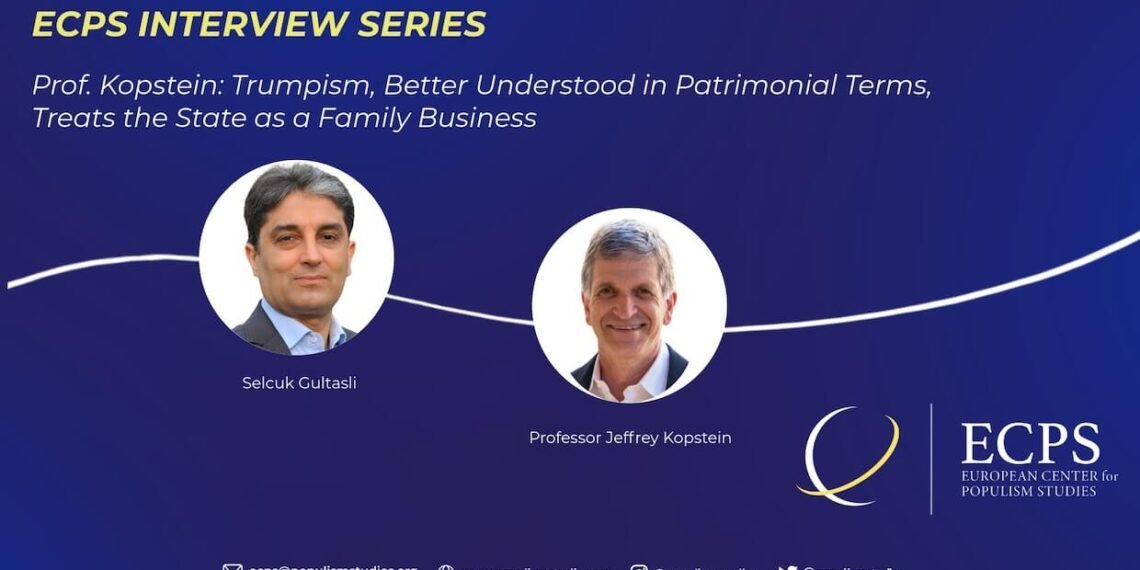
Professor Jeffrey Kopstein argues that Trumpism is best analyzed not primarily as populism, but as patrimonial rule—where “the state itself becomes an extension of the ruler’s household” and governance turns into “a family business.” In this ECPS interview, Professor Kopstein distinguishes patrimonialism from classic competitive authoritarianism: rather than merely “tilting the playing field,” patrimonial leaders seek to “own the entire field.” He traces how loyalty tests, selective legality, and the “monetization of office” reshape elite incentives and accelerate institutional hollowing. Drawing on Weberian theory, Professor Kopstein warns that irreversibility arrives when career survival depends on pleasing a patron rather than serving an office—and when the line between public and private interests starts to seem “quaint.” The interview also examines selective impunity, conditional judicial autonomy, personalized coercion, and why democratic resistance must target structural vulnerabilities rather than “waiting for collapse.”
Interview by Selcuk Gultasli
Giving an interview to the European Center for Populism Studies (ECPS), Jeffrey Kopstein, Professor of Political Science at the University of California, Irvine, offers a conceptually rigorous reinterpretation of Trumpism that moves beyond the familiar vocabulary of populism and competitive authoritarianism. Anchored in Weberian state theory and comparative authoritarianism, Professor Kopstein argues that the most analytically precise framework for understanding the contemporary transformation of American governance is patrimonialism—a form of rule in which the state is treated as the personal domain of the leader. As he memorably puts it, under patrimonial logic “the state itself becomes an extension of the ruler’s household,” collapsing the boundary between public authority and private interest and turning governance into what he repeatedly calls “a family business.”
Professor Kopstein’s intervention challenges dominant scholarly narratives that focus primarily on rhetoric, electoral manipulation, or ideological polarization. While competitive authoritarianism “rigs the game,” he contends, patrimonialism seeks something more radical: ownership of the system itself. In his words, the logic is “not simply to tilt the playing field, but to own the entire field.” This shift, he suggests, captures a deeper transformation from constitutional republicanism toward personalized rule structured by loyalty, selective legality, and the monetization of office. Trumpism, he argues, is best understood through this lens because its defining features—“loyalty tests, public humiliation of subordinates, monetization of office, and the personalization of coercive authority”—are not incidental pathologies but the governing principle of the system.
A central theme of the interview is institutional hollowing. Drawing on Max Weber’s theory of modern bureaucracy, Professor Kopstein explains how privileging personal loyalty over professional expertise erodes state capacity from within. When career advancement depends on pleasing the patron rather than serving impersonal offices, information deteriorates, policy becomes erratic, and public goods provision declines. The critical threshold, he warns, is reached when citizens and elites alike lose the ability to distinguish between public and private interests—when that distinction begins to seem “quaint.” At that point, patrimonial consolidation is effectively complete.
Equally significant is Professor Kopstein’s analysis of elite incentives. When public office becomes a revenue stream, neutrality becomes costly and adaptation becomes rational. Economic success increasingly depends not on market entrepreneurship but on proximity to power, reversing the conventional liberal assumption that wealth generates political influence. In patrimonial systems, he notes, the causal arrow often runs in the opposite direction: political power produces wealth. This dynamic helps explain why scandals, legal controversies, or reputational crises frequently fail to weaken such regimes. Surviving scandal without consequences signals immunity and reinforces an aura of invincibility among supporters.
By reframing Trumpism as a patrimonial project rather than merely a populist movement, Professor Kopstein invites scholars to redirect analytical attention from mass ideology to elite control over institutions, resources, and coercive capacity. The interview thus situates contemporary American politics within a broader comparative perspective on personalist rule, offering a sobering account of how democratic systems can be gradually transformed without the overt dismantling of formal institutions.