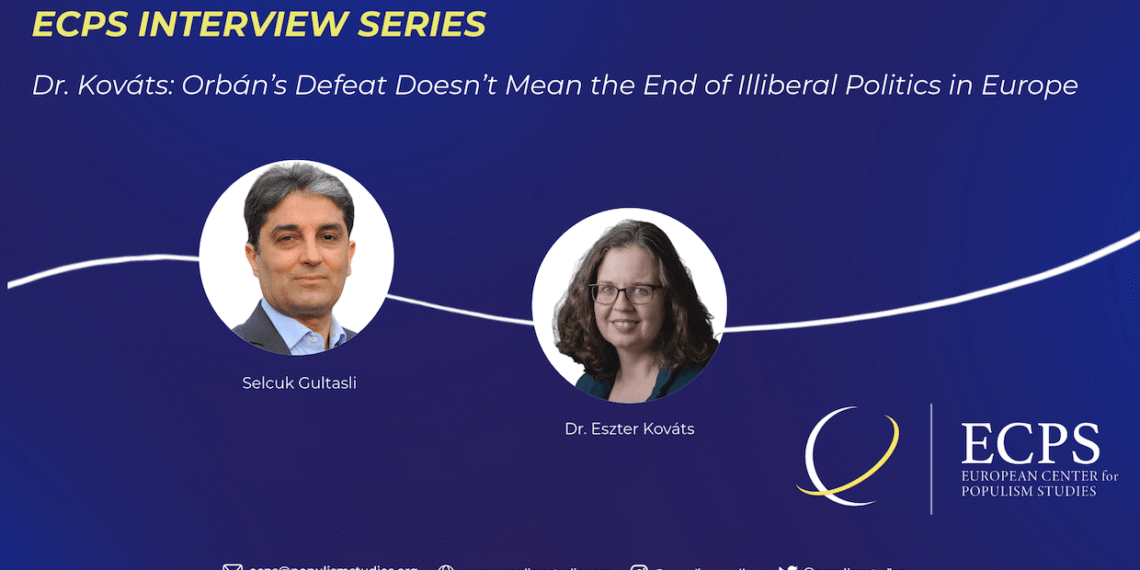
In this ECPS interview, Dr. Eszter Kováts offers a measured reassessment of Viktor Orbán’s electoral defeat and its wider implications for Europe. While the 2026 Hungarian elections mark a major rupture in domestic politics, she cautions against triumphalist readings that treat Orbán’s fall as the collapse of illiberalism itself. “It is something of a liberal dream,” she argues, to assume that the defeat of one leader means the defeat of the entire project. Kováts situates Orbánism within deeper structural, economic, and discursive dynamics, showing how it combined institutional power, culture-war politics, and claims to national sovereignty. At the same time, she underscores Hungary’s enduring polarization, the persistence of Fidesz’s electorate, and the unresolved conditions that continue to sustain illiberal-right politics across Europe.
Interview by Selcuk Gultasli
As Hungary enters the post-2026 electoral moment, the defeat of Viktor Orbán has been widely interpreted as a watershed in the trajectory of illiberal governance in Europe. For more than a decade, Orbán’s system stood as a paradigmatic case of what has often been termed “illiberal democracy”—a political formation combining electoral legitimacy with institutional centralization, ideological mobilization, and a sophisticated use of culture wars and transnational alliances. Yet, as this interview with Dr. Eszter Kováts makes clear, such interpretations risk overstating both the rupture and its implications.
In conversation with the European Center for Populism Studies (ECPS), Dr. Eszter Kováts—Marie Skłodowska-Curie postdoctoral research fellow at the University of Vienna—offers a careful and analytically grounded reassessment of this moment. While the electoral outcome may appear decisive, she cautions against reading it as a definitive break. As she puts it, “it is something of a liberal dream to treat Orbán’s defeat as the defeat of his entire project.” The persistence of “many Fidesz voters,” alongside the broader constituency of “far-right and illiberal-right parties across Europe,”underscores the continued relevance of the political and social forces that sustained Orbánism.
This insight frames the central tension explored throughout the interview: whether the Hungarian case represents a genuine transformation or a reconfiguration of underlying structural dynamics. Dr. Kováts emphasizes that both the rise and the exhaustion of Orbán’s system can only be understood through a layered analysis that combines structural, contextual, and contingent factors. Economically, the regime rested on a distinctive model—often described as a hybrid of state intervention and market adaptation—which, for a time, delivered tangible improvements in living standards. Politically, it capitalized on what she identifies as “blind spots” within liberal and progressive frameworks, constructing an antagonistic narrative around migration, gender, and geopolitical conflict, each containing a “kernel of truth” but amplified into an “apocalyptic vision.”
At the same time, the interview challenges conventional narratives that frame right-wing mobilization simply as“backlash.” Such interpretations, Dr. Kováts argues, rely on overly teleological assumptions about democratic development and obscure the deeper systemic tensions that shape political contestation. Orbán’s success, in this reading, lay not merely in institutional control but in his ability to articulate these tensions—though this articulation ultimately faltered as economic conditions deteriorated and rhetoric became “increasingly detached from reality.”
The emergence of Péter Magyar introduces a further layer of complexity. Rather than a straightforward democratic reversal, Dr. Kováts describes the transition as, in part, a “democratic rebalancing,” but also as a moment fraught with uncertainty. Hungary remains “deeply divided,” with 94 percent of voters concentrated in two opposing camps, reflecting not only political polarization but competing “perceptions of reality.” Moreover, Magyar’s own political trajectory—rooted in Fidesz—raises questions about continuity as much as change, particularly given his constitutional majority and capacity to reshape state institutions.
Beyond Hungary, the implications for European populism are similarly ambiguous. Illiberal networks, Dr. Kováts notes, are not dependent on a single figure; they are embedded in national contexts and sustained by what she terms a “representation gap.” The assumption that Orbán’s exit signals the broader decline of illiberal politics is therefore, in her words, “a compelling discourse, but… a political one rather than an analytical description.”
In sum, Dr. Kováts’s reflections invite a more measured interpretation of Hungary’s political shift—one that resists both triumphalism and determinism. Rather than marking the end of a political era, the Orbán–Magyar transition may be better understood as a contingent episode within a longer and unresolved contest between competing visions of democracy in Europe.