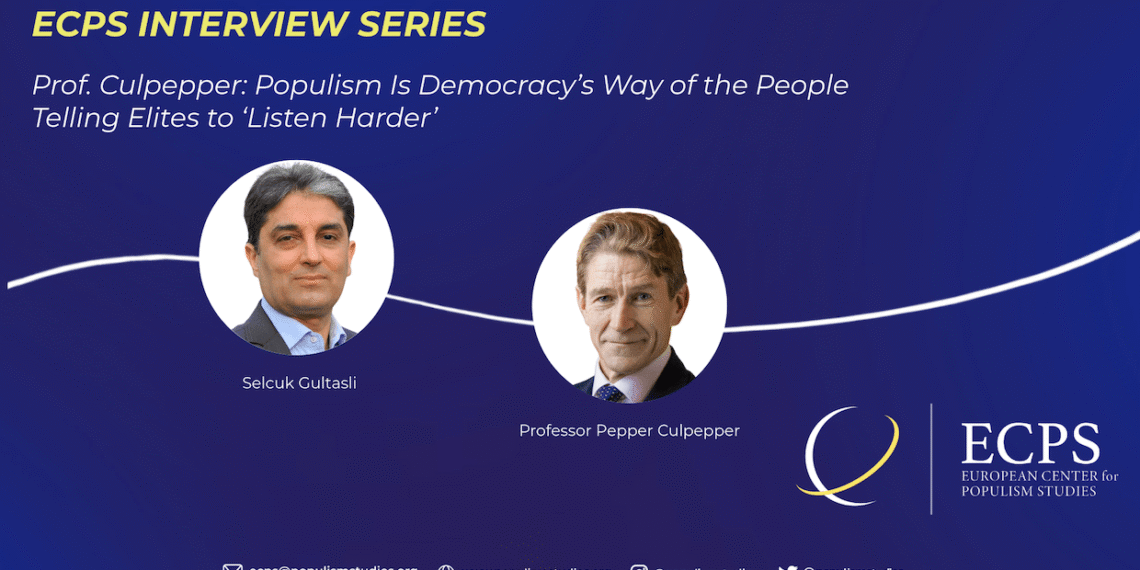
In an interview with the ECPS, Professor Pepper Culpepper argues that populism should not be treated as inherently anti-democratic. Rather, under certain conditions, it can function as a corrective force that exposes failures of responsiveness and pressures elites to address neglected public demands. Drawing on his work on quiet politics, corporate scandal, and democratic accountability, Professor Culpepper distinguishes between populism rooted in political failure and that driven by economic unfairness. While the former can erode pluralism, the latter may help rebalance distorted relations between citizens, markets, and institutions. The interview offers a nuanced reflection on public anger, corporate power, and the democratic potential—as well as the dangers—of contemporary anti-elite mobilization.
Interview by Selcuk Gultasli
At a moment when democratic systems are under strain from two mutually reinforcing pressures—rising populist mobilization and the growing concentration of corporate power—the question of whether public anger can renew democratic accountability has acquired unusual urgency. In this wide-ranging interview with the European Center for Populism Studies (ECPS), Professor Pepper Culpepper, Vice Dean for Academic Affairs and Blavatnik Chair in Government and Public Policy at the Blavatnik School of Government, University of Oxford, offers a careful but provocative answer. Drawing on his influential scholarship—from Quiet Politics to his recent book Billionaire Backlash— Professor Culpepper argues that populism should not be understood simply as a threat to democracy. Under certain conditions, it can function as a corrective force, signaling failures of responsiveness and compelling elites to confront public demands they have too long ignored.
This argument runs directly through the spirit of the interview’s headline: “Populism Is Democracy’s Way of the People Telling Elites to ‘Listen Harder’.” Rather than treating populism as inherently pathological, Professor Culpepper urges a more discriminating view. In his recent Journal of Democracy article, “When Populism Can Be Good,” co-authored with Taeku Lee, he distinguishes between two broad dimensions of anti-elite sentiment: one rooted in political failure, the other in economic unfairness. For Professor Culpepper, this distinction is decisive. A populism centered on political failure—marked by distrust in elections, media, and institutions—can become corrosive to pluralism. By contrast, populist energies organized around economic unfairness may serve as a democratizing counterweight to entrenched power. As he puts it, “there are, of course, many negative aspects of populism, but one positive dimension is its potential to enhance responsiveness.”
The interview shows that this concern with responsiveness is inseparable from Professor Culpepper’s broader work on corporate scandal, media narratives, and regulatory change. Across cases ranging from the Beef Trust and The Jungle to Cambridge Analytica, AI regulation, and Big Tech, he explores how moments of public outrage can disrupt what he famously described as “quiet politics”—those domains in which organized business interests dominate because public attention is weak. Scandals, in his account, operate like “earthquakes”: they release latent pressure, render previously obscure issues politically salient, and sometimes create openings for institutional reform. Yet these openings do not arise automatically. They depend on policy entrepreneurs, compelling narratives of blame, and political actors capable of translating outrage into durable regulation.
What emerges from this conversation is a deeply textured account of the ambivalence of populism in contemporary democracy. Professor Culpepper does not romanticize anti-elite anger; he repeatedly underscores the dangers of polarization, scapegoating, and demagogic capture. Still, he insists that democratic theory must take seriously the possibility that public outrage, when directed at economic concentration and political unresponsiveness, can help rebalance distorted systems of power. The key question, as he suggests, is not whether populism exists, but which grievances it channels and toward what ends. In that sense, this interview is both an analysis of populism and a meditation on democracy’s capacity for self-correction.