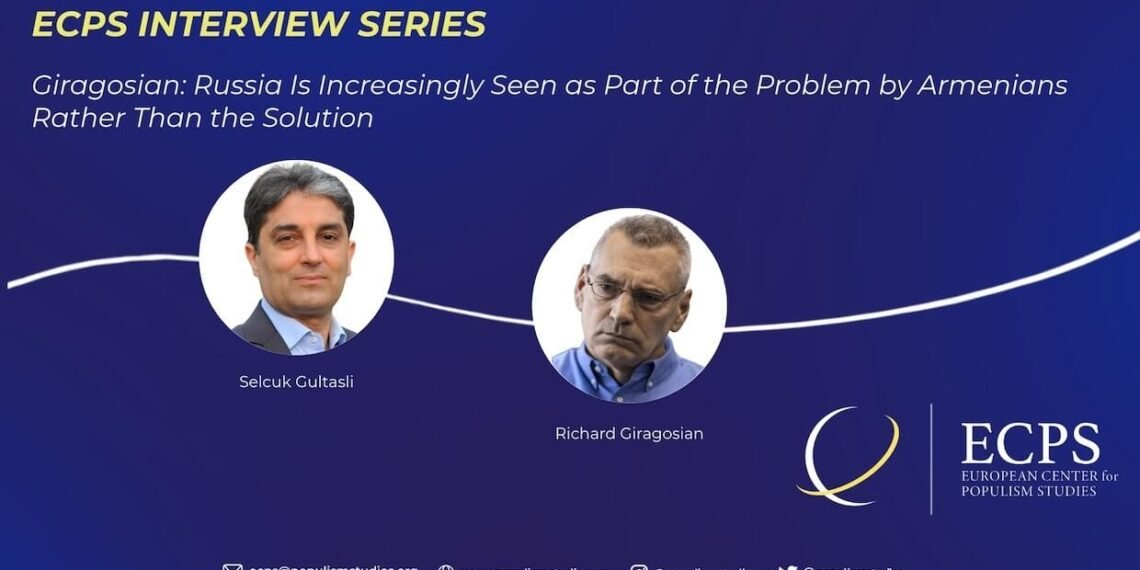
As Armenia navigates the aftermath of war, the loss of Nagorno-Karabakh, and a far-reaching geopolitical realignment, one question looms large: Can democratic resilience survive amid regional insecurity and great-power competition? In this compelling ECPS interview, Richard Giragosian—Founding Director of the Regional Studies Center (RSC) in Yerevan—examines Armenia’s evolving relationship with Russia, the democratic implications of Nikol Pashinyan’s populist leadership, and the country’s strategic turn toward Europe. Giragosian argues that many Armenians now view Russia as “part of the problem rather than part of the solution,” while emphasizing that Armenia’s recent election represented a mandate for peace, normalization, and democratic continuity. The conversation explores populism in power, post-war identity transformation, Armenia–Turkey normalization, democratic institution-building, and the future of the South Caucasus. Ultimately, Giragosian suggests that Armenia may be less a model than “an accidental exception” in an era of democratic backsliding and geopolitical upheaval.
Interview by Selcuk Gultasli
As Armenia emerges from one of the most turbulent periods in its modern history, the country stands at the intersection of democratic resilience, geopolitical realignment, and post-war transformation. The aftermath of the 2020 war, the loss of Nagorno-Karabakh, deepening estrangement from Russia, and ongoing normalization efforts with Turkey and Azerbaijan have profoundly reshaped Armenian politics and strategic thinking. Against this backdrop, the 2026 parliamentary elections have been widely interpreted as a referendum not only on Prime Minister Nikol Pashinyan’s leadership but also on Armenia’s future place between Russia, Europe, and the wider region.
In this wide-ranging interview with the European Center for Populism Studies (ECPS), Richard Giragosian—Armenian-American academic, security analyst, and Founding Director of the Regional Studies Center (RSC) in Yerevan—examines the forces driving Armenia’s remarkable political trajectory. He argues that the election result reflected far more than a geopolitical choice. It represented a mandate for democratic continuity, political stability, and the pursuit of diplomatic normalization with Armenia’s neighbors. As Giragosian notes, the vote marked Armenia’s “third consecutive genuinely free and fair vote,” underscoring the country’s democratic consolidation despite war, insecurity, and external pressure.
A central theme of the conversation concerns the evolution of populism in power. Emerging from the 2018 Velvet Revolution, Pashinyan embodied a rare case of successful anti-establishment mobilization driven by nonviolent popular protest. Yet Giragosian argues that the qualities that enabled Pashinyan’s rise have not necessarily translated into effective governance. While acknowledging the historic significance of the revolution as “a rare victory of nonviolent people power,” he contends that Pashinyan remains “as impulsive as ever, as emotional, and sometimes reckless,” while public policy continues to be “overly centralized in the Prime Minister’s office.” In Giragosian’s assessment, the populist style that propelled Pashinyan to power now coexists with persistent institutional weaknesses and governance challenges.
The interview’s most striking insights, however, concern Armenia’s changing relationship with Russia. According to Giragosian, the war of 2020 and the loss of Nagorno-Karabakh fundamentally altered Armenian perceptions of Moscow. Russia is no longer widely viewed as Armenia’s indispensable protector. Instead, he argues, many Armenians increasingly regard Russia as “dangerously unreliable,” adding that the conflict has led them to see Russia “as part of the problem rather than part of the solution.” This shift reflects not simply a foreign policy adjustment but a broader reassessment of Armenia’s security assumptions and strategic dependencies.
The discussion also explores Armenia’s efforts to balance relations with Europe and Russia, prospects for peace with Azerbaijan, normalization with Turkey, democratic institution-building, and the emergence of a more civic and pragmatic understanding of patriotism. Yet Giragosian remains cautious about presenting Armenia as a model for others. Indeed, he suggests that Armenia may be “less of a lesson and more of an accidental exception”—a rare convergence of democratic mobilization, geopolitical opportunity, and regional recalibration. Whether that exception can endure may prove to be one of the defining questions for the future of the South Caucasus.