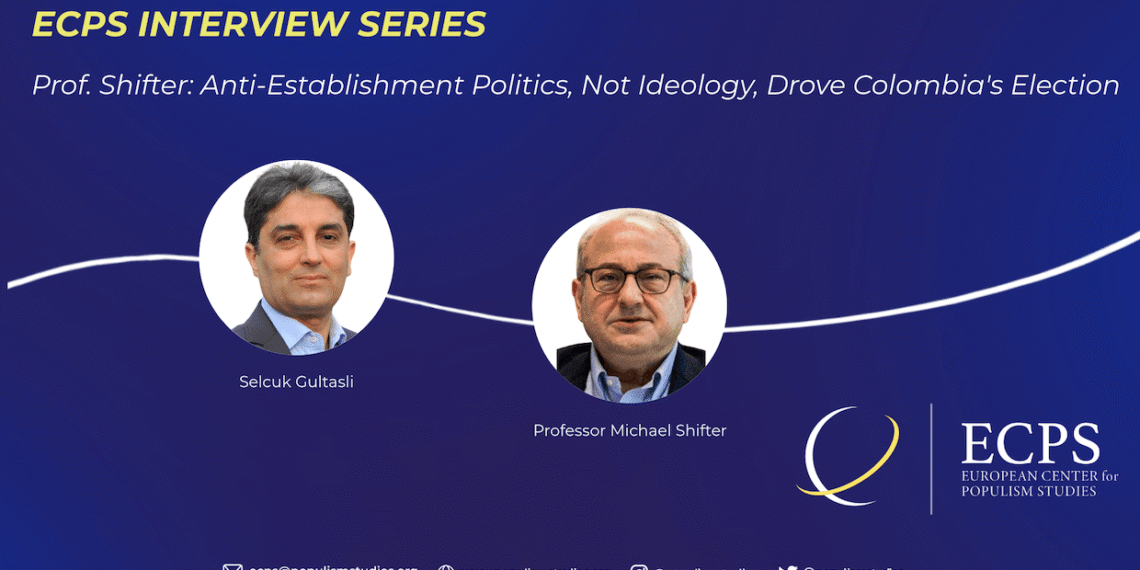
Colombia’s 2026 presidential election has reignited fundamental debates about populism, democratic resilience, institutional legitimacy, and the future of representative democracy in Latin America. Is the country experiencing a conventional ideological shift, or does the election reveal a deeper transformation in democratic politics? In this ECPS interview, Professor Michael Shifter argues that Colombia’s election was driven less by ideology than by widespread anti-establishment sentiment rooted in persistent insecurity, weak state capacity, and public frustration with successive governments’ failure to deliver results. Examining the rise of security populism, the erosion of political moderation, the resilience of Colombian democratic institutions, and the evolving relationship with the United States, Professor Shifter offers a nuanced assessment of Colombia’s political trajectory and its broader implications for comparative studies of populism and democratic governance.
Interview by Selcuk Gultasli
Colombia’s 2026 presidential election marks one of the most consequential political turning points in contemporary Latin America, raising fundamental questions about populism, democratic resilience, institutional legitimacy, and the future of representative government. The election of Abelardo de la Espriella, following the historic presidency of Gustavo Petro, has frequently been interpreted as evidence of a regional shift from the left toward the populist radical right. Yet such an interpretation, while politically intuitive, risks overlooking the deeper structural forces reshaping democratic politics across the hemisphere. Is Colombia witnessing an ideological realignment, or does the election reveal something more profound about the changing nature of democratic representation itself? As insecurity, organized crime, institutional distrust, and dissatisfaction with political elites intensify across Latin America, electoral competition increasingly appears to revolve less around competing ideological projects than around public demands for effective governance, security, and political renewal.
Few scholars are better positioned to interpret these developments than Professor Michael Shifter, Adjunct Professor at the Center for Latin American Studies (CLAS) at Georgetown University and Senior Fellow at the Inter-American Dialogue. For decades, his scholarship has examined the intersections of democratic governance, state-building, political violence, US–Latin American relations, and institutional development. In this wide-ranging interview with the European Center for Populism Studies (ECPS), Professor Shifter offers a nuanced interpretation of Colombia’s election that challenges conventional narratives about ideological polarization and instead places anti-establishment politics at the center of democratic change.
Professor Shifter argues that the conventional interpretation of Colombia’s 2026 election as simply a shift from left to right overlooks a deeper transformation taking place in the country’s democratic politics. "The conventional narrative… is that we’re seeing a turn to the right… I think that’s only part of the story," he explains. "If we focus only on that, we’re missing something more profound and more fundamental," namely "profound discontent, widespread anger, and a strong anti-establishment sentiment." In his view, Abelardo de la Espriella’s victory represents not merely a rejection of Gustavo Petro’s left-wing government but the continuation of the same anti-establishment dynamic that first brought Petro himself to power in 2022. "It is not simply a shift from the left to the right," he observes, "but a continuation of anti-establishment politics."
Throughout the interview, Professor Shifter explores how declining confidence in traditional political parties, the rise of social media-driven campaigning, persistent insecurity, and frustration over governments’ inability to deliver tangible results are transforming democratic competition throughout Latin America. He explains why contemporary electoral behavior is increasingly shaped by emotional appeals rather than coherent political programs; why "security populism"has become an increasingly powerful electoral force; why the apparent rise of a unified global populist right often conceals significant ideological differences among its leaders; and why Colombia’s political center continues to erode under the combined pressures of institutional failure and rejectionist voting. At the same time, he cautions against reducing contemporary Latin American politics to simplistic ideological categories, emphasizing instead the diversity of populist experiences across the region.
Despite his concern about growing populist pressures, Professor Shifter ultimately offers a measured assessment of Colombia’s democratic future. One of the most important—and, in his view, most overlooked—developments of the Petro years was "the resilience of Colombian institutions: Congress, the courts, civil society, and the press." While acknowledging the serious challenges posed by insecurity, polarization, and anti-establishment politics, he concludes on a cautiously optimistic note, expressing confidence that Colombia’s democratic institutions remain capable of preserving constitutional order and maintaining effective checks and balances in the years ahead.