
Please cite as:
Kalaitzidis, Akis. (2026). “From Economic Crisis to Democratic Backsliding: Evidence from Thailand, Argentina, the United States, and Greece.” Journal of Populism Studies (JPS). July 06, 2026. https://doi.org/10.55271/JPS000127
Abstract
Economic crises often serve as incubators of populism. When currencies collapse, or debts spiral out of control, mainstream parties lose credibility, creating openings for leaders who claim to defend “the people” against distant elites. The cases of Thailand, Argentina, the United States, and Greece illustrate how crises enable populism, how populists frame economic struggles, and use them to subvert the political order. In Thailand, the 1997 Asian Financial Crisis led to IMF-imposed reforms that hurt the rural poor. Thaksin Shinawatra rose on a populist platform of cheap healthcare and rural development, casting himself as defender of the countryside against Bangkok elites (Phongpaichit & Baker, 2009). In Argentina, the 2001–2002 default discredited neoliberal economic policies. Néstor and Cristina Kirchner mobilized popular anger against the IMF and creditors, mixing subsidies and protectionism with nationalist rhetoric (Levitsky & Murillo, 2008). In the United States, the 2008 financial crash produced dual populist currents: the Tea Party and Donald Trump on the right, and Occupy Wall Street and Bernie Sanders on the left, both targeting elites, including Wall Street and the Washington establishment (Skocpol & Williamson, 2012; Frank, 2016). In Greece, Syriza rose during the Eurozone crisis, opposing austerity and demanding sovereignty from the EU “Troika” (Pappas, 2019). Across these cases, populists reframed abstract economic shocks as moral struggles, pitting ordinary people against elites, technocrats, or foreign powers (Mudde & Rovira Kaltwasser, 2017). Their policies emphasized immediate relief—subsidies, redistribution, debt resistance—over fiscal orthodoxy. Yet each also confronted the hard limits of global capitalism, leading to compromise, backlash, or renewed instability (Dornbusch & Edwards, 1991; Kahler & Lake, 2013). Economic crises highlight the tension between national democracy and global markets; populism thrives in this gap, using it to decay institutions and norms in democratic states. I argue that economic crises lead to democratic backsliding.
Keywords: Populism, Economic Crises, Democratic backsliding, Greece, USA, Thailand, Argentina
By Akis Kalaitzidis[1]
Do economic crises necessarily lead to democratic backsliding? My argument in this paper is that it does. Economic crises lead to increased populism, which ultimately erodes public confidence in the political system and degrades not only democratic regimes (Levitsky & Murillo, 2008) but also authoritarian ones (O’Donnell, 1999; Schedler, 2013). Bunce and Wolchik (2011) argued that the exclusionary populist politics of Slobodan Milosevic destroyed the multicultural authoritarian regime in Yugoslavia. Others have argued it is not necessarily the economic crises that produce populism but the conflict between the “winners and losers” of said economic crisis, which increases the feeling of loss among the many, something in conflict studies we call the Relative Deprivation thesis (Gurr, 1970). Others argue that it is race and status that are responsible for the increasing populism worldwide (Palmer, 2019). Finally, some blame global migratory patterns for being zero-sum, arguing that every newcomer is a net negative for the country that receives them (Palmer, 2019).
Populist regimes are, par excellence, illiberal, argues Pappas (2019). In this sense, democracies decline step by step, embracing new institutional structures that undermine the preceding democratic ones and replace them with illiberal ones. Often personalistic, these new regimes create institutions closer to authoritarianism than to actual democracy and dominate their countries for a long time, for example, Hungary, Turkey, Argentina, etc.
In this paper, I will examine four cases, in the order of the economic crises that affected them: Thailand in 1997, Argentina in 2001, the US in 2008, and Greece in 2015. It is my argument that economic crises arising from global economic dislocations and contagion (Desai, 2003) produce populist regimes that wreak havoc on established institutions and lead countries to political backsliding (Foa & Mounk, 2017). I will explain how populism works in light of severe financial crises, addressing the key elements such as a) its social base, b) the policies associated with the regime, c) its rhetoric, d) the organizational strategy of the regime, e) its leadership style, f) the mobilization associated with regime change, and finally, g) the legacy of each regime.
Populism and Its Discontents
What is populism? And how does it affect different countries? Before I analyze my case studies, it is important to examine how these populist movements form and what they mean. Considering the variation in regimes and political cultures that produce populism, as well as the nebulousness of the concept, it is essential to define it as precisely as possible. Generically, the definition of populism is “a thin center ideology that considers society to be ultimately separated into two homogenous and antagonistic camps, ‘the pure people’ versus the ‘corrupt elite’ and which argues that politics should be an expression of the volonté générale (general will) of the people.” (Mudde & Kaltwasser, 2017). Although Ernesto Laclau (2005) argued that populism does not lead to authoritarianism, my research finds evidence to the contrary. In fact, using populism as an intermediary variable, one can see that economic crisis can lead to political backsliding that takes the form of authoritarianism (Thailand, the USA) or not (Argentina and Greece), depending on political culture. I agree with Laclau that populism is a form of politics, not an ideology, but unlike Laclau, I view populism as a challenge to democracy and argue it should be viewed as such.
Benjamin Moffit describes the various approaches to defining the concept through the years with a) the ideational approach, b) the strategic approach, and c) the discussive performative approach (Moffit, 2020). The Ideational approach argues that populism is a worldview and an ideology. Populism, sure enough, increasingly appeals to even the younger generation and has made inroads in even the strongest liberal democracies. Roberto Stefan Foa and Yascha Mounk argue that there are signs of the deconsolidation of democracies across the board (Foa & Mounk, 2017). Americans have long been growing dissatisfied with the state of their political system. As survey researchers have chronicled over recent decades, an overwhelming majority of citizens now believe that the US is ‘headed in the wrong direction,” (Foa & Mounk, 2017).
In Europe, the shock of Brexit was felt in the corridors of European capitals, and some decided to work against the established order. Several populist leaders, among them the leaders of Italy, Croatia, Slovakia, Hungary, and Bulgaria, made an extra effort to dismantle liberal justice requirements and regress their country’s democracy (The Guardian, 3.30.2026). It remains to be seen whether the trend of democratic backsliding can be reversed following Viktor Orbán’s decisive defeat.
In general, there are two forms of backsliding according to Nancy Bermeo (2016: 6): “Backsliding can take us to different end points at different speeds. Where backsliding involves rapid and radical change across a broad range of institutions, it leads to outright democratic breakdown and to regimes that are unambiguously authoritarian.” In one of my cases, a complete deconsolidation of democracy happened with the end of a populist regime in Thailand. Essentially, the end of the Thaksin experiment was the rise of the Thai military. In the other three cases, the backsliding has been much more gradual, and in those cases, Bermeo argues: “Where backsliding takes the form of gradual changes across a broad range of institutions, it is less likely to lead to all-out regime change and more likely to yield political systems that are ambiguously democratic or hybrid” (Bermeo 2016: 6). In other words, illiberal democracies.
The last three cases here, Argentina, the US, and Greece, experienced a decline in democratic values, with the US doing the heavy lifting under the Trump Administration. Yet, even in the mild cases of Greece and Argentina, we have seen a serious weakening of democratic institutions, thus “Democratic backsliding can thus constitute democratic breakdown or simply the serious weakening of existing democratic institutions for undefined ends. When backsliding yields situations that are fluid and ill-defined, taking action to defend democracy becomes particularly difficult,” (Bermeo, 2016:6). So as Palacios (2025: 1832) notes, “a large body of studies has found that populism ‘in the real world’ also has detrimental effects on the quality of democracy. Due to their ambiguous relationship with democracy, once in power, many populist forces adopt an agenda of institutional change that seeks to better approximate their illiberal democratic ideals to the practice.”
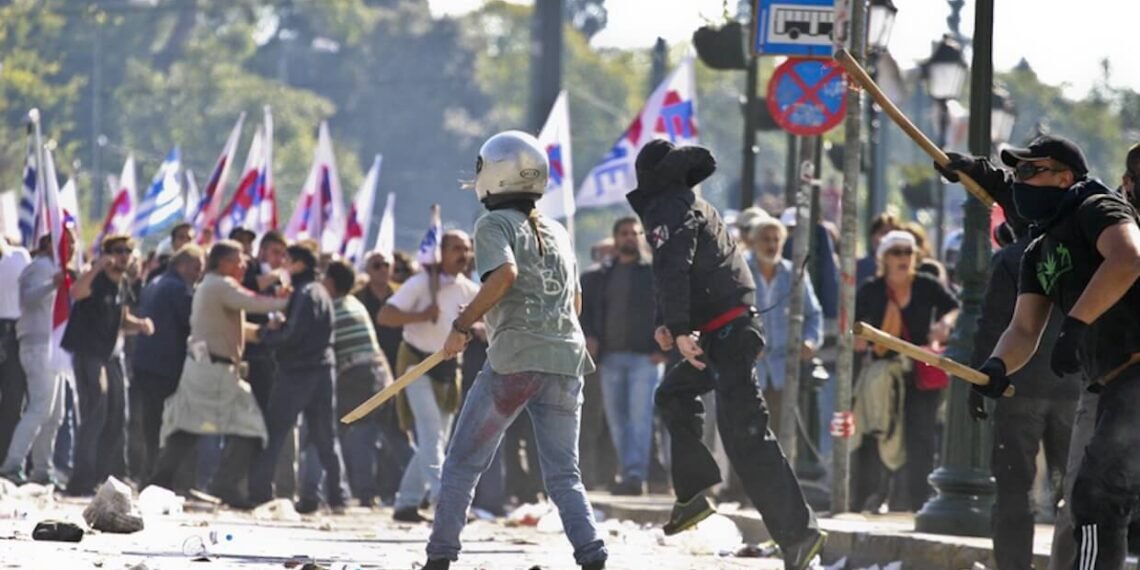
What I argue in this paper is that populism transforms economic woes into political and, especially, moral conundrums, pitting parts of society against one another for the benefit of the leadership. The result of populism‘s divisiveness is frequent democratic backsliding, as seen in Thailand, where it led to a coup d’ etat against Thaksin and renewed authoritarianism. In Greece, the collapse of the party system and increased violence among people, and in the US, the establishment of an authoritarian pronged leadership. Only in Argentina have the populists from the left been replaced by the populists of the right, with no discernible end to their economic woes.
Read the Full Text
[1] Akis Kalaitzidis is a Professor of Political Science at the Department of Government, Law, and International Affairs, University of Central Missouri. Email: kalaitzidis@ucmo.edu
