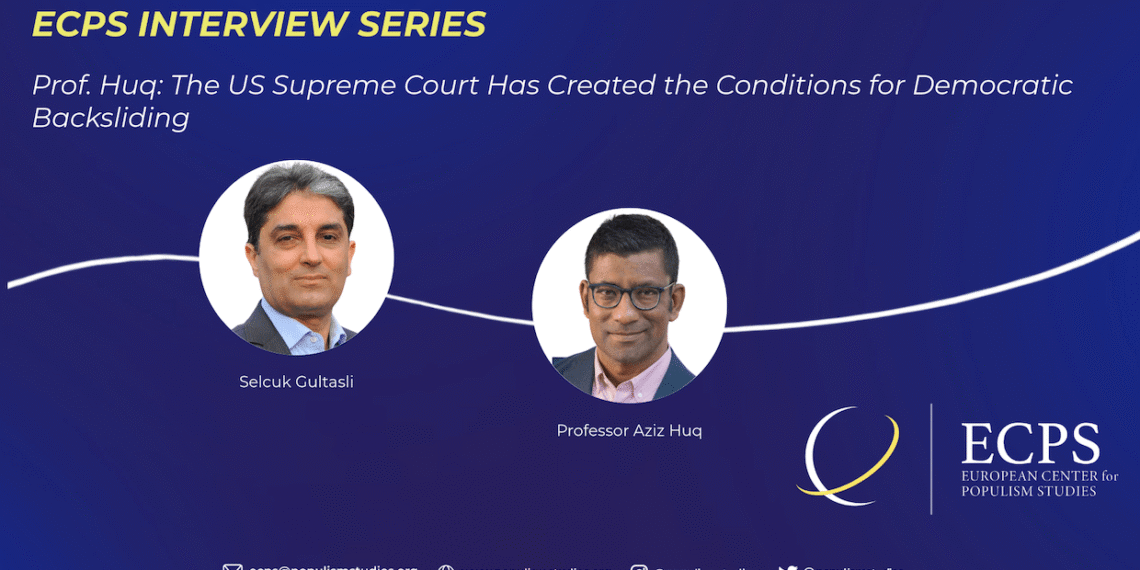
As democratic backsliding increasingly unfolds through legal institutions rather than overt constitutional rupture, what distinguishes constitutional resilience from constitutional decline? In this wide-ranging interview with the ECPS, Professor Aziz Huq of the University of Chicago examines how populism, executive power, judicial doctrine, digital platforms, and artificial intelligence are transforming liberal constitutionalism in the United States and beyond. Drawing on comparative constitutional law, he argues that contemporary democratic erosion often proceeds “under the cover of law,” while warning that populists are developing their own constitutional vision. From presidential immunity and democratic backsliding to algorithmic governance and AI-driven power concentration, Professor Huq offers a timely and sophisticated analysis of democracy’s evolving constitutional challenges in the twenty-first century.
Interview by Selcuk Gultasli
Across much of the democratic world, constitutional democracy is undergoing a profound transformation. Contemporary democratic erosion rarely arrives through military coups or overt constitutional rupture. Instead, it increasingly unfolds through courts, legislatures, executive decrees, and formally legal mechanisms that gradually weaken institutional constraints while preserving the appearance of constitutional continuity. At the same time, digital platforms and artificial intelligence are reshaping the public sphere, altering the production and circulation of political information, and redistributing power between states, private technology companies, and citizens. Together, these developments raise fundamental questions about the future of liberal constitutionalism, democratic resilience, and the capacity of democratic institutions to withstand both populist governance and technological disruption.
Few scholars have done more to illuminate these intersecting challenges than Professor Aziz Huq, Frank and Bernice J. Greenberg Professor of Law at the University of Chicago. One of the world’s leading authorities on constitutional law, democratic backsliding, judicial independence, executive power, and the constitutional implications of artificial intelligence, Professor Huq has produced influential scholarship that bridges American constitutional law with comparative democratic politics. His work has fundamentally reshaped scholarly debates on constitutional resilience, the institutional foundations of liberal democracy, and the legal mechanisms through which elected governments may gradually undermine democratic competition without abandoning constitutional forms.
In this wide-ranging conversation with the European Center for Populism Studies (ECPS), Professor Huq argues that understanding contemporary democratic backsliding requires moving beyond conventional labels such as populism or authoritarianism toward a more institutional analysis of incentives, constitutional design, and political time horizons. Drawing on Mancur Olson’s theory of the “stationary bandit,” he suggests that “the crucial question” is not simply whether a leader is populist, but “what the time horizon of a populist leader is.” In his view, democratic stability depends heavily on whether political leaders remain constrained by long-term institutional incentives or instead pursue short-term extraction of political and economic rents.
Turning to the United States, Professor Huq contends that “American democratic erosion is proceeding under the cover of law.” Rather than dramatic constitutional breakdown, he identifies legal innovations—including aggressive partisan gerrymandering, expansive presidential authority, and recent Supreme Court jurisprudence—as mechanisms through which democratic competition is being incrementally weakened. Most strikingly, he argues that “the Supreme Court has been responsible for creating the conditions for democratic backsliding,” particularly through its broad conception of presidential immunity and its endorsement of constitutional doctrines that facilitate the concentration of executive power.
Yet Professor Huq’s analysis extends well beyond the American case. He argues that “populists have developed their own version of constitutionalism,” challenging the assumption that constitutionalism necessarily remains synonymous with liberal democracy. Rather than witnessing the disappearance of constitutional government, he suggests, democracies may instead be entering an era in which competing constitutional visions coexist and contest one another. Simultaneously, the digital transformation of politics introduces an additional layer of constitutional complexity. While acknowledging that empirical evidence remains incomplete, Professor Huq warns that contemporary information ecosystems reward emotional engagement over deliberation, observing that “the shift from reasoning to emotion favors populist politics.” He also cautions that, despite its transformative potential, artificial intelligence is currently reinforcing rather than reducing inequalities, concluding that “AI is concentrating power rather than leveling the playing field.”
Ultimately, Professor Huq offers neither fatalism nor easy optimism. Instead, he presents a sober institutional diagnosis of democracy’s contemporary challenges while emphasizing that democratic renewal will require rebuilding effective constitutional constraints, representative institutions, and political organizations capable of responding both to populist pressures and to the unprecedented constitutional questions raised by the digital age.