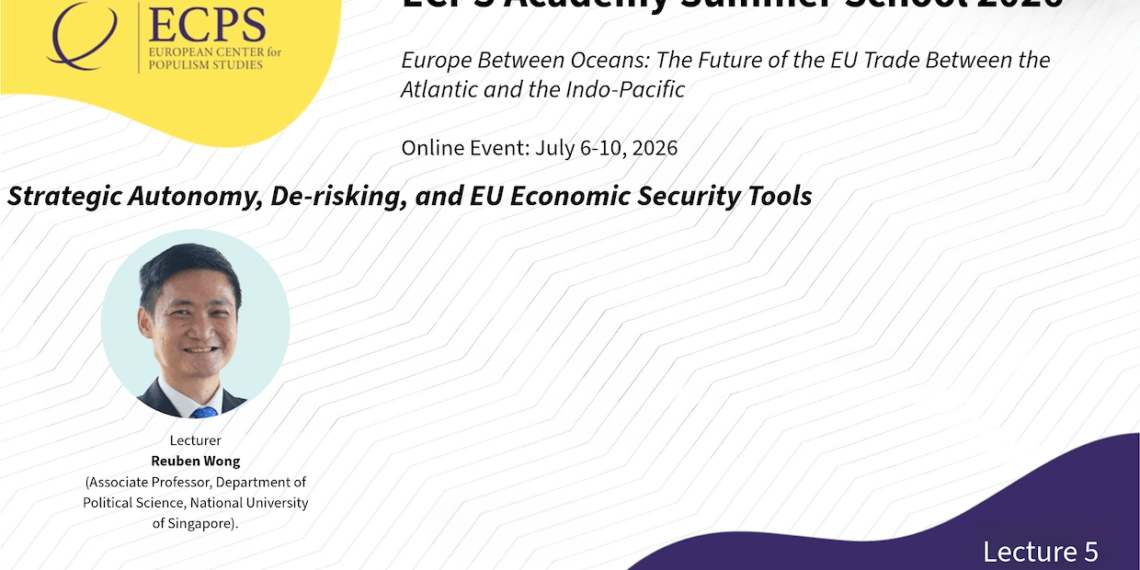
The European Union’s pursuit of strategic autonomy has emerged as one of the defining geopolitical debates of the twenty-first century, reflecting the growing convergence of security, economics, technology, and global power competition. In this intellectually stimulating lecture, Associate Professor Reuben Wong examined how Europe’s search for greater strategic independence has been reshaped by an increasingly volatile international environment marked by intensifying US–China rivalry, Russia’s revisionism, and rapid technological transformation. Challenging conventional assumptions about Europe’s transatlantic relationship and its approach toward China, he argued that strategic autonomy requires not only stronger defense and economic security instruments but also a fundamental reassessment of Europe’s place within an emerging multipolar order. The lecture offered participants a provocative and nuanced framework for understanding the future of European geopolitics.
Reported by ECPS Staff
The third day of the ECPS Academy Summer School 2026 marked a decisive transition from examining the political economy of international trade toward confronting the broader geopolitical forces reshaping Europe’s external relations. Convened under the overarching theme, “Europe Between Oceans: The EU in the Age of Geoeconomics, Populism, and Strategic Competition,” the programme explored how the European Union is increasingly compelled to navigate an international environment characterized not only by intensifying strategic rivalry between the United States and China but also by the erosion of long-standing assumptions about globalization, security, and the liberal international order. Against this backdrop, Associate Professor Reuben Wong of the National University of Singapore delivered a thought-provoking lecture entitled “Strategic Autonomy, De-risking, and EU Economic Security Tools,” inviting participants to reconsider Europe’s geopolitical position through an analytical lens that combined European integration studies with the strategic realities of contemporary international politics.
From the outset, Assoc. Prof. Wong made clear that his objective was not merely to catalogue the European Union’s emerging economic security instruments or explain the technical dimensions of de-risking. Rather, he sought to interrogate the underlying assumptions shaping European strategic thinking at a moment when the continent finds itself simultaneously confronting geopolitical uncertainty, technological transformation, and shifting distributions of global power. Drawing upon his long-standing scholarship on European foreign policy, as well as his experience observing both European and Asian strategic debates, Assoc. Prof. Wong encouraged participants to move beyond familiar policy slogans and instead examine the deeper questions surrounding Europe’s identity, capabilities, and long-term strategic interests.
One of the lecture’s distinguishing features was the perspective from which it was delivered. Speaking from Singapore—a country whose foreign policy has long depended upon balancing relations among competing major powers—Assoc. Prof. Wong approached debates over European strategic autonomy with a degree of analytical distance rarely encountered within discussions dominated by either Brussels or Washington. Rather than treating Europe’s geopolitical dilemmas as uniquely European, he situated them within a broader transformation of the international system, where established powers increasingly confront rising competitors, traditional alliances are being reassessed, and economic interdependence has itself become a source of strategic vulnerability. This external vantage point enriched the discussion by encouraging participants to question assumptions that often remain implicit within European policy circles.
Assoc. Prof. Wong also began by highlighting the conceptual ambiguity surrounding two of the most frequently invoked expressions in contemporary European policy discourse: strategic autonomy and de-risking. Although both terms have become central to debates on European foreign and economic policy, they often carry different meanings depending upon the context in which they are employed. Assoc. Prof. Wong observed that discussions of de-risking almost invariably evoke Europe’s increasingly complex relationship with China. The concept reflects growing concerns regarding excessive dependence on Chinese supply chains, critical raw materials, strategic technologies, intellectual property protection, and infrastructure deemed essential to European economic resilience. De-risking, therefore, does not necessarily imply economic decoupling from China but rather seeks to reduce strategic vulnerabilities while preserving mutually beneficial commercial relations.
By contrast, Assoc. Prof. Wong suggested that strategic autonomy has historically been associated less with China than with Europe’s relationship with the United States. At its core lies the question of whether the European Union possesses the political, military, and institutional capacity to pursue its own foreign policy independently of American strategic preferences. While the expression has acquired renewed prominence following Russia’s invasion of Ukraine and amid renewed uncertainty surrounding American global leadership, Assoc. Prof. Wong reminded participants that the debate itself stretches back to the end of the Cold War. Since the early 1990s, European leaders have repeatedly grappled with the challenge of transforming the Union from an economic giant into a credible geopolitical actor capable of defending both its interests and its values.