
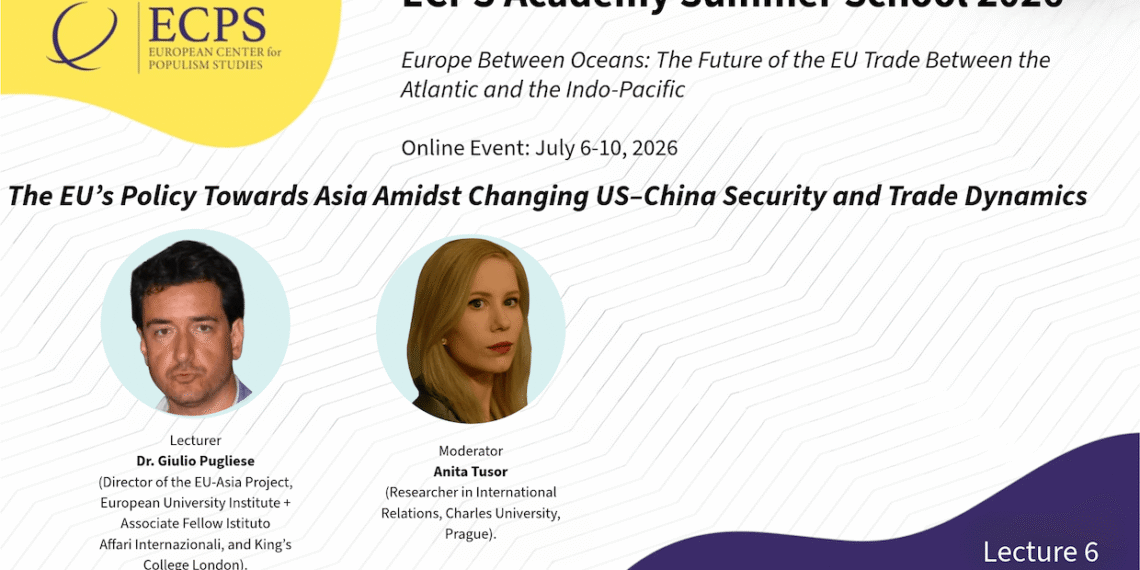
As Europe deepens its engagement with the Indo-Pacific, the region has become far more than a distant theatre of economic opportunity—it has emerged as a central arena where geopolitical competition, technological innovation, supply-chain resilience, and strategic autonomy intersect. In this insightful lecture, Dr. Giulio Pugliese demonstrated how the Indo-Pacific evolved from a Japanese strategic narrative into a defining framework for understanding twenty-first-century international politics. Examining the growing rivalry between the United States and China, Taiwan’s geopolitical and technological significance, and the implications of Washington’s increasingly transactional alliance strategy, he argued that Europe must move beyond traditional regional perspectives and formulate a coherent Indo-Pacific policy rooted in its own interests. The lecture offered participants a nuanced understanding of how Europe’s future security and prosperity are becoming increasingly intertwined with developments across Asia.
Reported by ECPS Staff
The third day of the ECPS Academy Summer School 2026 continued its exploration of Europe’s changing geopolitical environment by shifting attention beyond the Atlantic theatre to the increasingly consequential dynamics unfolding across the Indo-Pacific. Held under the overarching theme, “Europe Between Oceans: The EU in the Age of Geoeconomics, Populism, and Strategic Competition,” the sessions examined how the European Union is recalibrating its external relations amid intensifying strategic competition between the United States and China. Following discussions on strategic autonomy, de-risking, and economic security, the sixth lecture broadened the analytical horizon by investigating Europe’s evolving engagement with Asia and the conceptual transformations that increasingly shape international politics. Against this backdrop, Dr. Giulio Pugliese, Director of the EU–Asia Project at the European University Institute and Associate Fellow at the Istituto Affari Internazionali and King’s College London, delivered a stimulating lecture entitled “The EU’s Policy Towards Asia Amidst Changing US–China Security and Trade Dynamics.” Combining insights from international relations, strategic studies, and Asian regional politics, the lecture challenged participants to rethink the Indo-Pacific not merely as a geographical designation but as a politically constructed strategic space whose emergence has profoundly influenced European foreign policy. <
The session was thoughtfully introduced by Anita Tusor, doctoral researcher at Charles University and Staff Officer at NATO’s Allied Command Transformation, who situated the discussion within one of the defining strategic dilemmas confronting contemporary Europe. She observed that the European Union increasingly finds itself navigating between its two most important economic partners—the United States and China—at a time when their rivalry is reshaping both global trade and international security. Rather than portraying the Indo-Pacific as a distant theatre of commercial interest, Tusor argued that recent geopolitical developments, particularly Russia’s full-scale invasion of Ukraine, have fundamentally altered European strategic thinking. The conflict has created direct linkages between the Euro-Atlantic and Indo-Pacific security theatres, compelling European policymakers to recognize that developments in East Asia now carry direct implications for Europe’s own security calculations. She further suggested that Europe’s growing interest in Japan’s experience of managing long-standing US–China tensions provides valuable opportunities for policy learning as Brussels seeks to navigate an increasingly polarized international environment. Her introduction effectively framed the lecture by emphasizing that Europe’s engagement with Asia is no longer peripheral but has become an integral component of its broader strategy for managing geopolitical competition.
Reimagining the Indo-Pacific: Strategic Narratives and Europe’s Asian Turn
Connecting live from Taipei, Dr. Pugliese began by explaining that his primary objective was not simply to review recent European policy initiatives toward Asia but to unpack the intellectual foundations of one of the most widely used yet insufficiently examined concepts in contemporary international relations: the Indo-Pacific. While the term has rapidly entered the vocabulary of policymakers, diplomats, and scholars alike, he argued that it should not be understood as a politically neutral geographical label. Instead, it represents what strategic communication scholars describe as a strategic narrative—a carefully constructed story designed to simplify complex geopolitical realities, define particular challenges, identify preferred actors, and legitimize specific policy responses. Seen through this lens, the Indo-Pacific is not merely a map but a political project that reflects competing visions of regional order, international leadership, and global governance. Dr. Pugliese invited participants to appreciate that language itself constitutes an instrument of power, capable of shaping perceptions, legitimizing alliances, and influencing strategic behavior.
At the heart of Dr. Pugliese’s analysis lay the argument that the Indo-Pacific concept originated not in Washington but in Tokyo. Drawing extensively upon his own research on Japanese foreign policy, he demonstrated that the contemporary understanding of the Indo-Pacific owes much to the strategic vision developed by the late Japanese Prime Minister Shinzo Abe and a relatively small circle of policymakers who sought to redefine Asia’s geopolitical architecture during the late 2000s and early 2010s. Their objective was to present an alternative regional order capable of responding to China’s expanding economic and strategic influence, particularly the growing prominence of the Belt and Road Initiative (BRI). By advancing the concept of a Free and Open Indo-Pacific (FOIP), Japan deliberately expanded the geographical imagination of Asia beyond a China-centered perspective. Rather than viewing Asia exclusively through East Asia and the Western Pacific, the Indo-Pacific connected the Pacific and Indian Oceans into a single strategic theatre stretching from East Africa to the western shores of the Americas, encompassing India, Australia, Southeast Asia, and maritime democracies across the region. In doing so, the concept challenged what Pugliese described as the increasingly Sinocentric geographical narrative embedded within Beijing’s own regional initiatives.