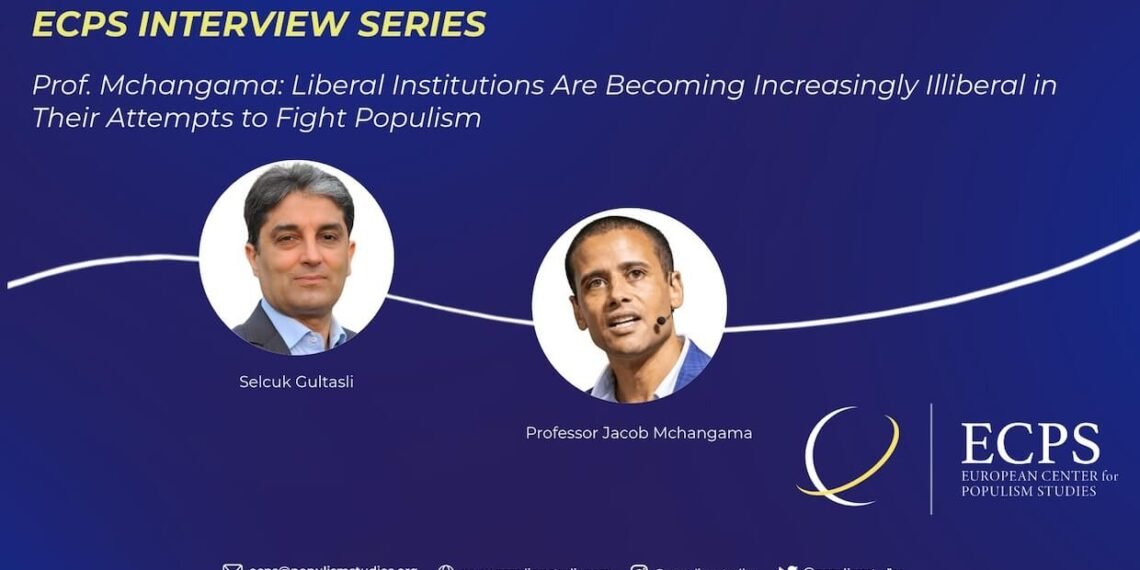
In an in-depth interview with the ECPS, Professor Jacob Mchangama warns that liberal institutions are becoming “increasingly illiberal” in their efforts to combat populism and disinformation. Examining electoral censorship in Brazil, Germany’s militant democracy, and the EU’s Digital Services Act, he argues that restrictive speech policies risk undermining democratic legitimacy while strengthening authoritarian forces. Emphasizing the democratic significance of independent digital media, particularly in Hungary, he cautions that “imposing government control is ultimately a cure worse than the disease.” Professor Mchangama also examines the dangers of AI-driven censorship, selective free-speech advocacy, and declining institutional trust, advocating decentralization, transparency, and user empowerment as alternatives to increasingly technocratic approaches to regulating the democratic public sphere.
Interview by Selcuk Gultasli
At a time when democratic institutions confront populism, disinformation, political censorship, and the growing influence of artificial intelligence and technology giants, freedom of expression has become both a cornerstone of democratic resilience and a deeply contested principle. Brazil’s presidential election and the US midterms offer particularly revealing examples of these tensions. Across liberal democracies, efforts to counter extremist mobilization and digital disinformation raise an increasingly urgent question: Can democracy be protected through restrictions on the very freedoms that sustain it?
In an in-depth interview with the European Center for Populism Studies (ECPS), Professor Jacob Mchangama, Executive Director of The Future of Free Speech, Research Professor at Vanderbilt University, Senior Fellow at the Foundation for Individual Rights and Expression (FIRE), and author of Free Speech: A History from Socrates to Social Media, examines this paradox. His central concern is that the erosion of public trust has prompted liberal institutions to adopt increasingly illiberal responses. As he observes, “this collapse of trust has led liberal institutions to become increasingly illiberal, responding to mistrust from the demos with mistrust of the demos.” Such efforts to control political narratives, he warns, create “a vicious cycle that, in the long term, will undermine rather than strengthen democracy.”
Professor Mchangama develops this argument through Brazil’s judicial interventions in electoral expression, Germany’s increasingly restrictive speech legislation, and the European Union’s Digital Services Act (DSA). Questioning the effectiveness of Europe’s militant democracy model, he invokes the Weimar Republic’s historical experience, when emergency powers intended to safeguard democratic institutions were subsequently exploited by the Nazis. His conclusion is stark: “the very instruments intended to protect democracy were used to abolish it.” For Professor Mchangama, contemporary restrictions risk reproducing this institutional vulnerability, particularly when political forces hostile to liberal pluralism acquire governmental power.
The dangers become especially pronounced in the digital sphere. Reflecting on Hungary’s opposition mobilization through independent online media, Professor Mchangama emphasizes that social platforms remain indispensable instruments of democratic dissent, even when dominated by powerful corporations. Although acknowledging the internet’s toxicity and concentrated ownership, he argues that “imposing government control is ultimately a cure worse than the disease.” Similarly, he cautions that Europe, historically central to developing legal protections for expression, is now “creating the blueprint for online censorship,” potentially legitimizing authoritarian restrictions elsewhere.
Beyond censorship, the interview explores artificial intelligence, decentralized factchecking, governmental transparency, and the democratic potential of digital participation. Professor Mchangama distinguishes user empowerment from preemptive safetyism, warning against transforming AI governance into preventive ideological gatekeeping. Ultimately, drawing inspiration from Frederick Douglass, he insists that freedom of expression protects listeners as well as speakers. His overarching democratic principle is unequivocal: “You’re not going to strengthen democracy by hiding that reality.”