
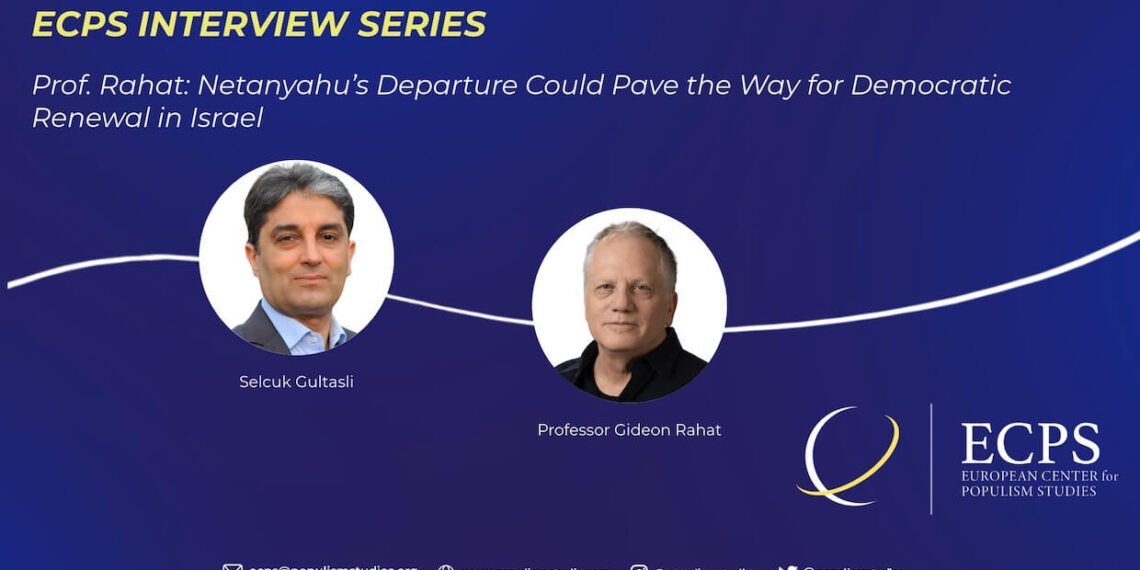
In an interview with the European Center for Populism Studies (ECPS), Professor Gideon Rahat of the Hebrew University of Jerusalem examines Israel’s democratic prospects ahead of the October 27 elections. He argues that Netanyahu’s departure could enable a redistribution of political power and a return to consensus-based democracy, while warning that deeply personalized parties and weakened institutional checks threaten democratic resilience. Highlighting Netanyahu’s role in legitimizing the religious-nationalist far right, Professor Rahat cautions: “But once you let this genie out of the bottle, which is what Netanyahu did, the genie is here to stay.” Despite these enduring challenges, he sees opportunities for democratic renewal through institutional reform, stronger political parties, and the restoration of checks and balances.
Interview by Selcuk Gultasli
As Israel approaches the October 27 elections, its political landscape remains deeply polarized by Benjamin Netanyahu’s leadership, the growing influence of the religious-nationalist far right, and the profound consequences of the October 7 attacks and the devastating war in Gaza. Beyond the immediate electoral contest, fundamental questions concern the resilience of democratic institutions, the personalization of political power, and whether a post-Netanyahu government could reverse Israel’s democratic backsliding.
In an extensive interview with the European Center for Populism Studies (ECPS), Professor Gideon Rahat, holder of the Gersten Family Chair in Political Science at the Hebrew University of Jerusalem and Senior Fellow at the Israel Democracy Institute, offers a nuanced assessment of these challenges. Drawing on his scholarship on political parties, populism, and democratic institutions, Professor Rahat argues that Netanyahu’s departure could create an opportunity for democratic renewal, although Israel’s deeply personalized party system presents formidable structural obstacles.
Central to his analysis is Netanyahu’s consolidation of political authority and his transformation of Likud. According to Professor Rahat, Netanyahu’s populism combines centralized personalism with an antagonistic division between the supposedly authentic people and institutional elites. Yet his removal could fundamentally alter these dynamics. As Professor Rahat explains, “Netanyahu did not allow anyone around him to grow politically.” Consequently, he argues, no obvious successor possesses the capacity to reproduce Netanyahu’s centralized political infrastructure. His departure could therefore allow political power to be redistributed, potentially facilitating a return to consensus-based democracy.
However, Professor Rahat simultaneously warns that Netanyahu has fundamentally transformed Israel’s political landscape by legitimizing previously marginal ultranationalist forces. Examining the rise of Itamar Ben-Gvir and Bezalel Smotrich, he emphasizes the decisive role of political elites in enabling radicalization. Referring to Netanyahu’s political elevation of Ben-Gvir, Professor Rahat observes: “But once you let this genie out of the bottle, which is what Netanyahu did, the genie is here to stay.” This normalization of the far right represents an enduring challenge that may survive Netanyahu’s eventual departure.
The interview also explores the weakening of judicial independence, the marginalization of Arab political parties, and the enduring trauma of October 7. Professor Rahat emphasizes that the erosion of institutional safeguards cannot be reversed through leadership change alone, warning that “a court cannot sustain democracy by itself.” Democratic reconstruction, he argues, requires stronger political parties, institutional reforms, and a broader distribution of political authority.
Moreover, Professor Rahat’s analysis distinguishes between the possibility of ending Netanyahu’s personalized rule and the more demanding task of rebuilding Israeli democracy. His cautiously hopeful conclusion underscores the importance of institutional transformation beyond electoral alternation: “Hopefully, this would allow Israel to return to a more consensus-based form of democracy.”