
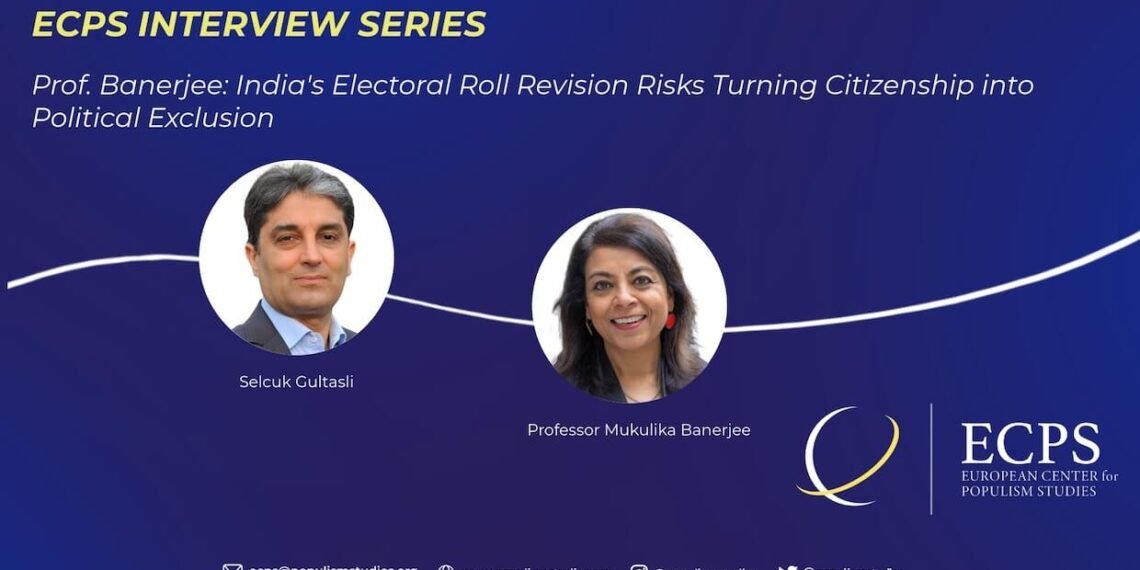
In an exclusive interview with the ECPS, Professor Mukulika Banerjee of the London School of Economics and Political Science warns that India’s controversial electoral-roll revisions risk transforming political citizenship into an instrument of exclusion. Describing the reported deletion of approximately 130 million voters as part of “the biggest assault on India’s electoral system that independent India has seen,” she highlights the disproportionate vulnerability of Muslims, Dalits, women, and other marginalized communities. Professor Banerjee examines how student-led protests are challenging democratic backsliding, political intimidation, and Hindu majoritarianism while forging broader alliances around electoral integrity. Drawing on her scholarship on everyday democracy, she argues that protecting political equality requires sustained civic participation, institutional accountability, vigilance, and collective democratic action.
Interview by Selcuk Gultasli
India is witnessing a significant wave of youth-led protests challenging unemployment, educational injustice, and the erosion of democratic accountability. The emerging Cockroach Janta Party (CJP) has expanded its mobilization from examination irregularities to contested electoral-roll revisions, raising fundamental questions about political representation, citizenship, and the resilience of democracy under Narendra Modi’s Hindu nationalist government.
In an interview with the European Center for Populism Studies (ECPS), Professor Mukulika Banerjee, Professor of Anthropology at the London School of Economics and Political Science, offers a critical assessment of India’s democratic trajectory. Drawing on her influential scholarship on electoral participation, everyday citizenship, democratic culture, and the social foundations of political life, she examines how controversies surrounding electoral integrity threaten the principles of political equality and inclusive citizenship.
At the heart of Professor Banerjee’s analysis is the Special Intensive Revision (SIR) of electoral rolls and reports of approximately 130 million deletions. Describing the controversy as “the biggest assault on India’s electoral system that independent India has seen,” she warns that the country’s historically inclusive electoral framework risks becoming an instrument of political exclusion. According to Professor Banerjee, the reported deletions have disproportionately affected Muslims, Dalits, indigenous communities, women, and other socially disadvantaged groups.
For Professor Banerjee, the consequences extend far beyond electoral competition. India’s democratic achievement has rested on the equalizing power of the ballot, particularly for citizens experiencing profound socioeconomic hierarchies. As she explains, “This equalizing power of the vote, of political equality, which is a very basic democratic right, is highly valued in India.” She cautions that electoral-roll revisions could undermine precisely this foundation of citizenship, transforming the right to vote from a universal democratic entitlement into a mechanism of selective political inclusion.
The interview also explores the emergence of student-led resistance as a potential counterweight to institutional democratic backsliding. Professor Banerjee argues that young protesters have challenged a pervasive climate of intimidation while bringing opposition parties, farmers’ unions, and civil society organizations together around electoral integrity. Their mobilization, she suggests, demonstrates that “in order to live in a democracy, you have to be an active citizen.”
Beyond India, Professor Banerjee situates these developments within broader debates over authoritarian populism, crony capitalism, Hindu majoritarianism, and transnational democratic resistance. Her analysis connects electoral exclusion to economic inequality and the erosion of institutional accountability.
Ultimately, Professor Banerjee’s warning is also a call for sustained democratic engagement. Drawing on her metaphor of democracy as a plant requiring constant care, she concludes: “In order to cultivate democracy, you need vigilance, you need patience, you need hard work, and you need hope.”