
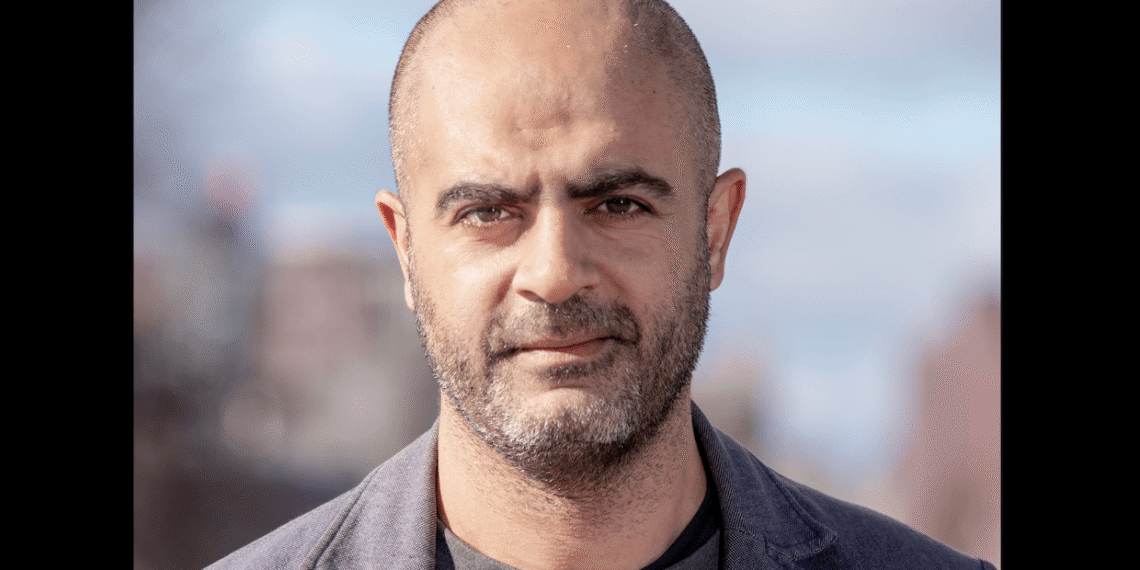
In this interview with the ECPS, Dr. Amir Ahmadi Arian offers a penetrating account of Iran at a moment of war, repression, and political uncertainty. As the Israel/US–Iran conflict deepens and succession struggles intensify in Tehran, he argues that the central issue is the systematic erasure of Iranian popular agency. For Dr. Arian, the Islamic Republic has evolved from an ideological revolutionary order into an increasingly militarized system—“basically a killing machine”—while external intervention risks further marginalizing the people in whose name it claims to act. Moving from everyday micropower and censorship to the IRGC’s rise, social humiliation, and the politics of war, he underscores a stark reality: neither foreign powers nor clerical elites genuinely represent the Iranian people.
Interview by Selcuk Gultasli
Giving an interview to the European Center for Populism Studies (ECPS), Dr. Amir Ahmadi Arian—Iranian American writer and journalist, and Assistant Professor of Creative Writing at Binghamton University—offers a powerful and deeply textured analysis of Iran’s current condition at a moment of extraordinary peril. As the Israel/US–Iran war expands into a broader regional conflict marked by bombardment, civilian displacement, and intensifying regime-change rhetoric, Dr. Arian cautions against narratives that erase the agency of the Iranian people themselves. In a context where President Donald Trump has demanded Iran’s “unconditional surrender,” openly declared an interest in shaping the country’s postwar leadership, and where succession debates have reportedly intensified following the death of Ayatollah Ali Khamenei, Dr. Arian’s central warning is stark: “neither of them has anything to do with the Iranian people.”
That insistence on popular agency—and on its systematic denial—runs through the interview as a whole. For Dr. Arian, Iran’s predicament cannot be reduced either to foreign pressure alone or to a simplistic image of “clerical rule.” Rather, he describes a political system that has evolved over 47 years from an ideological revolutionary order into something far more militarized, coercive, and socially corrosive. What began with “a very strong ideological core, surrounded by a security apparatus,” he argues, has gradually become “less and less ideological and more and more militarized.” In his starkest formulation, the regime today is “basically a killing machine,” one whose relationship to society has been reduced to a binary of “friend and enemy.”
Yet Dr. Arian’s account is not confined to the spectacular violence of war and mass repression. One of the interview’s greatest strengths lies in its insistence that authoritarian domination in Iran is reproduced through everyday practices, cultural control, and administrative routines. Recalling his own childhood and youth, he explains that in the 1980s and 1990s one “felt the presence of the state almost on your skin.” From school rituals and anti-American iconography to compulsory hijab and the disciplining of bodies, the regime exercised what he calls a “very Foucauldian kind of presence of power in daily life.” The same logic extended into literature and language: censorship, exile, and the weakening of Persian literary culture did not merely restrict expression but also narrowed the horizons of political imagination itself.
At the same time, Dr. Arian foregrounds the uneven social distribution of repression. The Islamic Republic, he notes, presents itself internationally as a defender of “the poor, the wretched of the earth, the underdog,” yet “nobody has suffered at its hands more than the poor.” Women, Baha’is, workers, and peripheral communities have borne disproportionate burdens of exclusion, persecution, and violence.
Against this backdrop, his analysis of the current war is especially sobering. If military intervention deepens, he warns, “the will of the people becomes the last thing that counts.” The core question, then, is not simply whether the regime survives, but whether Iranians themselves can recover political agency from both authoritarian rulers and external powers claiming to act in their name.
Here is the edited version of our interview with Assistant Professor Amir Ahmed Arian, revised slightly to improve clarity and flow.
Iran Regime’s Presence Felt Omnipresent
Professor Amir Ahmed Arian, thank you so much for joining our interview series. Let me start right away with the first question: Having grown up and begun your literary career inside Iran, how would you describe the everyday texture of life under Iran’s clerical-authoritarian system? At the level of routines—schooling, workplaces, gender norms, religion, and bureaucracy—how do these micro-practices reproduce obedience, negotiation, or subtle forms of resistance?
Dr. Amir Ahmadi Arian: In Iran, one caveat I have to give at the beginning—which will apply to all my answers—is that when we talk about the Islamic Republic, we are talking about 47 years of rule by this political system, and it has evolved and changed a lot over time. So, the practices that you mentioned—the way they were conducted in the 1980s and the 1990s—are very different from those in 2000 or 2010. The rulers have changed a lot as well. Depending on who the president was, society changed dramatically. And even more importantly, Iranian society itself sheds its skin very quickly, generation after generation.
What you see among young people now—this generation—has very little to do with my generation. People who were born around the time of the revolution are now middle-aged, and the twenty-somethings today do not really listen to us or care much about what we think. So, what I am saying is mainly founded on my own personal experience growing up there. I left Iran in 2011, and over the last fifteen years the country has changed quite dramatically. So, what I say is less a comprehensive analysis of what is going on in Iran and more an account based on my own personal experience.
To answer your question, growing up in Iran in the 1980s and the 1990s, you really did feel the presence of the state, because that was the strictest period after the revolution. After the reformist movement in the late 1990s, things began to open up. But in those first two decades, you felt the presence of the state almost on your skin.
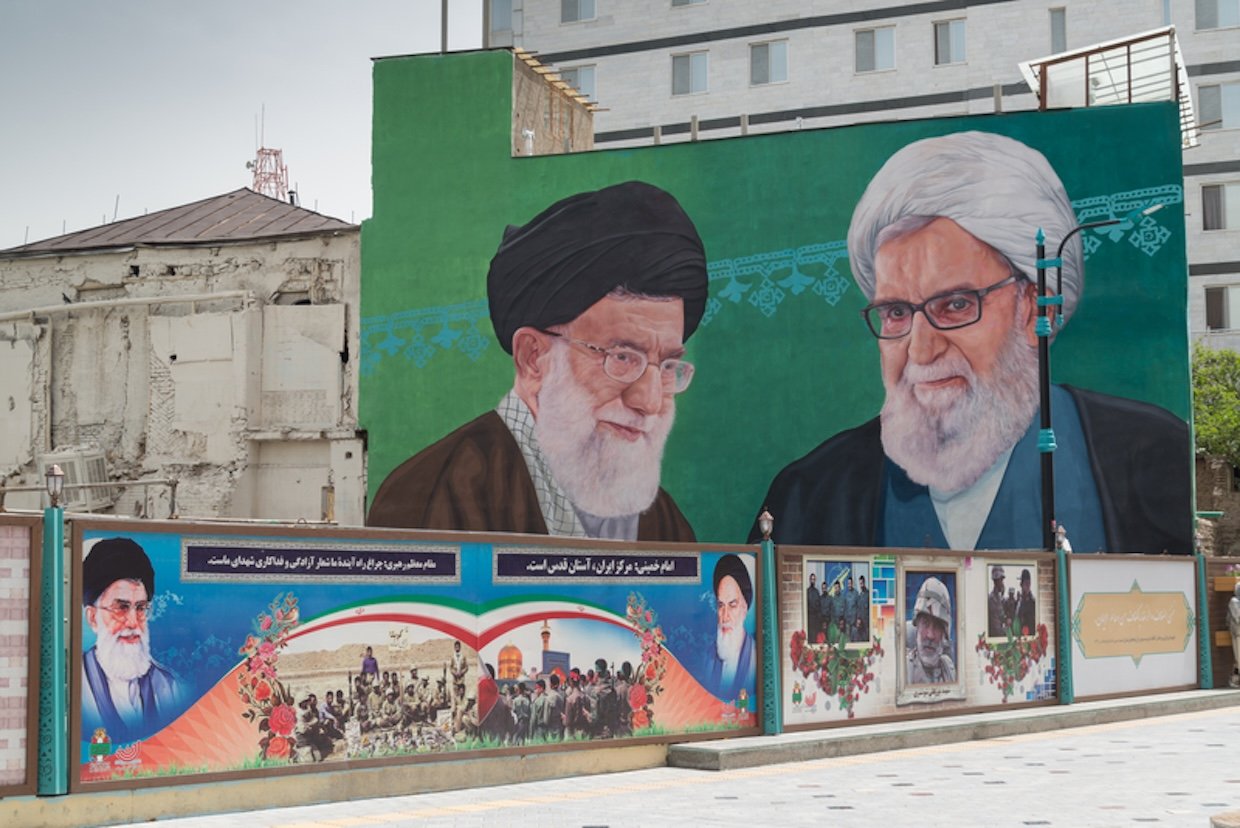
It was overwhelming and omnipresent all the time. To give you one example, the way they tried to inculcate their foreign policy in the mind of a child was that throughout my education—during elementary school, high school, and later in college, when I attended the University of Tehran—there were massive flags of the US and Israel painted on the ground in front of the gates of all those institutions.
So, when you walked into the school or through the university gate, you could not even enter without stepping on them. Imagine doing that for twelve years in school and then five years in college—almost every day. Not just me, but millions of children across the country stepped on the US and Israeli flags in order to enter school. Just imagine what that does to your unconscious mind—how it shapes the way you see the world unwittingly, beyond what you consciously know or learn.
For women especially, there was another, much more aggressive layer, which was the compulsory hijab. This started in elementary school. Six-year-old girls had to wear uniforms and maghnaeh, these tight scarves, and they had to keep them on throughout the day. Of course, in public spaces there was also a very strict dress code for women. Women could not appear in the street without complying with it. I do not think anything embodies the aggressive presence of the state in all aspects of daily life as clearly as the compulsory hijab.
These are just two small examples.
The way the system worked was that, instead of relying only on a top-down system of propaganda, there was also the presence of micropower spread throughout society. These mechanisms were designed to strictly control bodies and constantly remind you that the state is here, and the state is watching you. So, it was a very Foucauldian kind of presence of power in daily life.
Iran’s System Is Not Just Clerical Rule—It Is a Militarized Security State
Analysts often reduce Iran’s system to “clerical rule,” yet your work suggests a far more complex configuration of institutions. How should we conceptualize the Iranian regime today—as a theocratic regime, a bureaucratic-security state, or a hybrid authoritarian system combining ideology, patronage networks, and coercive institutions?
Dr. Amir Ahmadi Arian: It’s basically all of the above. From the beginning of the revolution, the system has had a very strong ideological core, surrounded by a security apparatus. And you have the Revolutionary Guards, which constitute a very complicated and vast network of people. Within it, there are individuals who are completely cynical and technocratic, or those who are there to run their own businesses through military means, as well as truly apocalyptic warriors who want to bring about Armageddon and believe they are involved in some sort of end-of-the-world battle.
In between, you have all kinds of government bureaucracies and institutions that try to find a foothold in this network.
But the point is that, as time has gone on—from the beginning of the revolution to now, over these 47 years—the Iranian government has become less and less ideological and more and more militarized. So right now, more than anything, it resembles something like a European fascist regime in the 1930s and 1940s, one that was completely reduced to security forces. It is basically a killing machine. And the last moment when we saw that very clearly was this January.
On January 8 and 9, they opened fire with live ammunition on unarmed protesters all over the country and killed at least 8,000 people. I know that number is very contested, but at this point we have 8,000 names identified without a shadow of doubt. The organization that documented this is also working on verifying 11,000 more names. Many of them are already partially verified, but the process of full verification is ongoing. So even if half of that is true, we are looking at a five-digit death toll in basically 36 hours, which would make it the bloodiest massacre a state has committed against its own population in modern history.
That alone should make it very clear that the ideological façade and the bureaucratic elements are collapsing. The ideological façade is gone, because what they did then cannot be justified by any religious doctrine—or, frankly, by any ideological doctrine other than some form of fascism, perhaps something like Shia fascism. And the bureaucratic veneer is also very thin now; I would even argue that it has largely disappeared. Because no reasonable governing entity—whether a state or any other governing body—would do that simply to control society. You only do that when you see your own people as the enemy. There is really no other explanation.
So right now, the system has been reduced to a very hardcore security corps composed of armed elements of the Basij, the Revolutionary Guards, and parts of the police. And their relationship with the Iranian people is essentially one of friend and enemy. You are either in their camp, or you are not. And if you are not, they are out there to eliminate you. They do not really want you to exist anymore. So, of all the political systems that have existed, from what little I know of European history, they remind me of Franco’s regime in Spain—something that functions in a very similar way or resembles certain forms of 20th-century fascism.
The Revolutionary Guards Have Become a Military–Political–Economic Juggernaut
The Islamic Revolutionary Guard Corps occupies a central position in Iran’s political and economic life. Should the IRGC be understood primarily as a military institution, a security apparatus, a sprawling economic conglomerate, or even a ruling class? What does its economic embeddedness mean for reform, regime durability, or potential transition?
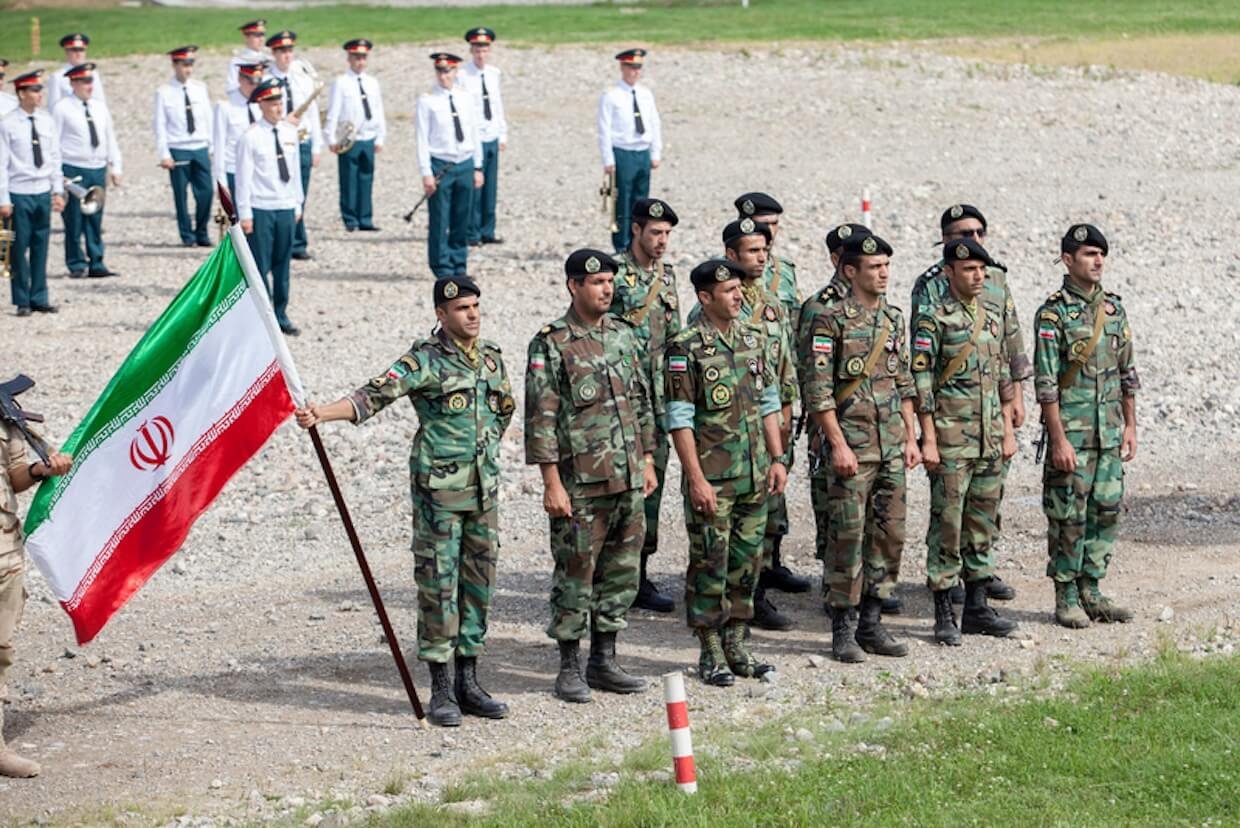
Dr. Amir Ahmadi Arian: So again, that’s another case with the IRGC, or the Sepah. It started off as a military organization at the beginning of the revolution, mainly to help the official army during the Iran–Iraq War. It was almost exclusively military in the beginning. Then, as time went on, it started consolidating power, accruing more and more influence through the decades. This became especially evident during the reformist movement, because the commanders of the IRGC were opposed to Khatami and the reformists in power, as well as to the political elite that came to power in the late 1990s. After that, they decided to become increasingly involved in politics.
Another turning point came later with the economic sanctions imposed after the controversy surrounding Iran’s nuclear program. Following these disputes, Western countries began imposing some of the harshest sanctions in the world on Iran. As we know, such conditions often become a recipe for corruption. In my view, these sanctions cast something like a net over Iran’s economy. They disrupted the natural flow of exports and imports, especially oil exports. However, there was a significant hole in this net: Iran’s access to China. China was simply too powerful to fully comply with the sanctions and follow the United States’ lead, so it continued to purchase oil from Iran. Because China has an enormous and constant appetite for energy, Iran could sell oil to it below market price and still sell large volumes. As a result, even under very harsh sanctions, Iran was still able to generate a considerable amount of revenue through oil sales to China.
The problem, however, was that this revenue flowed through only one channel: the Revolutionary Guards. As a result, large segments of the economy gradually became concentrated in their hands, which almost inevitably led to corruption. Over time, within the ranks of the Revolutionary Guards, you can see an oligarchy beginning to take shape. And not just within the Revolutionary Guards—the broader political elite, especially their children and relatives, also joined this oligarchic network. Perhaps a few thousand people became involved in the export and import of oil with very little accountability. As a result, they began making themselves extremely rich, often at the expense of the well-being of ordinary Iranians and their daily lives.
At that point—perhaps by the mid-2010s—you could see that the Revolutionary Guards, which had started as a military organization and later evolved into a military–political organization, were becoming a military–political–economic juggernaut. It became something like an octopus, with tentacles reaching into almost every aspect of Iranian society, and that has continued to be the case until now.
Humiliation Is One of the Main Engines of Protest in Iran
Your writings frequently evoke emotions such as humiliation, anger, fear, and exhaustion. How do these affective dimensions shape political mobilization in Iran? In particular, how do humiliation and generational frustration interact with social fatigue to influence the timing and intensity of protest movements?
Dr. Amir Ahmadi Arian: I think humiliation is really key, especially if you watch the state media in Iran. It is a relentless and non-stop process of insulting your intelligence through the way propaganda is produced. It is really as absurd as looking at the sky in broad daylight while the TV tells you that it is nighttime. And they say it very aggressively, with zero respect for the intelligence and dignity of their audience.
Iranians are very well aware of the source of their problems. They know that the main source of their misery is their rulers, the Islamic Republic. Yes, sanctions have contributed heavily. The hostility from Israel, all the stories about the nuclear program—some exaggerated, some fabricated—and the accusations coming from a state that possesses far more nuclear weapons than Iran will ever have all contain a degree of hypocrisy. Iranians recognize that. But when you look at the political landscape of Iran, it is very clear to everyone that most of what we have gone through is the responsibility of the Islamic Republic. And the rulers know that too. It is not a secret to them.
But for 47 years, you look at their behavior and see that they have not taken a single step toward the people of Iran. Not one. They have never shown any willingness to make concessions to civil society or to protesters in the streets. They have never demonstrated any real interest in listening to them. Every time people have come out to protest, the regime initially responded with batons, and as protests intensified, with bullets. And we saw just last month what a wholesale massacre was essentially.
Even today, they continue to deny most of their responsibility for the absolute disaster they have inflicted on Iranian lives. So, when you look at this while living inside Iran, you see a government responsible for the immiseration of multiple generations yet unwilling to take even a shred of responsibility for what it has done. They have shown no willingness to change course.
This is the frustration, the rage, and the humiliation that it instills. And it can very easily boil over and drive people into the streets.
Iranians know how brutal their rulers are, how willing the regime is to kill them, and yet protests continue. In fact, you have rarely seen street protests as frequently anywhere in the world as in Iran over the past 10 or 15 years. Every couple of years there is a major wave of mass protest—whether over economic conditions, the compulsory hijab, or other issues.
Each time, people know they will be met with extreme violence, with bullets and batons. Every time they go out into the streets, they know they may never return home. Yet they still do it, because the sense of humiliation and frustration runs so deep that, in their minds, risking death can feel worthwhile simply to express it publicly.

Women, Minorities, and the Poor Bear the Heaviest Burdens of Repression
For those who challenge the regime—writers, activists, workers, or ordinary protesters—what does the spectrum of repression look like in practice? How are risks such as censorship, economic exclusion, detention, torture, or exile distributed across class, gender, ethnicity, and geography?
Dr. Amir Ahmadi Arian: Probably the biggest irony of the Islamic Republic is that its outward presence to the world—its public face—and unfortunately many in the West buy into that, especially people on the left, is that it presents itself as standing up for the poor, for the wretched of the earth, for the underdog, for the downtrodden, and so on. So, it defines itself as one of the few states in the world that stands with the underdog. But when you go inside Iran, nobody has suffered at its hands more than the poor, working people, and those who do not have the means to make ends meet.
And this has been the case for decades, at least since the 1990s. You could argue that in the 1980s the regime implemented some policies aimed at creating a degree of economic equality. But definitely since the 1990s, after the death of Ayatollah Khomeini, it has essentially operated as an economic system that consistently favors the rich while suppressing the poor. It has only worsened over time, and as I mentioned earlier, the sanctions have also contributed to this dynamic.
So if you are poor—and there is a reason why in more recent demonstrations and protests you see more working people and poor citizens from the margins of society, from smaller towns near the borders where poverty is particularly severe—those are often the people who take to the streets and risk their lives more than people in the major cities. That was not the case back in 2009 during the Green Movement.
Then, of course, there are religious minorities, especially the Baha’is. It is actually a principle of their religion not to engage in political activism, so they have never posed any significant threat to the political order in Iran. Yet, because of the dogmatism and fanaticism of the Shia clerics in power, that community has been persecuted more savagely than almost any other group.
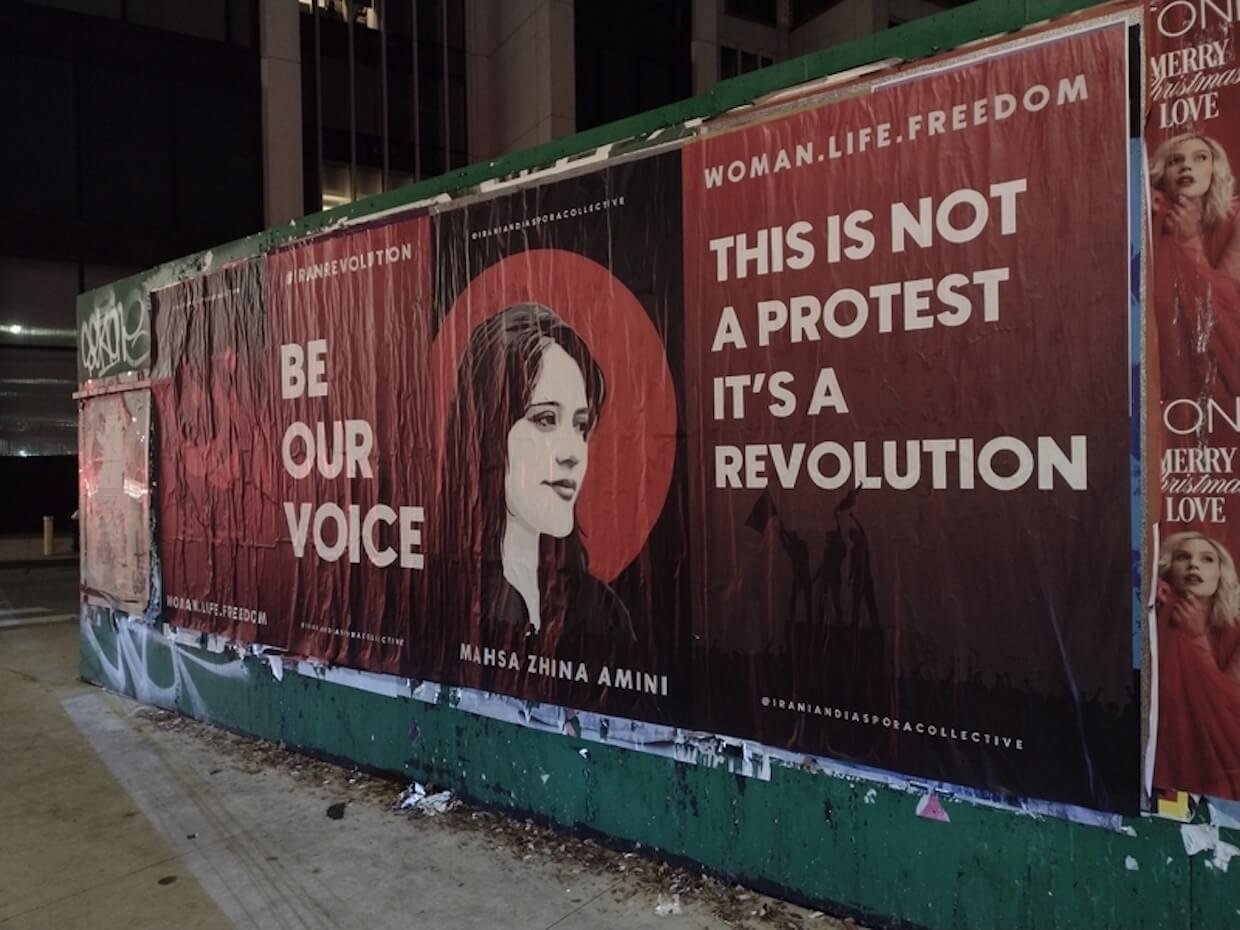
So, you have the persecution of the poor through economic means, the persecution of the Baha’is for religious reasons, and of course the situation of women, who have effectively been treated as second-class citizens since the beginning of the revolution. They have been fighting for very basic rights for a very long time. And just three years ago, during the Women, Life, Freedom movement, they finally managed to force the state to abandon the enforcement of compulsory hijab—though at enormous cost—after months of civil protests across the country.
So, this is also a form of gender apartheid. You have extreme economic discrimination against the poor, religious discrimination against minorities, and what amounts to a flat-out system of gender apartheid from which women have suffered enormously over the last half century.
Iran Regime Is Not a Well-Oiled Machine, It Is Corroded by Corruption
You have often suggested that repression in Iran operates through mundane institutional routines rather than overt ideological fanaticism. To what extent does this resemble Hannah Arendt’s notion of the “banality of evil,” where ordinary bureaucratic practices normalize authoritarian violence?
Dr. Amir Ahmadi Arian: I think there is an important difference there. In Arendt’s articulation of the banality of evil, it emerges from a bureaucratic machine that actually functions extremely well. You have a system whose cogs rotate together very efficiently. The Nazi extermination process was, in that sense, a highly organized and well-oiled machine. Every officer was a small cog within that machine, carrying out their assigned tasks without really reflecting on the consequences of what they were doing.
In the case of Iran, however, what you see is incompetence—sheer incompetence. Part of the problem is that the state has essentially collapsed, and its bureaucratic institutions are no longer functioning properly. There is so much corruption, so much nepotism, and so much discrimination based on factors such as religious beliefs, social background, or political loyalty—especially when it comes to employment in government institutions, even in very basic administrative matters.
Over time, this has corroded the system of governance to such an extent that it simply no longer works effectively. Even very simple things—like renewing a driver’s license or dealing with routine banking procedures—can become extremely frustrating experiences when you live inside Iran.
So, the way government authority grates on people’s nerves stems less from a highly efficient bureaucratic machine and more from pervasive incompetence and corruption, rather than from a system operating smoothly but devoid of moral reflection.
No One Has Damaged Persian Literature More Than the Islamic Republic
Drawing on your own experience with literary censorship, how does the state’s control over cultural production shape not only what can be said publicly but also what can be imagined politically? In other words, how does censorship function as a technology of power over narrative and collective imagination?
Dr. Amir Ahmadi Arian: There is another irony here. The state in Iran has always prided itself on having a kind of nationalist element. They made a great deal out of independence when you go back to the beginning of the revolution. The main slogan was “Independence, freedom, the Islamic Republic.” So, independence came first. There was always a kind of Islamic nationalism embedded within the discourse. And the Persian language was always part of that. Especially Mr. Khamenei, the supreme leader who was recently killed—he was very much into Persian poetry. He was a very skilled orator, a very good speaker, and he knew Persian very well. They were enamored with Persian literature and the history of Persian poetry, and so on. Yet no one has damaged the Persian language or launched such a profound assault on Persian literature as the Islamic Republic has through censorship.
I am just one example. Until I was 30 years old, I was a writer in Iran. I published a number of books and many articles, and I loved writing in my mother tongue. But they basically forced me out of Iran. At some point after the Green Movement, it became impossible to continue living there. So, I had to move out of Iran—first to Australia and then to the United States—and I had to switch to writing in English.
I am just one small example. I could have contributed to that language and to that literary culture. I could have added something to it. I was doing well there as a writer. But over extremely small and trivial issues, the censorship office started banning my books, and they effectively took away my job as a newspaper writer. So, I had to leave. And I am just one example among thousands of writers like me who loved that language and that culture and were more than willing to contribute to it and devote their lives to it. But the state did not want us around.
Through censorship, what has happened is an extreme weakening of the Persian language itself. When you talk about political imagination, language is crucial. When a language is battered for so long—when it has been depleted of its resources through censorship for half a century—it inevitably loses many of its tools. Its toolbox becomes depleted.
Some of those tools have started to return since the emergence of the internet, but it is very different to have a formal written culture in a society than to have a writing culture mainly on social media. These are two very different phenomena.
What the state has done is to erode the abilities and capabilities of the Persian language, which historically has been a very strong force in maintaining the fabric of Iranian society. Through that erosion, they have negatively affected not only Iranian culture and literature but also the broader cohesion of Iranian society as a whole.
Military Intervention Often Pushes the Will of the People to the Margins
In the context of the ongoing confrontation between Iran and the US–Israel alliance, how might external military pressure reshape internal political dynamics? Historically, do wars weaken authoritarian regimes by exposing their fragility, or strengthen them by mobilizing nationalism and securitizing dissent?
Dr. Amir Ahmadi Arian: It is very hard to say now. We are right in the middle of the war, and it is very unclear how it will turn out—at least it is unclear to me. Right now, there are so many contradictory accounts and reports about who has the upper hand, whose military is in a weaker position, who is running out of ammunition, and who is running out of defensive shields, and so on. So, it is very difficult to draw conclusions at this point.
But at the end of the day, we have many examples of military intervention, especially in Middle Eastern countries, and none of them have ended well. The way events are unfolding now can already be seen in the recent quarrel over the selection of the next Supreme Leader.
The Assembly—the council of elders, as it is sometimes called in Iran—consists of the people who choose the next leader. There are about 80 very old clerics, all men and all clerics. They are very old and do not represent Iranian society in any meaningful way. In fact, they are about as far removed from Iranian society as possible, yet they are tasked with choosing the next leader. So, whoever they choose will have nothing to do with the Iranian people. It does not matter who it is; it is simply not a democratic process.
On the other hand, you have Donald Trump, who just yesterday said that he wants to have a say in choosing the next Supreme Leader of Iran. He almost sounded as if he meant it, so I will take him at his word. He said something like, “I need to be there when they choose the next Supreme Leader. I want to have a say.”
So, you see two entities talking about selecting the Supreme Leader—the highest political position in Iran—and neither of them has anything to do with the Iranian people. This is often what happens in the aftermath of military intervention. The will of the people becomes the last thing that counts. The agency of the Iranian population is already pushed aside, unless, after this war, they somehow manage to reclaim it.
A Political Vacuum Could Activate Long-Dormant Ethnic Fault Lines
One of the most catastrophic scenarios involves state fragmentation, separatist mobilization, and armed conflict across border regions. Given Iran’s complex ethnic landscape—including Kurds, Baluch, Arabs, Azeris, etc.—how real is the risk of civil conflict if state authority weakens, and what might a pluralistic settlement look like in such conditions?
Dr. Amir Ahmadi Arian: That’s another thing I can’t really say. I have no idea how that will turn out. Iran is a little different from other Middle Eastern countries that have this sort of ethnic tension, in that it has existed within roughly the same borders for about 400 years now. I mean, it has lost some territories over time, but since the Safavid era in the 17th century, Iran has largely remained the same territorial entity that it is today. It is smaller than it was back then, but the core of the country has remained intact.
In this area, all of the ethnic minorities you mentioned have been living together fairly peacefully for hundreds of years. So, Iran is not a colonial construction in the same way that Syria or Iraq are. Because of that, there is more cohesion and a greater possibility of coexistence. Civil war and ethnic conflict are probably less likely in Iran than people sometimes assume, given the long history of these communities living together for many centuries.
But when you have a political vacuum at the center, combined with a deep accumulation of discontent and rage toward the central government, anything can happen. When you bring down a sledgehammer on a society—or a double-stage sledgehammer, both from the government and from a foreign invader—you activate all these fault lines that may have been dormant for centuries, perhaps even millennia. Those fault lines can then produce tremors and earthquakes here and there. How destructive they might become is anyone’s guess. But they could potentially end up destroying this political entity that has existed for many centuries.
When Soldiers Defect, the End of the Regime May Be Near
Lastly, Professor Arian, looking ahead over the next months, what early-warning indicators should observers watch—elite defections, labor strikes, inflation thresholds, prison dynamics, clerical positioning, IRGC cohesion, or international mediation—to determine which trajectory Iran is moving toward? And do you see the emergence of a “fifth scenario,” a hybrid outcome that analysts currently underestimate?
Dr. Amir Ahmadi Arian: I think defection, definitely. Defection—and also what you mentioned about IRGC cohesion, which is kind of synonymous with defection. As I said before, the government in Iran has been reduced to a security force. Right now, more than anything, it is essentially a military entity that is fighting both its own people and the United States and Israel. So, labor strikes are a fantasy at this point. Under bombs, no one can organize a labor strike.
And what the clerics say or think really does not matter anymore. In this situation, you always have to look at the armed forces—the people in uniform. If you see any form of substantial defection in their ranks, both in terms of rank and numbers—meaning defections among high-ranking officers as well as a significant number of personnel—then I think that would be the strongest indication that regime collapse is imminent. But as long as you do not see that, other scenarios should still be considered. I think defection is the key sign we should be looking for.