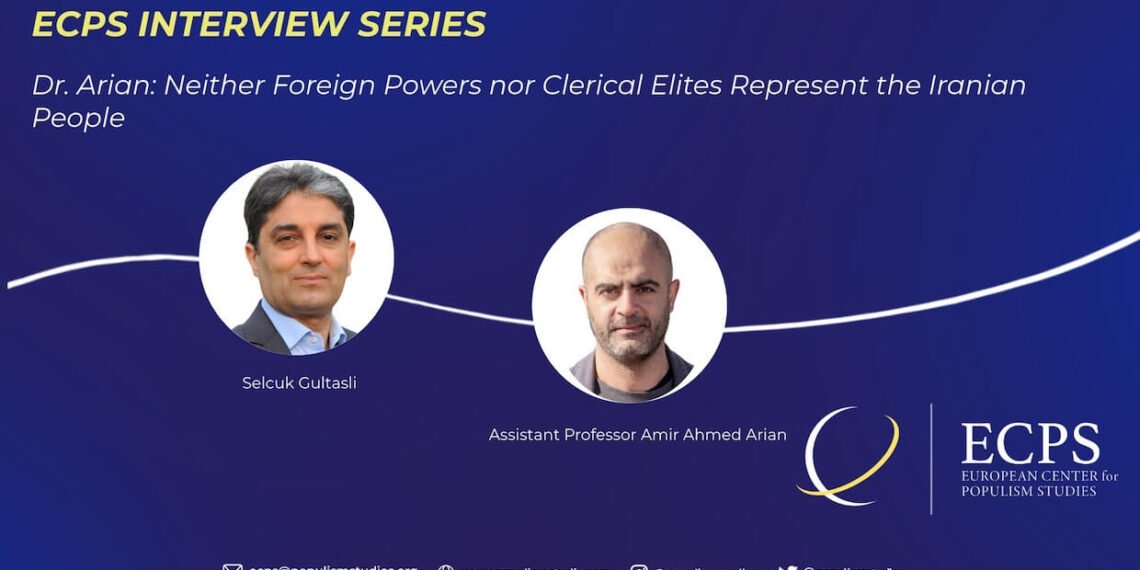
In this interview with the ECPS, Dr. Amir Ahmadi Arian offers a penetrating account of Iran at a moment of war, repression, and political uncertainty. As the Israel/US–Iran conflict deepens and succession struggles intensify in Tehran, he argues that the central issue is the systematic erasure of Iranian popular agency. For Dr. Arian, the Islamic Republic has evolved from an ideological revolutionary order into an increasingly militarized system—“basically a killing machine”—while external intervention risks further marginalizing the people in whose name it claims to act. Moving from everyday micropower and censorship to the IRGC’s rise, social humiliation, and the politics of war, he underscores a stark reality: neither foreign powers nor clerical elites genuinely represent the Iranian people.
Interview by Selcuk Gultasli
Giving an interview to the European Center for Populism Studies (ECPS), Dr. Amir Ahmadi Arian—Iranian American writer and journalist, and Assistant Professor of Creative Writing at Binghamton University—offers a powerful and deeply textured analysis of Iran’s current condition at a moment of extraordinary peril. As the Israel/US–Iran war expands into a broader regional conflict marked by bombardment, civilian displacement, and intensifying regime-change rhetoric, Dr. Arian cautions against narratives that erase the agency of the Iranian people themselves. In a context where President Donald Trump has demanded Iran’s “unconditional surrender,” openly declared an interest in shaping the country’s postwar leadership, and where succession debates have reportedly intensified following the death of Ayatollah Ali Khamenei, Dr. Arian’s central warning is stark: “neither of them has anything to do with the Iranian people.”
That insistence on popular agency—and on its systematic denial—runs through the interview as a whole. For Dr. Arian, Iran’s predicament cannot be reduced either to foreign pressure alone or to a simplistic image of “clerical rule.” Rather, he describes a political system that has evolved over 47 years from an ideological revolutionary order into something far more militarized, coercive, and socially corrosive. What began with “a very strong ideological core, surrounded by a security apparatus,” he argues, has gradually become “less and less ideological and more and more militarized.” In his starkest formulation, the regime today is “basically a killing machine,” one whose relationship to society has been reduced to a binary of “friend and enemy.”
Yet Dr. Arian’s account is not confined to the spectacular violence of war and mass repression. One of the interview’s greatest strengths lies in its insistence that authoritarian domination in Iran is reproduced through everyday practices, cultural control, and administrative routines. Recalling his own childhood and youth, he explains that in the 1980s and 1990s one “felt the presence of the state almost on your skin.” From school rituals and anti-American iconography to compulsory hijab and the disciplining of bodies, the regime exercised what he calls a “very Foucauldian kind of presence of power in daily life.” The same logic extended into literature and language: censorship, exile, and the weakening of Persian literary culture did not merely restrict expression but also narrowed the horizons of political imagination itself.
At the same time, Dr. Arian foregrounds the uneven social distribution of repression. The Islamic Republic, he notes, presents itself internationally as a defender of “the poor, the wretched of the earth, the underdog,” yet “nobody has suffered at its hands more than the poor.” Women, Baha’is, workers, and peripheral communities have borne disproportionate burdens of exclusion, persecution, and violence.
Against this backdrop, his analysis of the current war is especially sobering. If military intervention deepens, he warns, “the will of the people becomes the last thing that counts.” The core question, then, is not simply whether the regime survives, but whether Iranians themselves can recover political agency from both authoritarian rulers and external powers claiming to act in their name.