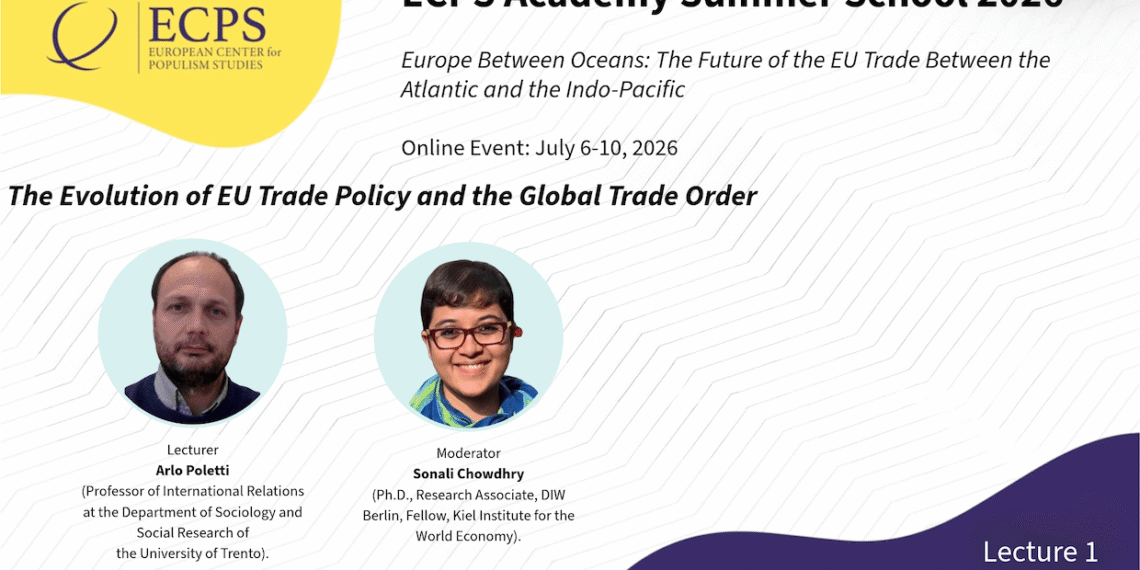
How has the European Union’s trade policy evolved from championing liberal multilateralism to pursuing strategic autonomy in an era of geopolitical rivalry? In his opening lecture at the ECPS Academy Summer School 2026, “Europe Between Oceans: The EU in the Age of Geoeconomics, Populism, and Strategic Competition,” Professor Arlo Poletti examines the historical transformation of EU trade policy against the backdrop of globalization, China’s rise, populist contestation, and the growing weaponization of economic interdependence. Moderated by Dr. Sonali Chowdhry, the session demonstrates that contemporary trade policy can no longer be understood solely through the lens of market liberalization but must increasingly be viewed as an instrument of geopolitical strategy, economic resilience, industrial policy, and European strategic autonomy.
Reported by ECPS Staff
The accelerating transformation of the international political economy has fundamentally reshaped the role of trade in global affairs. Once understood primarily as a vehicle for market integration, economic efficiency, and multilateral cooperation, trade policy has increasingly become intertwined with geopolitical competition, technological rivalry, economic security, and democratic politics. The resurgence of great-power rivalry, the weaponization of economic interdependence, the fragmentation of global supply chains, and the rise of populist and nationalist movements have challenged many of the assumptions underpinning the post-war liberal trading order. As governments increasingly employ tariffs, industrial policy, sanctions, export controls, and investment screening as instruments of strategic statecraft, understanding contemporary trade policy requires a broader analytical perspective that integrates economics, international relations, and political science.
These developments provided the intellectual backdrop for the opening lecture of the ECPS Academy Summer School 2026, held under the theme “Europe Between Oceans: The EU in the Age of Geoeconomics, Populism, and Strategic Competition.” Bringing together leading scholars and participants from around the world, the programme explored how profound geopolitical, economic, and political transformations are reshaping Europe and the wider international order. Within this context, Professor Arlo Poletti delivered a wide-ranging lecture, “The Evolution of EU Trade Policy and the Global Trade Order,” examining how the European Union has evolved from one of the principal architects and defenders of the liberal multilateral trading system into an increasingly geoeconomic actor seeking to balance openness with resilience, strategic autonomy, and economic security. Combining insights from international political economy, European integration studies, and comparative political economy, Professor Poletti demonstrated that contemporary EU trade policy can no longer be understood solely through the lens of market liberalization but must increasingly be analyzed as an instrument of foreign policy, industrial strategy, and geopolitical influence.
The session was thoughtfully moderated by by Dr. Sonali Chowdhry, Research Associate at DIW Berlin and Fellow at the Kiel Institute for the World Economy, whose own scholarship on global value chains, international trade, sanctions, and the distributional consequences of trade policy provided an ideal intellectual framework for the discussion. She observed that the rules-based multilateral trading order that had long provided the foundation for European prosperity could no longer be taken for granted. Rising geopolitical rivalry, intensifying technological competition with China, increasingly protectionist trade policies emanating from the United States, and the disruption of global energy markets following Russia’s invasion of Ukraine have collectively transformed the strategic environment within which European trade policy operates.
She further explained that understanding Europe’s response requires looking beyond individual trade agreements or tariff disputes. Instead, participants needed to appreciate the historical trajectory through which European trade policy evolved—from an instrument primarily concerned with market liberalization into one increasingly intertwined with questions of industrial policy, technological competitiveness, economic resilience, and national security. This broader perspective, she argued, would enable participants to understand not only contemporary EU trade policy but also the wider transformations affecting the international economic order itself.
By situating Professor Poletti’s presentation within the broader transformations affecting the global political economy, Dr. Chowdhry emphasized why the evolution of European trade policy has become central to understanding Europe’s strategic position in an era marked by intensifying geopolitical competition and growing uncertainty. Her moderation effectively established the conceptual foundations for a lecture that encouraged participants to rethink trade not merely as an economic policy domain, but as one of the principal arenas through which power, security, and international order are increasingly contested.