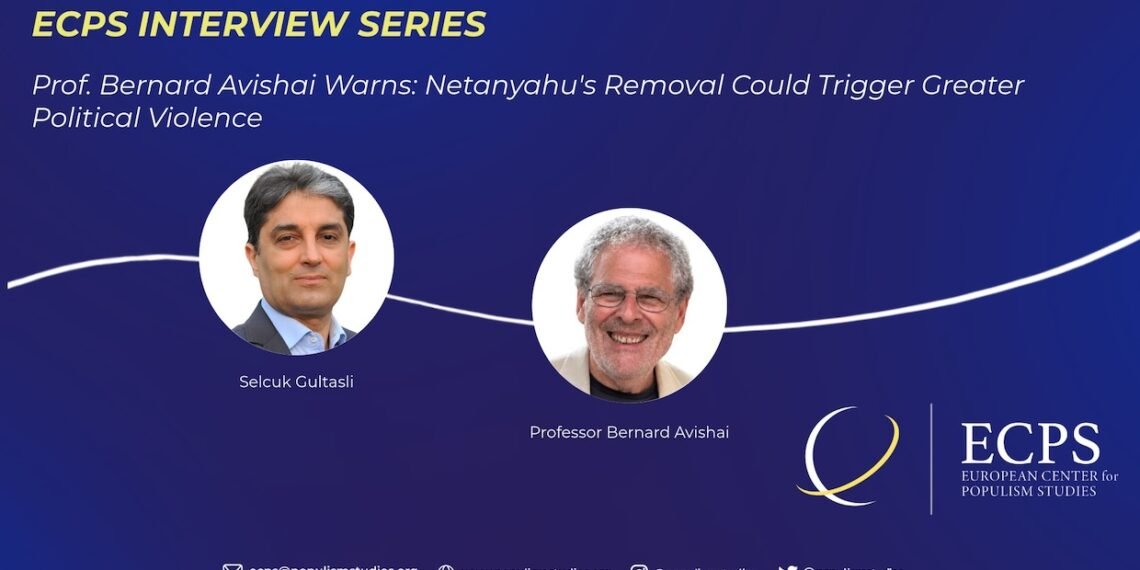
In an exclusive interview with the European Center for PopulismStudies (ECPS), Professor Bernard Avishai of Dartmouth College warns that Benjamin Netanyahu’s removal from power could intensify political violence in Israel. Examining the enduring influence of Netanyahuism, religious nationalism, and the settler movement, Professor Avishai argues that Israel’s democratic crisis extends beyond electoral politics. He highlights the deepening confrontation between “Greater Israel theocrats” and “global Israel liberals and cosmopolitans,” cautioning that meaningful democratic reforms could provoke violent resistance. Advocating constitutional reform, judicial independence, universal civic obligations, and Arab political inclusion, he calls for a fundamental rethinking of Zionism and citizenship. Professor Avishai also emphasizes that lasting democratic renewal requires ending the occupation and establishing reciprocal political rights for Israelis and Palestinians.
Interview by Selcuk Gultasli*
Israel faces profound political uncertainty following the October 27 elections. Although Benjamin Netanyahu’s Likud remains the largest party, his right-wing and religious coalition has lost its parliamentary majority. Gadi Eisenkot’s efforts to form an alternative government confront deep divisions over Arab political participation, ultra-Orthodox military exemptions, and the enduring influence of religious nationalism. Beyond coalition arithmetic, fundamental questions persist concerning judicial independence, Palestinian rights, and Israel’s democratic identity.
In an extensive interview with the European Center for Populism Studies (ECPS), Professor Bernard Avishai, visiting professor of political economy at Dartmouth College and former technology and strategy editor of the Harvard Business Review, warns that Netanyahu’s departure could intensify rather than resolve Israel’s political and institutional crisis. “The potential for violence here is really great, regardless of whether Bibi remains in power,” he cautions. “The prospect of violence might be even greater if he’s removed from power.”
For Professor Avishai, the underlying conflict extends beyond Netanyahu’s personalized leadership. “I think Bibi’s world will outlive Bibi,” he argues, emphasizing the entrenched religious-nationalist constituencies and institutional arrangements sustaining Netanyahuism. Comparing a possible Eisenkot government to Abraham Lincoln’s accession to power in 1860, he suggests that substantial democratic reforms could threaten communities whose political identities and material interests depend on the existing order.
Professor Avishai anticipates particularly fierce resistance from ultra-Orthodox communities and armed West Bank settlers. “If the opposition takes power and tries to introduce genuine changes,” he warns, “there will be violence.”Invoking Yitzhak Rabin’s assassination, he underscores the historical precedents for political extremism: “These people have already killed a prime minister. Let’s not forget that.”
Nevertheless, Professor Avishai rejects political violence as a justification for postponing democratic renewal. He advocates constitutional reform, an empowered independent judiciary, universal schooling, and equal civic obligations. A new Basic Law enshrining Israel’s Declaration of Independence, he argues, could establish the foundations for a more inclusive democratic republic.
Central to this transformation is the struggle between what Professor Avishai calls “Greater Israel theocrats” and “global Israel liberals and cosmopolitans.” Arab political participation becomes a defining democratic test. “There’s absolutely no reason why Hebrew Republicans cannot cooperate with Arab parties,” he insists, framing Israel’s predicament as a fundamental choice between “a Jewish theocracy and a Hebrew democracy.”
Drawing on his longstanding scholarship on Zionism and secular republicanism, Professor Avishai also maintains that lasting democratic renewal ultimately requires ending the occupation and developing reciprocal political rights with Palestinians.
The interview thus explores a central paradox of Israel’s post-election moment: electoral alternation may create an opportunity for democratic reconstruction while simultaneously provoking resistance from the very forces that such reconstruction seeks to constrain.